
Let’s talk AI, not the sci-fi kind, but the increasingly real kind impacting our industry right now.
We’re diving deep into the ethical considerations because, let’s face it, with great power comes great responsibility. This is especially true when we’re dealing with high-value properties, complex cross-border transactions, and discerning clientele who demand absolute discretion.
The integration of artificial intelligence into property markets isn’t just about streamlining our workflows or predicting market tops. It fundamentally alters the relationship between the investor, the advisor, and the asset.
As capital migrates rapidly toward emerging logistics hubs, mega-infrastructure developments, and elite residential enclaves globally, the algorithms we deploy act as the invisible gatekeepers of opportunity.
To navigate this exciting yet complex terrain safely, we must deconstruct the ethical tightropes we walk every time we log into an AI-powered platform.
To observe this ethical dilemma properly in 7 phases. Oh yeah…
1. Personalization vs. Manipulative Marketing
Think about it. AI can personalize property recommendations like never before. Imagine an AI that knows your client’s taste down to the architectural style, historical appreciation preference, or even the thread count of their sheets, suggesting properties they’d fall head over heels for. Amazing, right?
By analyzing massive datasets: ranging from public registries and search behaviors to subtle digital footprints, predictive algorithms can identify exactly when a high-net-worth individual is primed to diversify their portfolio.
They can pinpoint the exact yield threshold or lifestyle amenity that will trigger a buying decision. But where is the line between personalized service and manipulative marketing?
+-------------------------------------------------------------------------+
|                        THE PERSONALIZATION SPECTRUM                     |
+-------------------------------------------------------------------------+
|  [Ethical Curation]                               [Predatory Targeting] |
|  Analyzing explicit preferences  --->  Exploitation of liquidity crises |
|  to uncover off-market assets.          or asymmetric information gaps. |
+-------------------------------------------------------------------------+
When an algorithm detects that an international investor is facing sudden liquidity pressures or regulatory shifts in their home jurisdiction, and uses that data to aggressively push specific distressed assets, personalization veers into exploitation. Luxury real estate has always relied on curation, but traditional curation honors the client’s autonomy.
AI, conversely, can subtly alter the digital environment around a buyer, showing them only the options that maximize a platform’s commission or satisfy an institutional seller’s volume targets.
Are we ethically obligated to disclose when AI is driving the suggestions, or is it a trade secret? If our primary value proposition as elite real estate professionals is bespoke, independent advisory, then masking an automated recommendation engine as pure human intuition borders on misrepresentation.
We must ask ourselves whether we are using these systems to expand our clients’ horizons or to quietly narrow their choices for a faster closing.
2. Data Privacy and the Liquidity of Trust
Then there’s data privacy. AI thrives on data; the more it has, the better it performs.
To train a machine learning model to accurately forecast property yields in fast-moving port cities or luxury urban centers, the system requires granular inputs: historical transaction volumes, tax filings, corporate structures, and beneficial ownership records.
But what happens to all that information once it is ingested into a cloud-based neural network?
                 DATA INGESTION TOSTEPS DIAGRAM

  [Client Financials & IDs] ---> [Proprietary AI Engine] ---\
                                                             X ---> [Data Leak Risk]
  [Corporate Structures]    ---> [Third-Party Cloud APIs] --/
Are we ensuring our clients’ privacy is protected, or are we feeding their private financial lives into third-party black boxes to generate quick pitch decks? High-net-worth individuals and corporate funds do not just pay for real estate; they pay for anonymity and security.
When we upload unencrypted joint-venture agreements, non-disclosure agreements, or corporate incorporation documents into unverified AI plugins to summarize the terms, we may be violating our fundamental fiduciary duties.
Are we being transparent about how we’re using their data? Remember, trust is the cornerstone of any luxury transaction. In a market where a single leak can compromise a multi-million-dollar acquisition strategy or expose a family office to geopolitical risk, anything that erodes that trust is a major red flag.
If an AI platform retains the rights to user inputs to train its future models, your client’s confidential investment strategy could inadvertently become part of a competitor’s market analysis next quarter.
3. The Automation Paradox – Losing the Human Element
AI can also automate tasks across the entire lifecycle of a transaction, from automated valuation models (AVMs) to contract generation and predictive title verification. This boosts efficiency, sure, but what about the human element?
Are we sacrificing the personal touch that defines high-end real estate?
Consider property valuation. An AI can scrape thousands of data points: zoning laws, maritime proximity indices, historic price per square meter, and macro-economic indicators to output a property value in seconds.
What it cannot capture is the emotional equity of an architectural masterpiece, the distinct light at sunset, or the subtle geopolitical whispers driving capital out of one safe haven and into another.
+-----------------------------------------------+
|          THE VALUATION VALUE SPLIT            |
+-----------------------------------------------+
| AI Strengths:                                 |
| - Macroeconomic trends & zoning data          |
| - Price per square meter historic averages    |
|                                               |
| Human Strengths:                              |
| - Emotional equity of architectural design     |
| - Geopolitical nuances & off-market sentiment |
+-----------------------------------------------+
When we fully automate valuations, we risk reducing real estate to mere spreadsheets, ignoring the qualitative nuances that often justify premium pricing.
The same risk applies to contract generation. Standardizing cross-border purchase agreements through large language models saves hours of legal drafting, but it can overlook specific clauses needed to safeguard title security in jurisdictions with complex land tenure systems.
Are we creating a system where clients feel like they’re dealing with algorithms, not people?
We need to find the right balance between automation and human interaction to ensure our clients feel valued, protected, and deeply understood.
True luxury service isn’t about speed; it’s about context, judgment, and relationship.
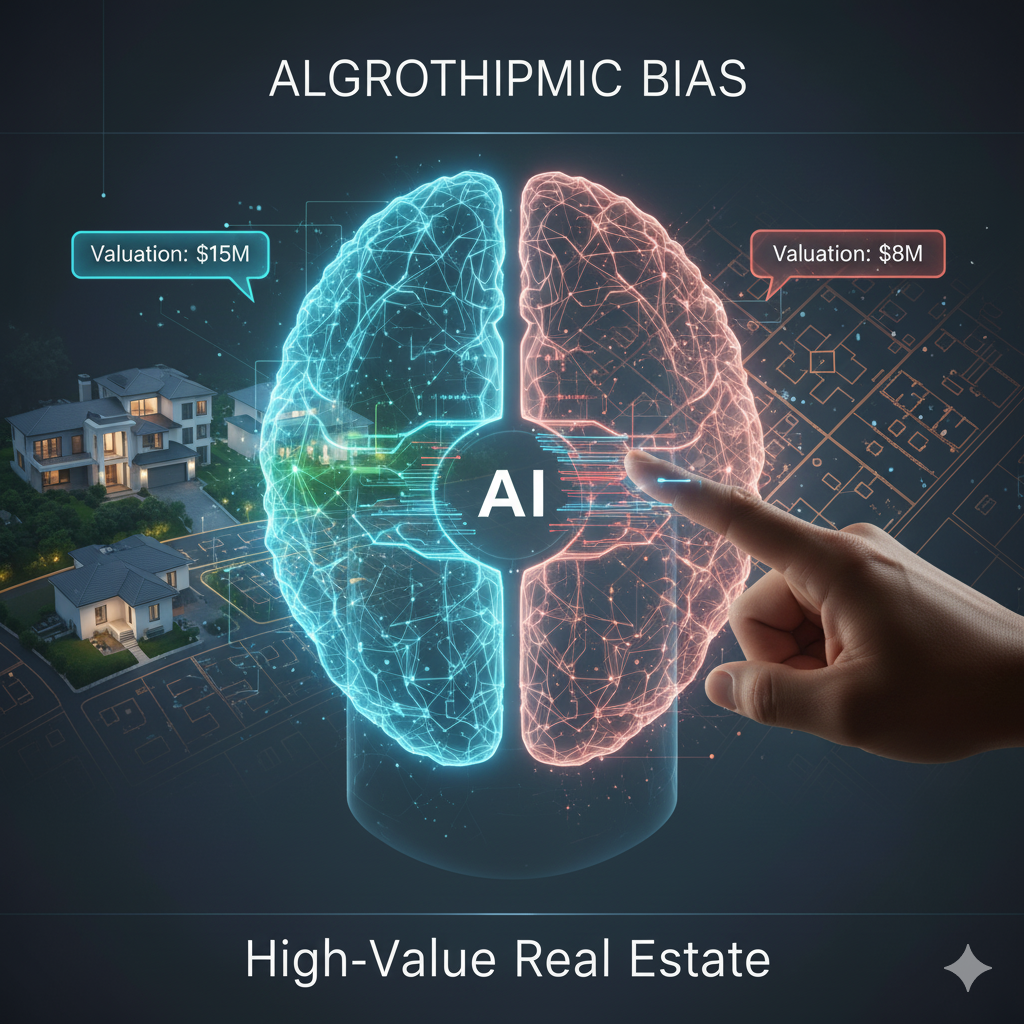
4. Algorithmic Bias and Structural Inequality
Let’s not forget about bias. AI is only as good as the data it’s trained on. If that historical data reflects existing biases, structural inequalities, or legacy discriminatory practices, the AI will perpetuate them with terrifying mathematical efficiency.
In real estate, this risk is deeply systemic. If an automated underwriting or investment-scoring algorithm uses historical neighborhood data to calculate risk profiles, it will inherently undervalue regions that have suffered from historical underinvestment.
               HOW ALGORITHMIC BIAS PERPETUATES

  [Biased Historical Data] ---> [AI Training Process] ---> [Discriminatory Output]
             ^                                                        |
             \------------------ [Reinforced Market Trends] <---------/
For instance, when evaluating emerging markets or maritime logistics hubs undergoing rapid modernization, an AI trained solely on the past twenty years of sluggish localized data might completely miss the future yield potential driven by a new deep-sea port or regulatory free-trade zone.
Worse, on the residential side, predictive sorting algorithms can inadvertently replicate steering practices—presenting certain high-value listings only to specific demographic profiles based on proxies like search histories, educational backgrounds, or current zip codes. This could lead to discriminatory practices, even unintentionally.
We have a responsibility to ensure our AI systems are fair and equitable, and that they don’t reinforce societal inequalities under the guise of “objective data science.”
As market makers, we must actively cross-examine the inputs of our tech stacks. If the underlying data is flawed, the automated decisions will be systematically unfair.
5. The Transparency Dilemma, Opens the Black Box
Another ethical tightrope walk is transparency. How much should we reveal about the AI’s role in the transaction?
Do clients have a right to know when an AI is involved in pricing a property, evaluating their financial creditworthiness, or negotiating a deal via algorithmic matching platforms?
The challenge here is the black box problem of modern deep learning. Often, even the developers who built a neural network cannot trace the exact path of weights and biases used to arrive at a specific output.
If an AI determines that a piece of commercial real estate is worth 15% less than the human consensus, and we cannot explain why to the seller, we violate our duty of care.
+-----------------------------------------------------------------------+
|                        THE BLACK BOX PROBLEM                          |
+-----------------------------------------------------------------------+
|  [Inputs] --------> [ Hidden Neural Network Layers ] --------> [Output]
|  Data Scrapes       Inscrutable mathematical weights            Price   |
|  & Registries       and complex algorithmic biases.             Verdict |
+-----------------------------------------------------------------------+
Complete transparency might not always be technically feasible, but we must find a way to be open and honest with our clients about how AI is being used.
If an automated negotiation bot is interacting with an institutional buyer’s procurement software to settle on a final sale price, both parties should know that machines are setting the boundaries of the deal. Transparency preserves the integrity of the open market; concealment breeds suspicion.
6. Job Displacement and the Evolution of the Workforce
Then there’s the systemic question of job displacement. As AI takes over routine tasks: running comparable market analyses, generating SEO-optimized property descriptions, managing property management ticketing systems, and auditing titles—what happens to the people who used to do them?
The real estate industry supports a massive ecosystem of junior analysts, administrative assistants, transaction coordinators, and content creators.
If brokerage houses aggressively automate these entry-level roles to expand profit margins, we run the risk of cutting off the pipeline for future industry leaders.
Who learns the nuances of property law or market sentiment if the machines handle all the foundational work?
+---------------------------------------------------------------------+
|                     WORKFORCE EVOLUTION PATTERN                     |
+---------------------------------------------------------------------+
| Legacy Workflow:     [Data Entry] -> [Analysis] -> [Strategy]       |
|                                                                     |
| AI-Augmented Model:  [Automated Systems] ------> [Strategic Human   |
|                      Continuous Data Intake     Oversight & Ethics] |
+---------------------------------------------------------------------+
Do we have a responsibility to retrain and upskill our workforce to adapt to this changing landscape? Absolutely. Ignoring this issue could have serious social and economic consequences.
Brokerages must pivot from replacing human labour to augmenting it. The goal should be to free up our teams from administrative burdens so they can focus on high-touch client advisory, ethical oversight, and strategic creative work that machines simply cannot replicate.
7. Constructing an Ethical Real Estate Framework
So, where does this leave us? We cannot simply opt out of technological progress; the efficiencies and insights offered by artificial intelligence are too massive to ignore, and the market rewards adoption.
Instead, we need to develop a clear, rigorous ethical framework for the use of AI in real estate.
This framework cannot be a vague mission statement hidden away in a corporate handbook.
It must be an operational roadmap that guides every software procurement choice, every data-sharing agreement, and every client interaction.
| Core Pillar | Operational Mandate |
| Data Sovereignty | Absolute client consent for every upload; mandatory data scrubbing after a transaction closes. |
| Algorithmic Auditing | Annual reviews of AVMs and scoring tools to detect and eliminate systemic bias. |
| Human-in-the-Loop | No automated pricing, contract finalization, or marketing deployment without human sign-off. |
| Radical Transparency | Explicit disclosure to clients when AI systems generate valuations or recommendation streams. |
By committing to these pillars, we protect our clients and future-proof our businesses. Innovation loses its value if it destroys the foundational trust that makes high-value property transactions possible.
Summary
To summarize, we’ve touched on the profound ethical implications of AI in real estate, focusing on:
Personalization vs. Manipulation: Guarding against predatory targeting while maintaining custom curation.
Data Privacy: Protecting client confidentiality inside cloud environments to preserve trust.
The Human Element: Balancing automation with personal, high-touch advisory.
Algorithmic Bias: Ensuring our data inputs do not reinforce historical inequalities or blind us to emerging market opportunities.
Transparency: Committing to clear disclosure regarding the role of algorithms in valuations and negotiations.
Job Displacement: Upskilling our workforce to ensure technology expands human potential rather than eliminating entry-level talent.
These are critical considerations as we navigate the exciting, yet complex, world of AI-driven real estate.
The future belongs to those who deploy these powerful tools with precision, clarity, and an unyielding commitment to ethical integrity.
-REM

Moses Oyong is a Real Estate Growth Marketing Manager and PropTech specialist with over a decade of closing residential and commercial deals worth over 200 million across Nigeria and international markets. Known for engineering AI-driven workflows that delivered a 69% uplift in sales targets and cut lead response times by 85%, Moses bridges the gap between high-performance marketing, land law, and technology to help investors, developers, and first-time buyers make confident, informed property decisions in an increasingly digital world.

Great points—AI brings amazing possibilities but also important ethical and privacy challenges to consider. I love RealEstateMoses So Much- He is our leader in this industry.