$17,000,000 Luxury Mansion In West Vancouver, Canada
The acquisition of high-tier coastal real estate within the Pacific Northwest is heavily influenced by the prestige of rare shoreline footprints and classic European design elements. When an estate emerges within the exclusive marine corridors of West Vancouver, British Columbia, carrying a substantial valuation of $17,000,000 USD (approximately $23,000,000 CAD), real estate marketing channels immediately deploy romantic, luxury-centric narratives. They write prose detailing private sandy beaches, chocolate-truffle locations, and cloud-like master suites, encouraging affluent buyers to evaluate a complex coastal infrastructure asset as a simple, passive residential home.
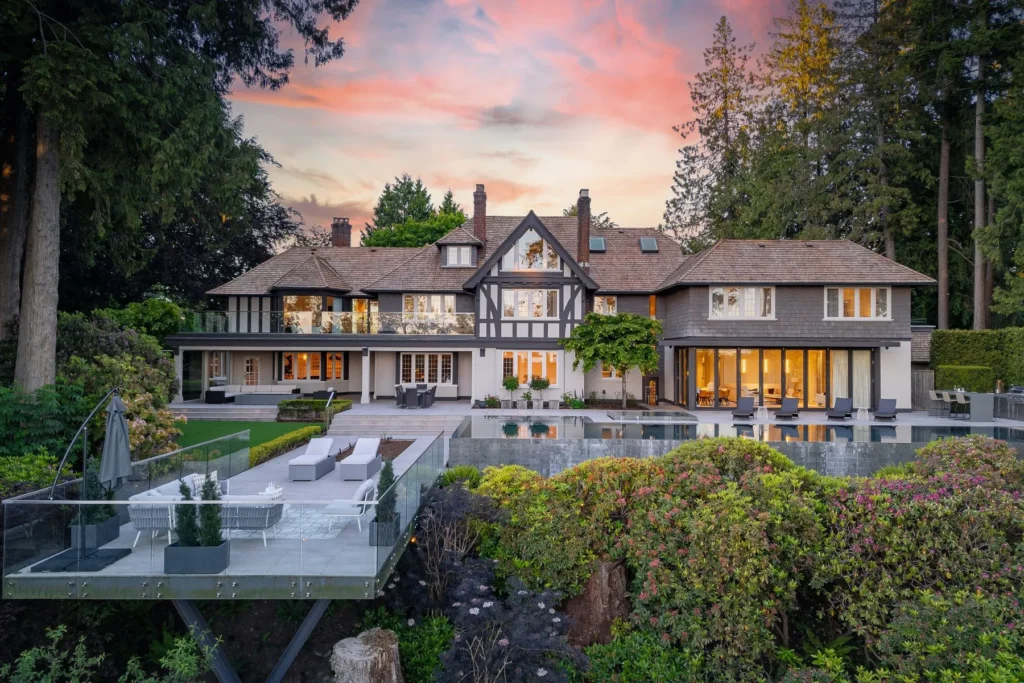
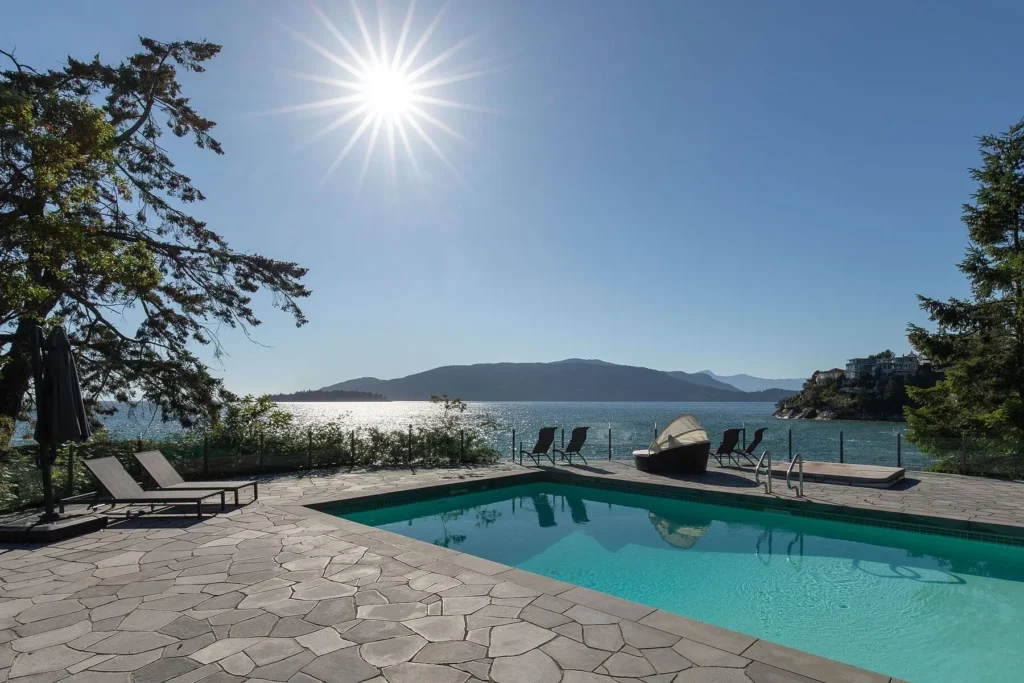
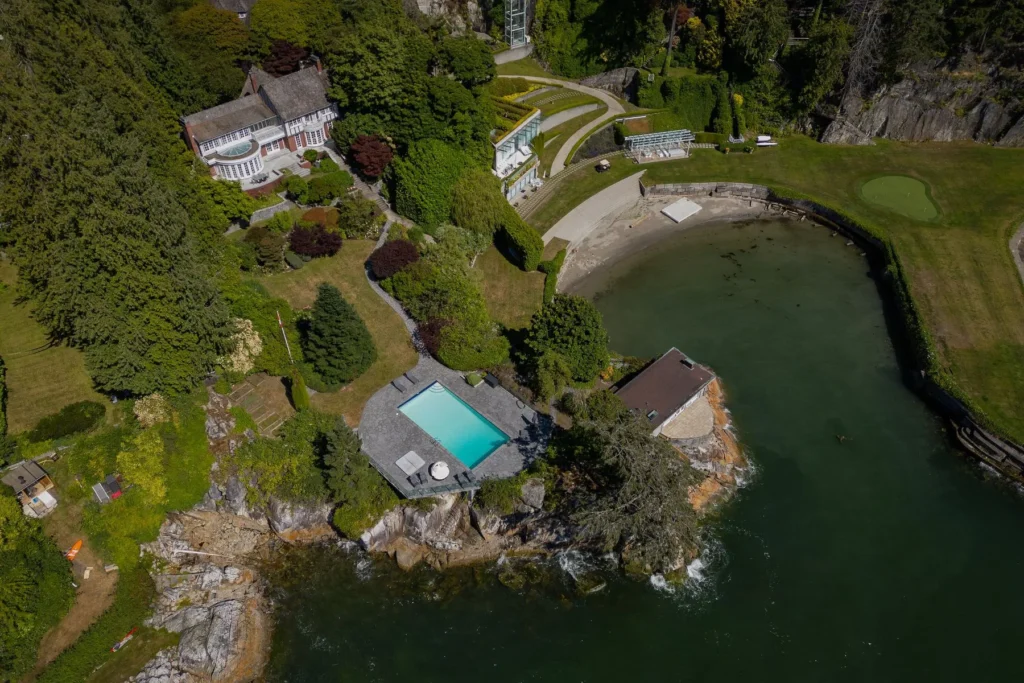
The physical property commanding this high-tier positioning is Cotton Cove Estate, an expansive 8,000 square foot Tudor-style residence positioned on a sprawling 1.58-acre private plot. The estate features over 300 feet of direct oceanfront, terraced slate patios, an open-plan kitchen and family pavilion, a standalone two-bedroom coach house, a private beachside studio outcropping, an outdoor swimming pool, and professionally curated mature gardens.
On a glossy social media presentation or an international luxury brokerage portal, this property presents an image of complete lifestyle victory.
However, if you strip away the high-energy marketing text and evaluate this estate from an advanced architectural preservation, geomorphological risk, and asset-scarcity angle, a completely different valuation profile emerges. A classic Tudor-style estate that manages 300 feet of active marine shoreline cannot be analyzed using standard residential real estate templates. It must be evaluated with the same precision applied to heritage asset preservation, coastal engineering projects, and highly technical capital portfolios. This exhaustive analysis looks past the standard lifestyle narrative, analyzes the maintenance mechanics of historic English timber-framed architecture, confronts the unique marine erosion pressures of Western Canada, and outlines the strategic parameters required to determine whether this $17,000,000 West Vancouver estate represents a true investment masterstroke or a profound capital drain.
1. The Tudor Architecture Asset Liability: Managing Half-Timber Structural Envelopes in a Marine Zone
The primary aesthetic pillar of Cotton Cove Estate is its classic Tudor-style architecture, designed to project an image of timeless English heritage combined with modern contemporary luxury. Real estate agents use this design language to justify a significant price premium, calling it a rare masterpiece within the West Vancouver valley.
From a structural engineering standpoint, traditional half-timbered Tudor architecture subjected to a frontline marine environment introduces relentless structural maintenance liabilities that require constant operational oversight,
- The Interfacial Leakage Challenge: Tudor architecture relies on an intricate combination of exposed external timber framing embedded within stucco or masonry infills. In a coastal setting exposed to high-velocity winds, wind-driven rain, and intense afternoon sun, these two distinct materials expand and contract at completely uneven rates. This continuous thermal movement creates micro-gaps along the timber-stucco interfaces. Once salt-laden moisture penetrates these gaps, it traps itself behind the decorative timbers, leading to hidden wood rot, structural timber deflection, and a total breakdown of the building’s exterior insulation envelope.
- The Timber Bleeding and Staining Abyss: To prevent heavy coastal rains from degrading the exposed wood facade, the timbers require regular professional chemical treatments, staining, and application of specialized micro-porous oils. If this maintenance is neglected, the natural tannins inside the wood will leach out onto the light stucco infill panels during rainstorms, creating unsightly dark run lines that ruin the clean lines of the design and require expensive facade power-washing and re-plastering.
2. Geomorphological Shoreline Risk: The Engineering Liabilities of 300 Feet of Active Oceanfront
The defining feature of Cotton Cove Estate is its spectacular 300 feet of direct oceanfront, complete with a private sandy beach and a private beachside studio outcropping. While the marketing copy frames this as a personal sanctuary where worries melt away, managing a significant coastal boundary along the shores of West Vancouver is an immense engineering responsibility.
The coastlines of British Columbia are subject to intense tidal shifts, powerful winter storm surges, and the long-term geomorphological forces of marine erosion,
- The Sea Wall and Riprap Abutment Abyss: To protect a 1.58-acre low-bank or cliffside lot from being slowly reclaimed by the Pacific Ocean, the property’s sea walls, riprap rock barriers, and concrete retaining lines must remain structurally unassailable. High-energy winter waves strike these defensive structures with immense force. Over extended holding windows, wave action can wash away sub-base soils behind the sea walls—a process known as under-scouring. If geotechnical anchor ties or drainage weep holes fail, the hydrostatic pressure built up from land runoff during heavy rains can cause localized wall collapse or land subsidence.
- The Beachside Studio Structural Vulnerability: The property includes an exclusive beachside studio outcropping sitting directly on the shoreline interface. Structures built in this extreme velocity zone face severe structural compliance codes enforced by West Vancouver municipal authorities and the Department of Fisheries and Oceans (DFO). Any structural reinforcement, roof repair, or foundation stabilization for a beachside studio requires complex environmental permitting, strict setbacks, and high-cost engineering solutions that prevent regular, budget-friendly home modifications.
3. The Coach House Logistical Deficit: Decentralized Infrastructure Maintenance
To expand its residential capacity, the estate incorporates a standalone two-bedroom coach house positioned away from the primary 8,000 square foot structure. Luxury brokers pitch this asset as a rare value-add, perfect for housing international delegates, extended family members, or high-profile friends in complete autonomy.
In reality, operating a decentralized, multi-building residential infrastructure introduces unique structural and financial liabilities that are absent in uniform luxury properties,
Despite its smaller physical footprint, a standalone coach house requires its own complete sub-networks for climate control, water heating production, sub-electrical distribution, and waste drainage lines. Because these secondary structures frequently sit unoccupied for long periods between guest arrivals, their plumbing loops are highly vulnerable to stagnant water issues or hidden pipe leaks that can cause silent interior water damage. You are essentially funding the permanent operational overhead and roof-envelope liabilities of a secondary home, transforming a guest convenience into an ongoing property management checklist.
4. The Swimming Pool and Salton Sea Paradox: High Maintenance on the Ocean Fringe
The outdoor entertainment zone of Cotton Cove Estate features a swimming pool surrounded by curated gardens and terraced patios. Brokers frame this feature as a tranquil oasis of tranquility where the owner can unwind in complete privacy away from the open ocean waters.
Let us evaluate the real-world operational challenges of running an open-air swimming pool directly on the oceanfront fringe of Western Canada,
- The Salt Mist Chemistry Battle: With over 300 feet of open oceanfront, the property experiences constant onshore winds that carry a fine, microscopic mist of marine salt crystals. This salt mist settles continuously into the open-air swimming pool water. The introduction of sodium chloride from the ocean completely disrupts the delicate chemical equilibrium of a standard freshwater pool, putting extreme workload strain on automated chlorinators, filtration pumps, and chemical dosing systems. If your maintenance team does not execute daily skimming and water testing, the pool will quickly experience pH imbalance and rapid water clouding.
- The Mechanical Thermal Load: West Vancouver experiences cool ambient temperatures for the vast majority of the calendar year. An open-air swimming pool acts as a giant radiant heat escape basin. To heat thousands of gallons of water to a comfortable swimming temperature during the spring, autumn, or winter cycles requires immense energy output. Your commercial gas or electrical heating units must run at maximum capacity around the clock, resulting in steep monthly utility bills.
5. Canadian Anti-Speculation Taxation: The Capital Erosion Matrix for British Columbia Luxury Property
The financial reality of deploying seventeen million dollars into British Columbia’s premium real estate market requires navigating an aggressive, multi-layered regulatory taxation framework specifically engineered by Canadian authorities to penalize high-end property allocations and foreign capital injections.
Upon entry, and throughout your holding window, your capital is subject to non-refundable fiscal drains that strip away potential profit margins before you even begin to calculate market growth,
- BC Property Transfer Tax (PTT): British Columbia levies a progressive property transfer tax on residential transactions. For a $17,000,000 purchase, the progressive tax rate calculates to a massive, non-refundable upfront cash drain exceeding $510,000 CAD. This capital adds zero functional value to the physical asset, putting your investment immediately in the red on day one.
- The Speculation and Vacancy Tax / Underutilized Housing Tax: If you are an international investor or an elite citizen utilizing this waterfront estate as a seasonal holiday home or an occasional maritime haven rather than a primary residence, you face Canada’s Speculation and Vacancy Tax, combined with the federal Underutilized Housing Tax (UHT). These penalties extract a percentage of the property’s assessed value annually if the mansion is deemed underutilized, creating a significant annual cash drain purely to hold the deed.
- Substantial Annual Property Taxes: Independent of vacancy penalties, the ongoing municipal and school taxes for a multi-acre luxury estate in West Vancouver represent a significant fixed annual expense that persists regardless of your personal liquidity or broader financial market conditions.
6. The 5-Bedroom Spatial Redundancy Trap: Funding Dead Square Footage
When buyers search for West Vancouver waterfront homes for sale or look at large 8,000 square foot layouts, they often mistake vast scale for enhanced personal lifestyle comfort. This mega-mansion features expansive multi-wing living areas, a formal dining zone, separate entertainment galleries, a coach house, and a beachside studio outcropping.
Let us map out the real-world operational efficiency of an over-scaled residential footprint over a standard calendar year,
In day-to-day operations, even the most socially active families utilize less than thirty-five percent of the available interior square footage. The secondary guest suites, the standalone coach house, the beachside studio outcropping, and the formal circulation corridors sit entirely silent for months at a time.
Yet, because the building features high ceilings and vast architectural volumes, the entire 100% of the structure must be actively heated, ventilated, dehumidified, and monitored twenty-four hours a day, seven days a week. The constant indoor humidity management required in British Columbia to prevent moisture from settling into walls, custom millwork, and furniture requires continuous HVAC activity. You are essentially funding the operational overhead of a luxury commercial lodge while only deriving personal utility from a tiny sliver of the space.
7. The Apex Illiquidity Trap: The Frozen Secondary Market of West Vancouver Waterfront Enclaves
While the general residential real estate market across British Columbia is globally famous for its intense demand, constant bidding wars, and rapid capital liquidity, those dynamic market rules apply exclusively to standard townhouses, suburban family homes, and mid-tier condos. The exact millisecond an asset crosses the seventeen million dollar threshold on an oceanfront footprint in West Vancouver, it exits the fluid real estate market completely and enters an incredibly sticky, frozen asset layer.
If your primary business operations, international ventures, or global equity portfolios encounter an unexpected requirement for rapid liquidity, you cannot easily or quickly convert a custom 8,000 square foot waterfront estate into liquid cash. The absolute pool of active buyers possessing the un-leveraged capacity to finalize a seventeen-million-dollar residential cash transaction—while willingly absorbing Canada’s modern anti-flipping and foreign ownership restrictions—is exceptionally small.
A trophy property of this magnitude frequently sits on the private luxury registry for twelve, twenty-four, or thirty-six months before discovering a buyer whose personal aesthetic taste aligns with the property’s Tudor design configuration. If changing economic conditions force you to execute a rapid exit from the asset, you will be systematically forced to accept an aggressive capital markdown just to attract an opportunistic cash buyer capable of closing a complex real estate transaction quickly.
8. The Staggering Financial Opportunity Cost of Seventeen Million Dollars of Dead Capital
The final, and most compelling financial reality against purchasing this West Vancouver waterfront mansion is the profound opportunity cost of capital. When you lock away seventeen million dollars of liquid wealth into a single, non-income-generating primary residential asset, you are permanently removing that capital from the global financial landscape where it could be working to produce highly secure, compounding cash flows.
Let us run a highly objective, conservative financial comparison of how that exact block of wealth behaves over a standard five-year investment holding window when deployed into active, liquid market instruments versus sitting inside a luxury residential asset,
Over a five-year investment window, a professional, diversified corporate portfolio worth seventeen million dollars will effortlessly produce over five million one hundred thousand dollars in clean, highly liquid compounding profit while maintaining absolute capital mobility. Conversely, the West Vancouver waterfront mansion will have actively drained millions of additional dollars out of your pocket to cover high municipal property taxes, substantial electrical utility bills to power the pools and industrial dehumidification, ongoing sea wall and marine geotechnical engineering maintenance, and potential vacancy penalties, while its final secondary market resale value remains completely dependent on the unpredictable high-end property cycles of Western Canada. From a standpoint of raw wealth optimization and asset protection, spending this scale of money on a single home is an inefficient use of capital.
Comprehensive Structural Matrix: The Sales Presentation vs. Valuation Reality
To ensure your luxury property acquisitions are guided by cold investment logic rather than romantic real estate storytelling, carefully evaluate this direct contrast between what the broker’s marketing brochure promises and the real-world operational reality of Cotton Cove Estate,
| The Hyper-Luxury Feature | The Broker’s Glamorous Presentation | The Real-World Operational & Financial Reality |
|---|---|---|
| $17,000,000 Purchase Price | An elite trophy property indicating the absolute peak of Western Canadian success and prestige. | Extreme capital lockup with heavy asset illiquidity and high annual fixed holding costs. |
| Classic Tudor Architecture | A Tudor-style dream masterpiece designed to project timeless elegance and comfort. | High risk of interfacial leakage and timber-stucco separation due to coastal weather fronts. |
| 300 Feet of Direct Oceanfront | Personal sanctuary where time stands still and your worries melt away like ice cream. | Immense geomorphological risk requiring continuous sea wall engineering and riprap inspections. |
| Standalone 2-Bed Coach House | Your own personal chocolate shop asset, perfect for housing family or guests in style. | Duplicated plumbing, climate control, and electrical sub-panel infrastructure liabilities. |
| Private Beachside Studio | An exclusive waterfront outcropping designed to allow elegant morning coffee relaxation. | Extreme wave velocity zone subject to rigid municipal and DFO environmental preservation codes. |
| 8,000 Square Foot Footprint | Seamlessly flowing living and dining areas designed for elite international entertainment. | Significant capital allocated to dead space that requires continuous cooling and dehumidification. |
Is Cotton Cove Estate Built for Anyone?
Despite this extensive structural, logistical, and financial critique, this property remains a stunning achievement in large-scale modern coastal architecture. The critical step to avoiding severe investor remorse is recognizing whether your personal balance sheet and global wealth infrastructure are vast enough to absorb the severe inefficiencies of this property class.
You are completely wasting your money on this mansion if,
- You expect your assets to remain liquid and agile: If your investment strategy relies on rapid capital mobility and the ability to exit positions within a short calendar window.
- You analyze real estate through net-yield return: If you judge your asset allocations through the strict math of opportunity cost and capital efficiency.
- You value complete family privacy: If your lifestyle demands absolute seclusion without a permanent, multi-person staff workforce operating within your daily boundaries.
- You want a low-maintenance home: If you find managing exposed timber facades, high-volume pool chemistry on the salt fringe, and complex shoreline sea walls technically annoying.
This estate represents a justifiable acquisition only if,
- Your net worth exceeds several hundred million dollars: Meaning a seventeen-million-dollar capital lockdown represents a minor fraction of your overall global wealth footprint.
- You are an absolute purist for classic European Tudor design: And view living inside a massive 8,000 square foot home surrounded by managed coastlines as a vital legacy milestone.
- You maintain an established, long-term footprint in West Vancouver: And intend to utilize the property as a permanent family foundation for decades, neutralizing short-term liquidity concerns.
- The personal prestige of the address completely outweighs economic logic: And you possess the financial infrastructure to effortlessly support an active, live-in property management team to run a complex maritime structure.
The Verdict: Before You Issue an Inquiry to REM
If you are currently browsing high-end search results for West Vancouver waterfront homes for sale or analyzing this spectacular entry at Western Canada, the final conclusion requires looking past the glamorous real estate presentation.
This five-bedroom residence is an architectural triumph, but as a financial investment vehicle, it carries heavy operational and regulatory liabilities. It demands an immense lifestyle and operational sacrifice from its custodian. It forces you to manage high-maintenance landscape and pool infrastructure, navigate punitive Canadian tax frameworks, combat aggressive Pacific Northwest moisture elements, and accept a massive capital lockup within an illiquid price bracket.
Before you take any steps toward requesting private viewings, formal contract reviews, or structured financial terms, protect your global wealth. Work alongside an independent luxury asset advisory office to run a comprehensive multi-year operational cost projection. Physically audit the structural performance of the coastal sea walls against wave-induced under-scouring, and deeply calculate the true opportunity cost of moving seventeen million dollars out of the global financial markets.
For more information on the exact architectural layout files, to review construction compliance documentation, or to arrange an independent private tour of the West Vancouver sector, contact REM. Ensure you approach the negotiation table with a completely clear, realistic perspective on the long-term realities of ultra-luxury asset ownership.

Moses Oyong is a Real Estate Growth Marketing Manager and PropTech specialist with over a decade of closing residential and commercial deals worth over 200 million across Nigeria and international markets. Known for engineering AI-driven workflows that delivered a 69% uplift in sales targets and cut lead response times by 85%, Moses bridges the gap between high-performance marketing, land law, and technology to help investors, developers, and first-time buyers make confident, informed property decisions in an increasingly digital world.