The acquisition of high-end, historic estates within Eastern Canada is heavily influenced by the prestige of vast land area footprints and legendary architectural signatures. When a property listing emerges within the exclusive, turn-of-the-century enclave of Senneville, Montréal, carrying an international marketing valuation framework around $13,000,000 USD (marketed domestically up to $21,600,000 CAD), real estate channels immediately deploy deeply emotional sales copy. They write prose detailing fairy-tale Loire Valley châteaux, turrets piercing the morning mist, and romantic sanctuaries, encouraging affluent buyers to evaluate a highly complex heritage infrastructure asset as a simple, passive residential vacation home.
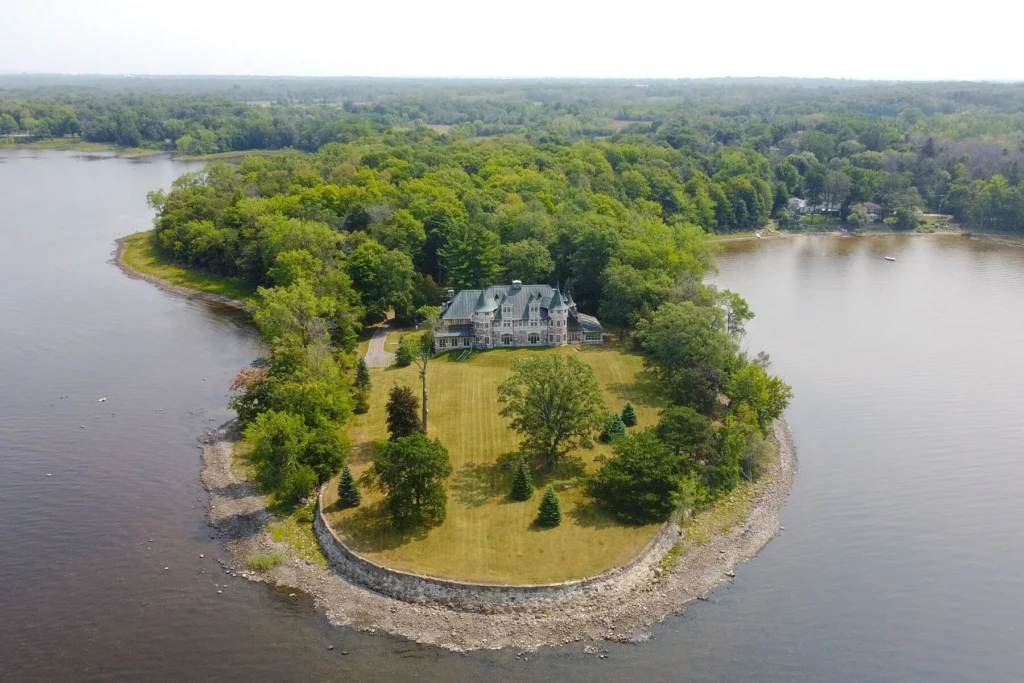
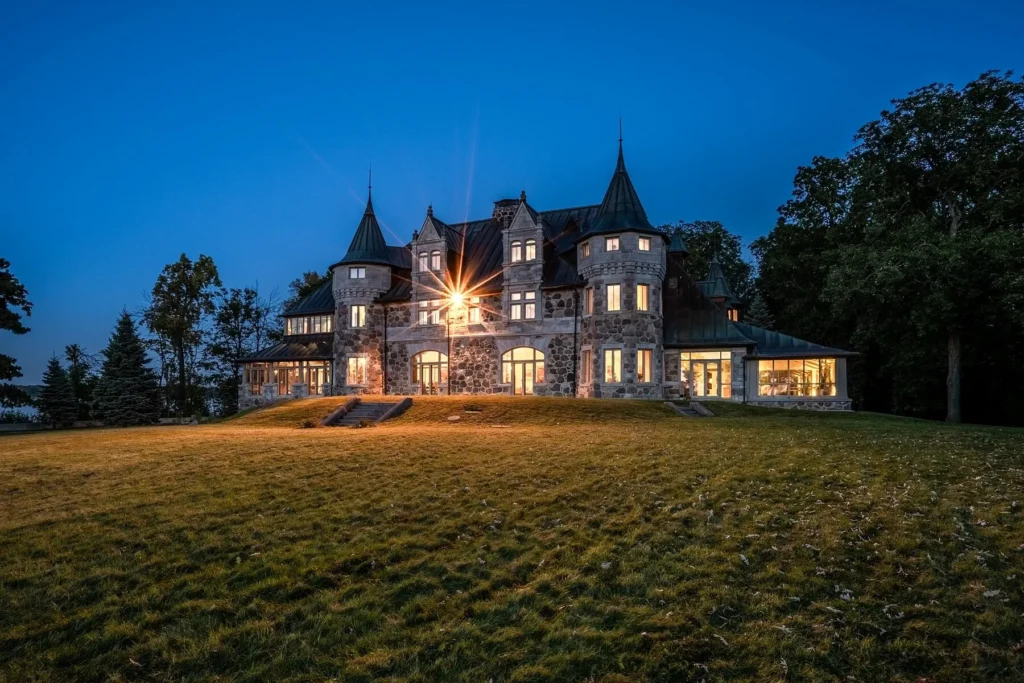
The physical property commanding this high-tier positioning is Bois-de-la-Roche, an iconic 18,427 square foot stone castle originally built in 1899. Positioned proudly on an expansive private peninsula (Pointe Forget) stretching into the Lake of Two Mountains, the estate reigns over nearly 20 acres of historic parkland attributed to the legendary landscape firm of Frederick Law Olmsted (the master designers behind New York’s Central Park and Montréal’s Mount Royal). Designed by the renowned Beaux-Arts architect Edward Maxwell as a country retreat for Senator Louis-Joseph Forget, the chateau-style stone manor features a high copper roof, historic turreted dormers, a multi-wing layout spanning three principal floors and a basement, 12 master fireplaces, an oak grand staircase, a large glass solarium, a heated indoor swimming pool pavilion, and an integrated four-story elevator system.
On a glossy architectural presentation or an international luxury brokerage portal, this property presents an imagery of pristine historical success and wealth preservation.
However, when an institutional investor or a seasoned ultra-high-net-worth asset manager evaluates an acquisition crossing this hyper-luxury threshold, the assessment must look past the emotional prose. We must execute a calculated financial, structural, and regulatory audit to answer one cold question: Is this property a strategic legacy asset or a permanent, frozen capital drain?
By dissecting the estate through the metrics of strict heritage preservation laws, harsh winter masonry freeze-thaw degradation, multi-acre Olmsted parkland maintenance economics, localized Quebec transfer taxes, and alternative asset opportunity costs, it becomes clear that Bois-de-la-Roche carries deep operational inefficiencies. Under a standard passive holding strategy, it behaves as a high-liability capital trap that will systematically erode your wealth. This unvarnished review breaks down the raw economic variables beneath this legendary Senneville chateau.
1. The Heritage Classification Trap: Zero Remodeling Autonomy under Québec Protection Frameworks
The primary structural risk confronting any investor looking at Senneville Montreal houses for sale is the strict regulatory oversight governing historic properties in the Province of Québec. Because Bois-de-la-Roche was designed by Edward Maxwell in 1899 and sits within the protected Senneville Historic District, the estate is viewed by municipal and provincial authorities as a monumental piece of Canadian cultural heritage rather than a private residential space.
Once an estate falls under this level of historic heritage classification, you lose total autonomous control over your property modification and customization choices,
[ Proposed Custom Double-Glaze Window Retrofit ] ──► [ Senneville Urban Planning PAC ] ──► [ Ministry of Culture Review ]
                                                                                                      │
[ Project Paralyzed / Costly Appeal Process ] ◄── [ Absolute Design Veto / Material Rejection ] ◄── [ Strict Historic Mandates ]
The Veto Power of Preservation Boards: If you wish to update the drafty original window assemblies with modern, energy-efficient aluminum frames, alter the stone layout to integrate a subterranean supercar gallery, or modify the high copper roofline to add modern skylights, you cannot simply hire a luxury contractor. You must submit your blueprints to the Senneville Planning Advisory Committee (PAC) and the provincial Ministry of Culture. These entities possess the absolute legal authority to veto your project if they feel your modifications compromise Maxwell’s original French Renaissance aesthetic.
The Artisanal Cost Multiplier: When heritage parameters force you to execute structural repairs, standard modern building methods are legally barred. You are legally required to hire specialized restoration carpenters and historical masons who utilize low-volume fabrication techniques, turning basic property modernizations into lengthy, multi-million-dollar construction projects.
2. The Freeze-Thaw Masonry Abyss: The Real Cost of Managing a 19th-Century Stone Shell
The architectural identity of Bois-de-la-Roche is defined by its massive stone facade, thick load-bearing masonry walls, and historic turreted dormers. While this execution projects an image of timeless strength, operating a late 19th-century stone fortress inside Quebec’s severe climate profile is a monumental structural and financial battle.
Montréal’s annual climate features a dramatic, highly aggressive 70-degree Celsius temperature variation between humid summer weeks and grueling sub-zero winter freezes, placing severe physical stress on the property’s exterior envelope,
The combination of extreme winter freeze-thaw cycles and porous 19th-century mortar grout lines triggers a destructive structural process known as moisture spalling.
[ Late Autumn Rain Saturates Exterior Stone ] ──► [ Winter Temperature Plunges to -20°C ] ──► [ Trapped Water Freezes & Expands ]
                                                                                                       │
[ High-Cost Specialized Restoration Masonry ] ◄── [ Structural Grout & Stone Face Fractures ] ◄── [ Interior Moisture Leaks ]
During late autumn, heavy rains saturate the stone facades. When winter temperatures plunge sharply, that trapped water freezes solid inside the masonry pores. The expansion forces crack the structural grout lines and cause the face of the premium stone to flake away—a highly destructive process known as spalling.
If this maintenance is neglected, moisture will migrate into the interior wall cavities, warping custom wood paneling and destroying plaster detailing. Restoring 19th-century masonry requires specialized restoration masons and commercial-grade lime-based mortars that match the historic composition, turning your exterior shell into an ongoing high-cost maintenance liability.
3. The 20-Acre Frederick Law Olmsted Landscaping Abyss: Managing Parkland Liabilities
The listing highlights the magnificent 20-acre private domain on a peninsula, featuring grounds designed by the legendary landscape designer Frederick Law Olmsted. While walking through private, mature forests and rolling lawns with 360-degree views of the Lake of Two Mountains sounds like an effortless paradise, managing twenty acres of historic parkland in Canada is an immense financial liability.
The transition between Quebec’s distinct seasons requires continuous, specialized professional groundskeeping teams to prevent the peninsula boundaries from deteriorating,
The Shoreline Erosion and Ice Heave Tax: With thousands of feet of direct lake frontage wrapping around the peninsula, the property’s retaining walls and natural stone riprap barriers are under continuous physical assault. During the spring thaw, massive shifting ice sheets from the Lake of Two Mountains push against the shoreline with immense force, capable of displacing heavy boulders and causing localized land subsidence. Monitoring and reinforcing a private peninsula shoreline requires ongoing geotechnical assessments and expensive structural anchoring solutions.
The Forestry Management Overhead: Managing a historic Olmsted forest means you are responsible for the health, pruning, and safety of hundreds of mature trees. Deadwood clearance, emerald ash borer protections, and storm damage clearing require permanent arborist teams operating heavy machinery across your private avenue, transforming a romantic sanctuary into a persistent operational chore.
4. The Four-Story Elevator and Indoor Pool Loop: Complex Mechanical Overheads
To ensure fluid mobility across its 18,427 square foot vertical footprint, the chateau incorporates an indoor pool pavilion accessed by a specialized staircase layout and a luxurious elevator system servicing all three principal levels and the basement.
While these interior amenities are marketed as the absolute peak of five-star residential luxury, running commercial-grade lifting machinery and indoor wet-spas inside a historic stone home creates intense technical maintenance challenges,
+-----------------------------------+-----------------------------------+
| Integrated Modern Luxury Condo    | Retrofitted Historic Chateau Shell|
+-----------------------------------+-----------------------------------+
| Single structural concrete frame,  | Custom elevator shafts cut through|
| standard utility lines, and easy  | 19th-century stone; indoor pool   |
| access to urban technical teams.  | moisture must be heavily managed. |
+-----------------------------------+-----------------------------------+
The Indoor Pool Moisture Loop: An indoor swimming pool requires a permanent input of thermal energy not just to heat the water, but to power high-capacity dehumidification systems designed to continuously extract moisture from the air. In a historic stone chateau, if the vapor barriers or ventilation systems experience even a brief drop in efficiency, warm, moisture-laden air will migrate into adjacent formal reception rooms, causing condensation to settle on original wood paneling, antique plaster moldings, and iron window hardware, triggering hidden rot.
The Elevator Maintenance Liability: A private elevator servicing four structural floors is a highly technical asset. To ensure baseline operational safety, you are required to maintain a high-cost service contract with a certified elevator engineering firm to execute regular weight-bearing track checks, hydraulic fluid analyses, and electronic synchronization updates.
5. The Immediate “Welcome Tax” Shock: Quebec’s Punitive Luxury Entry Fee
The financial reality of deploying your liquid wealth into premium real estate Quebec assets requires navigating an aggressive, multi-layered regulatory taxation framework specifically engineered by municipal authorities to extract capital from high-end real estate transactions.
Upon entry, your capital is instantly hit with Quebec’s property transfer system, commonly known as the Welcome Tax (Droit de mutation immobilière),
The Progressive Transfer Duty Penalty: Unlike standard real estate markets where closing transaction taxes are kept low, Montréal and its surrounding affluent municipalities enforce progressive transfer duty brackets that climb up to 4% for properties crossing luxury value thresholds. For an acquisition valued at roughly $21.6 million CAD, your municipal Welcome Tax invoice will scale to approximately $800,000+ CAD.
The Non-Negotiable Cash Outflow: This entire transfer fee must be settled directly with the municipality in a single, non-negotiable cash payment within 30 to 90 days of closing. It cannot be financed through your mortgage, and it adds absolutely zero functional value to the home. You enter ownership with a massive, immediate sunk-cost penalty that requires significant market appreciation just to return your portfolio to a baseline break-even state.
6. The 18,427 Square Foot Spatial Redundancy Trap: Funding Freezing Dead Space
When buyers look at buy 18000 sq ft mansion options, they often mistake vast scale and 37 rooms for enhanced personal comfort. Bois-de-la-Roche features expansive multi-wing social galleries, a massive central entrance hall, 9 bedrooms, 7 bathrooms, 3 powder rooms, a formal library, a music room, and multiple formal dining halls.
Let us map out the real-world operational efficiency of an over-scaled residential footprint over a standard calendar year,
                      [ Total Residential Square Footage ]
                                       │
         ┌─────────────────────────────┴─────────────────────────────┐
         ▼                                                           ▼
[ High-Frequency Active Zones ]                             [ Low-Frequency Dead Space ]
Primary Master Suite, Family Kitchen,                       Secondary Guest Rooms, Grand Ballroom,
Main Living Lounge, Solarium.                               Music Room, Basement Vaults, Corridors.
(Occupies ~30% of Total Space)                              (Occupies ~70% of Total Space)
In day-to-day operations outside of large-scale international gatherings or multi-generational family events, a family utilizes less than thirty percent of the available interior square footage. The secondary guest suites, the formal music and billiard salons, the separate basement utility rooms, and the vast interior circulation galleries sit entirely silent for months at a time.
Yet, because the building features soaring ceilings and vast architectural volumes exposed to the winds on an isolated peninsula, the entire 100% of the structure must be actively conditioned, heated, and monitored twenty-four hours a day, seven days a week.
Even during the deep winter months when you are not residing at the estate, you cannot simply turn off the heating networks. To prevent interior water pipes from freezing and bursting inside the walls, and to protect custom cabinetry from warping due to moisture fluctuations, the central furnace infrastructure must maintain a baseline temperature across 18,427 square feet, resulting in substantial, non-yielding monthly utility expenses.
7. The Apex Illiquidity Trap: The Frozen Secondary Market of Montréal’s Castle Tier
While the general residential real estate market across Montréal shows steady transaction speed and reliable capital liquidity for mid-market single-family homes and urban condos, those dynamic rules apply exclusively to standard properties. The exact millisecond a single residential property crosses the fifteen million dollar threshold in a historic chateau format, it exits the fluid real estate market completely and enters an incredibly sticky, frozen asset layer.
▲ [ Apex Layer: Bois-de-la-Roche Chateau ] ──► Buyer Pool: Handful of Global Billionaires & Heritage Purists (Years to Exit)
■ [ $3M - $6M Layer: Standard Westmount Detached ] ──► Buyer Pool: Affluent Regional Corporate Professionals (Moderate Speed)
● [ Under $1.5M Layer: Mass Market Condos & Towns ] ──► Buyer Pool: General Public & General Retail Investors (High Liquidity)
If your primary business operations, international ventures, or global equity portfolios encounter an unexpected requirement for rapid liquidity, you cannot easily or quickly convert a custom 18,427 square foot historic chateau into liquid cash. The absolute pool of active buyers possessing the un-leveraged capacity to finalize an transaction of this magnitude—while willingly absorbing Canada’s modern foreign ownership bans and Quebec’s Welcome Tax—is exceptionally small.
A trophy property of this scale routinely sits on the private luxury registry for twelve, twenty-four, or thirty-six months before discovering a buyer whose personal aesthetic taste aligns with the property’s specific configuration. If changing economic conditions force you to execute a rapid exit from the asset, you will be systematically forced to accept an aggressive capital markdown just to attract an opportunistic cash buyer capable of closing a complex real estate transaction quickly.
8. The Staggering Financial Opportunity Cost of Thirteen Million Dollars of Dead Capital
The final, and most compelling economic argument against deploying your liquid wealth into this Senneville chateau is the profound opportunity cost of capital. When you lock away thirteen million dollars of liquid wealth into a single, non-income-generating primary residential asset, you are permanently removing that capital from the global financial landscape where it could be working to produce highly secure, compounding cash flows.
Let us run a highly objective, conservative financial comparison of how that exact block of wealth behaves over a standard five-year investment holding window when deployed into active, liquid market instruments versus sitting inside a dead luxury residential asset,
+-----------------------------------+-----------------------------------+
| $13M Capital Sunk in Chateau Asset| $13M Capital Deployed in Markets  |
+-----------------------------------+-----------------------------------+
| Generates $0 in passive cash flow.| At a conservative 6% compounding  |
| Accumulates massive annual bills  | annual yield, generates over      |
| for masonry upkeep, HVAC, & taxes.| $780,000 in cash *every year*.    |
+-----------------------------------+-----------------------------------+
Over a five-year investment window, a professional, diversified corporate portfolio worth thirteen million dollars will effortlessly produce over three million nine hundred thousand dollars in clean, highly liquid compounding profit while maintaining absolute capital mobility. Conversely, the Senneville chateau will have actively drained millions of additional dollars out of your pocket to cover high municipal property taxes, substantial electrical and gas utility bills to heat a massive 18,427 square foot structure through Canadian winters, ongoing masonry restoration fees, and landscape maintenance, while its final secondary market resale value remains completely dependent on the unpredictable high-end property cycles of Quebec. From a standpoint of raw wealth optimization and asset protection, spending this scale of money on a single home is an inefficient use of capital.
Comprehensive Structural Matrix: The Sales Presentation vs. Reality
To ensure your luxury property acquisitions are guided by cold investment logic rather than romantic real estate storytelling, carefully evaluate this direct contrast between what the broker’s marketing brochure promises and the real-world operational reality of Bois-de-la-Roche,
| The Hyper-Luxury Feature | The Broker’s Glamorous Pitch | The Real-World Operational & Financial Reality |
| $13,000,000 Purchase Price | An elite trophy property indicating the absolute peak of Canadian success, wealth, and prestige. | Extreme capital lockup with heavy asset illiquidity and high annual fixed holding costs. |
| Edward Maxwell Custom Architecture | A rare historical masterpiece inspired by the great châteaux of the Loire Valley. | High risk of specialized masonry spalling and high-cost stone restoration due to winter freeze-thaw cycles. |
| 20-Acre Frederick Law Olmsted Lot | A park-like peninsula sanctuary offering unmatched privacy and 360-degree lake views. | Immense shoreline erosion risk and high forestry maintenance overhead across the grounds. |
| Integrated 4-Story Elevator System | A luxurious interior element providing effortless, grand vertical mobility across all floors. | Subject to mandatory regulatory safety audits and high-cost mechanical tracking checks annually. |
| Heated Indoor Swimming Pool | A private hotel wellness sanctuary designed for indoor recreation and winter relaxation. | High engineering liability requiring continuous running of industrial dehumidification systems. |
| 18,427 Square Foot Footprint | Soaring ceilings and grand staircases designed to accommodate your most extravagant gatherings. | Significant capital allocated to dead space that requires continuous heating and climate management. |
Is Bois-de-la-Roche Worth Buying?
Despite this extensive structural, logistical, and financial critique, this property remains a unique monument to Canadian residential architectural history. The critical step to avoiding severe investor remorse is recognizing whether your personal balance sheet and global wealth infrastructure are vast enough to absorb the severe inefficiencies of this property class.
You are completely wasting your money on this mansion if,
You expect your assets to remain liquid and agile: If your investment strategy relies on rapid capital mobility and the ability to exit positions within a short calendar window.
You analyze real estate through net-yield return: If you judge your asset allocations through the strict math of opportunity cost and capital efficiency.
You value complete, uncompromised structural autonomy: If you find operating within the regulatory boundaries of municipal planning advisory committees and heritage preservation boards annoying.
You want a low-maintenance home: If you find managing large-scale limestone masonry facades, automated multi-acre forest grids, and complex municipal transfer taxes technically annoying.
This estate represents a justifiable acquisition only if,
Your net worth exceeds several hundred million dollars: Meaning a thirteen-million-dollar capital lockdown represents a minor fraction of your overall global wealth footprint.
You are an absolute collector of rare historic style masterpieces: And view living inside an uncompromised Edward Maxwell chateau design as a vital status or personal legacy milestone.
You maintain an established, long-term footprint in Montréal: And intend to utilize the property as a permanent family foundation for decades, neutralizing short-term liquidity concerns.
The personal prestige of the address completely outweighs economic logic: And you possess the financial infrastructure to effortlessly support an active, live-in property management team to run a complex residential structure.
The Verdict: Before You Issue an Inquiry to REM
If you are currently browsing high-end search results for Senneville Montreal houses for sale or analyzing this spectacular entry at Bois-de-la-Roche, the final conclusion requires looking past the glamorous real estate presentation.
This 18,427 square foot residence is an architectural triumph, but as a financial investment vehicle, it carries heavy operational and regulatory liabilities. It demands an immense lifestyle and operational sacrifice from its custodian. It forces you to manage high-maintenance landscape and pool infrastructure, absorb punitive entry tax structures, combat aggressive winter elements, and accept a massive capital lockup within an illiquid price bracket.
Before you take any steps toward requesting private viewings, formal contract reviews, or structured financial terms, protect your global wealth. Work alongside an independent luxury asset advisory office to run a comprehensive multi-year operational cost projection. Physically audit the structural performance of the exterior stonework against moisture-induced spalling, and deeply calculate the true opportunity cost of moving thirteen million dollars out of the global financial markets.
For more information on the exact architectural layout files, to review construction compliance documentation, or to arrange an independent private tour of the estate grounds, contact REM. Ensure you approach the negotiation table with a completely clear, realistic perspective on the long-term realities of ultra-luxury asset ownership.

Moses Oyong is a Real Estate Growth Marketing Manager and PropTech specialist with over a decade of closing residential and commercial deals worth over 200 million across Nigeria and international markets. Known for engineering AI-driven workflows that delivered a 69% uplift in sales targets and cut lead response times by 85%, Moses bridges the gap between high-performance marketing, land law, and technology to help investors, developers, and first-time buyers make confident, informed property decisions in an increasingly digital world.