The high-end vertical real estate market in Toronto operates on a highly strategic system of brand-name premium validation, spatial concentration, and elevated lifestyle security. When a luxury listing emerges within the elite airspace of The Ritz-Carlton Toronto, carrying an astronomical entry valuation of $17,000,000 USD (approximately $23,000,000 CAD), real estate advisory channels immediately activate a standard hyper-premium narrative. They market the property as an unassailable trophy asset, a permanent vacation sanctuary, and a superior capital preservation vault that insulates your liquid wealth from global volatility while establishing your absolute dominance over the city’s skyline.
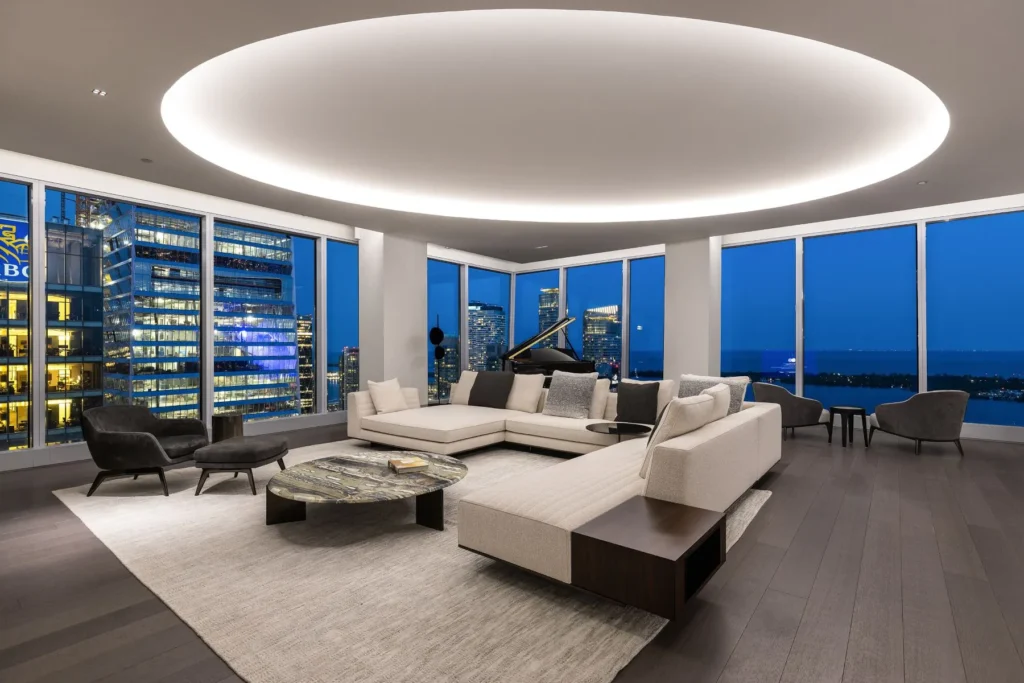
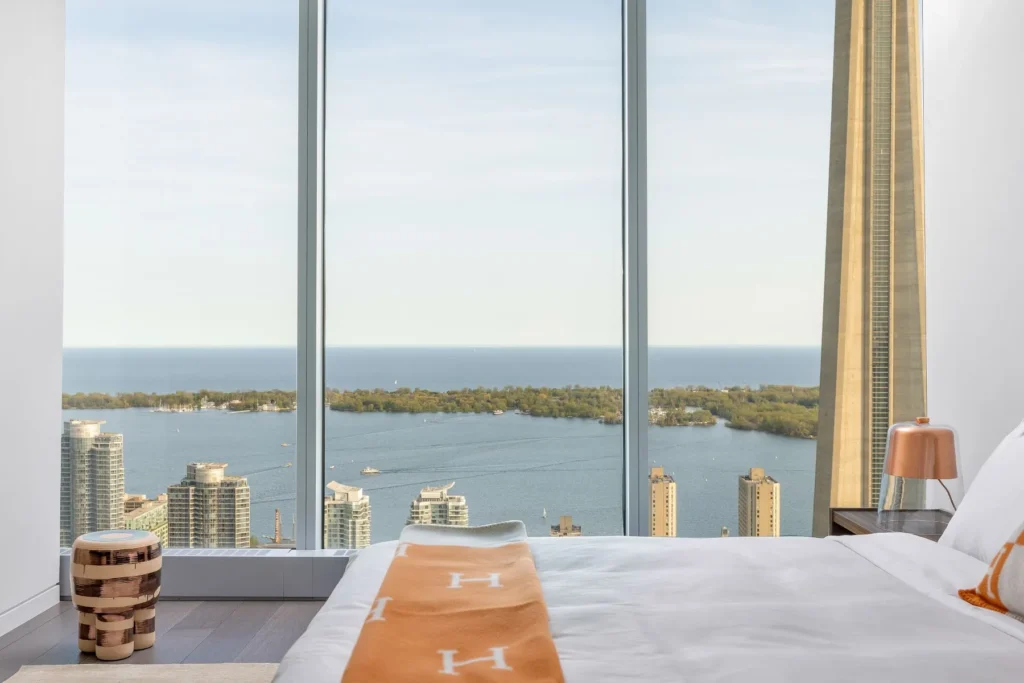
The specific vertical footprint currently commanding this intense market focus is Cielo Alba, an expansive 6,000 square foot single-level condominium penthouse managed under the flag of the Ritz-Carlton residential brand. The asset features soaring 10 and 11-foot finished ceilings, integrated custom millwork systems designed by the Italian house Poliform, frameless minimalist door frames, and floor-to-ceiling structural glass curtain walls delivering an uninterrupted, 180-degree panoramic vista of the Toronto city skyline and Lake Ontario. The layout incorporates elite lifestyle additions, including a custom-engineered 1,000-bottle temperature-controlled wine cellar, formal social salons, and full access to the building’s five-star white-glove concierge networks, private spa grids, and corporate valet infrastructure.
On a glossy architectural tour or an international wealth portfolio index, this condominium presents an imagery of pristine urban success.
However, when an ultra-high-net-worth investor analyzes an asset crossing the seventeen million dollar threshold, the evaluation must look past the brand-name upholstery and emotional marketing prose. We must execute a calculated financial, structural, and regulatory audit to answer one cold question: Is this property genuinely worth the price?
By dissecting the asset through the metrics of monthly non-yielding operational overhead, vertical structural liabilities, localized Canadian anti-speculation taxes, and the systemic opportunity cost of capital, it becomes evident that Cielo Alba carries deep operational inefficiencies that turn it into a high-liability capital trap. Here is an unvarnished, deep-dive review of the real-world economic variables beneath this $17,000,000 Toronto penthouse.
1. The Luxury Condo Fee Abyss: The Compounding Non-Yielding Operational Cash Drain
The primary structural trap that distinguishes ultra-luxury high-rise assets from equivalent freehold estates is the permanent, escalating nature of monthly condominium maintenance fees. Real estate brokers push the concept of effortless condo living, emphasizing that you are paying for world-class five-star amenities, elite security, and pristine communal maintenance.
From a strict capital-efficiency standpoint, high-end condominium fees represent a permanent, non-yielding cash drain that erodes your core capital every thirty days, with zero wealth retention,
[ Your Liquid Capital: $17,000,000 ]
                  │
     (Escalating High-Rise Monthly Maintenance Fees)
                  │
[ Estimated Monthly Fixed Outflow: $6,000 - $9,000 CAD ]
                  │
[ 10-Year Sunk Operational Loss: $720,000 - $1,080,000+ CAD In Pure Fees ]
For a 6,000 square foot residential footprint inside a branded five-star hotel tower like the Ritz-Carlton, monthly maintenance fees are calculated progressively based on internal square footage allocations and shared infrastructure loading. At this scale, your fixed monthly maintenance fee can easily range between $6,000 and $9,000 CAD per month, independent of your municipal property tax bills and individual utility consumption.
This money is completely unrecoverable; it acts as a recurring cash penalty purely to maintain the shared infrastructure of the tower. Over a standard ten-year investment holding window, you will drop between $720,000 and $1,080,000+ CAD in pure maintenance overhead. Because these fees are subject to board inflation adjustments and special infrastructure levies if the building’s central mechanical systems require maintenance, your holding cost carries a permanent, upward trajectory that compresses your terminal net asset returns.
2. The 1,000-Bottle High-Rise Wine Cellar: A Complex Engineering Vulnerability
A premier internal selling feature of the Cielo Alba penthouse is its spectacular, custom-built 1,000-bottle wine cellar vault. Real estate listings market this space as a connoisseur’s dream come true, allowing you to curate your vintage collection and entertain international associates with high style within the core of your living layout.
From a structural engineering and high-rise climate mechanics standpoint, housing a massive, commercial-grade refrigerated wine cellar inside a high-altitude condominium unit introduces notable technical risks,
Operating a specialized low-temperature, high-humidity refrigeration capsule directly inside a climate-controlled urban apartment creates intense atmospheric tension.
                        [ Active Wine Cellar Operation ]
                                       │
                                       ▼
                     [ Sustained Low-Temperature Cooling ]
                                       │
         ┌─────────────────────────────┴─────────────────────────────┐
         ▼                                                           ▼
[ Vapor Barrier Failures ]                                  [ Chiller Vibration Leaks ]
Condensation forms on the outer boundary walls,             Mechanical compressors generate micro-
warping adjacent Poliform wood millwork.                    vibrations that can fracture joinery.
A fine wine preservation environment demands a permanent ambient temperature of 12°C and a fixed relative humidity level of sixty to seventy percent. This creates a severe atmospheric gradient against the surrounding open-plan residential living areas, which are typically conditioned to 21°C with low humidity.
If the specialized vapor barriers, high-density thermal insulation layers, or frameless glass seals enclosing the cellar suffer even a microscopic degradation or layout tracking error over time, moisture will instantly begin to condense on the exterior faces of the boundary walls. This hidden moisture migration can cause surrounding custom Poliform wood millwork panels to warp, blister, and split, while creating hidden mold colonization channels behind the drywall finishes.
Furthermore, the mechanical compressor units required to run a high-capacity high-rise refrigeration matrix generate continuous micro-vibrations and heat re-direction that must be managed by the tower’s ventilation shafts, transforming an aesthetic status symbol into a high-maintenance technical asset.
3. The Poliform and Frameless Door Customization Trap: Zero Retainable Secondary Value
The interior architecture of Cielo Alba is characterized by a minimalist modern contemporary aesthetic, utilizing premium finished architectural components, including custom integrated wardrobe and wall units from the Italian design house Poliform, and frameless flush doors designed to maximize the feeling of internal spaciousness.
While these clean lines represent the absolute peak of modern European minimalism, from a capital preservation and secondary resale perspective, they carry an aggressive depreciation curve,
The Problem with Rigid Interior Layouts: High-end modern custom millwork like Poliform is precision-engineered to fit the exact physical coordinates and internal layout matrices of the specific condo frame on handover day. If a secondary buyer purchasing the unit on the secondary market dislikes the exact configuration of the built-in wardrobes, study zones, or entertainment panels, remodeling is exceptionally difficult. Unlike traditional homes where furniture can be easily moved, altering built-in Italian millwork requires completely stripping out the panels, patch-working the structural drywall, and re-engineering the integrated lighting systems.
Zero Resale Value Retention: Ultra-high-net-worth investors searching for Toronto ultra luxury penthouses do not factor the previous owner’s custom millwork choices into their purchase valuation equations. Buyers at the $15M+ tier routinely gut, strip, and completely redesign the interior surfaces of acquired condos to match their personal familial, regional, and design tastes. The multi-million dollar premium you pay upfront for finished Poliform installations behaves identically to loose luxury furniture—it depreciates rapidly the moment human occupancy begins, representing a substantial sunk cost.
4. Canadian Anti-Speculation Taxation: The Multi-Layered Capital Erosion Matrix
The financial reality of deploying seventeen million dollars into Ontario’s premium real estate sector requires navigating an aggressive, multi-layered regulatory taxation framework specifically engineered by Canadian authorities to penalize high-end property allocations and foreign capital injections.
Upon entry, and throughout your holding window, your capital is subject to significant non-refundable fiscal drains that strip away potential profit margins before you even begin to calculate market growth,
The Ontario Non-Resident Speculation Tax (NRST): If you are an international investor, an off-shore family office, or a non-citizen corporate entity looking to buy Ritz Carlton Toronto residences for sale, you face Canada’s sweeping foreign buyer ban and Ontario’s aggressive 25% Non-Resident Speculation Tax. On a $17,000,000 purchase, you must write an immediate, non-refundable check for over $4,250,000 USD directly to the provincial revenue authority as a pure entry penalty. This tax adds zero value to the physical asset, putting your capital deeply in the red on day one.
The Progressive Land Transfer Taxes: Independent of foreign buyer taxes, Toronto enforces a dual-layered land transfer tax system (Provincial and Municipal) that scales progressively with property value. For ultra-luxury estates crossing the multi-million-dollar mark, the combined transfer fees create a significant upfront cash drain that must be settled upon closing, lowering your capital mobility.
The Speculation and Vacancy Tax Framework: If you utilize this grand condominium as a seasonal holiday home or an occasional urban retreat rather than a verified primary residence, you face municipal and federal vacancy penalties, which extract a percentage of the property’s assessed value annually if the mansion is deemed underutilized or vacant, creating a significant annual cash drain purely to hold the deed.
5. The 6,000 Square Foot Spatial Redundancy Trap: Funding Dead Square Footage
When buyers search for buy luxury condo Toronto listings or look at large 6,000 square foot footprints, they often mistake vast scale for enhanced personal lifestyle comfort. The Cielo Alba penthouse offers grand entertaining zones, vast open living galleries, and separate hosting wings designed to accommodate large-scale social gatherings.
Let us evaluate the real-world operational efficiency of an over-scaled residential layout over a standard calendar year,
                      [ Total Residential Square Footage ]
                                       │
         ┌─────────────────────────────┴─────────────────────────────┐
         ▼                                                           ▼
[ High-Frequency Active Zones ]                             [ Low-Frequency Dead Space ]
Primary Master Suite, Family Kitchen,                       Secondary Guest Wings, Formal Reception
Main Living Lounge, Terraced Views.                         Galleries, Wine Cellar Vault, Corridors.
(Occupies ~35% of Total Space)                              (Occupies ~65% of Total Space)
In day-to-day operations, even the most socially active owners utilize less than thirty-five percent of the available interior square footage. The secondary guest wings, the formal circulation galleries, and the deep entertainment salons sit entirely silent for months at a time.
Yet, because the building features soaring ceilings and vast architectural volumes, the entire 100% of the structure must be actively cooled, heated, ventilated, and monitored twenty-four hours a day, seven days a week.
Toronto’s intense climate variations require continuous HVAC operation. You must maintain perfect interior climate control to prevent humidity and moisture from settling into custom plasterwork, delicate fabrics, and high-end artwork collections. You are essentially funding the permanent operational overhead of a luxury commercial hotel lodge while only deriving personal utility from a tiny sliver of the space.
6. The Apex Illiquidity Trap: The Frozen Secondary Market of Toronto Penthouses
While the general residential real estate market across the Greater Toronto Area is globally famous for its intense demand, constant bidding wars, and rapid capital liquidity, those dynamic market rules apply exclusively to standard townhouses, suburban family homes, and mid-tier condos. The exact millisecond a single residential asset crosses the fifteen million dollar threshold in a high-rise condominium format, it exits the fluid real estate market completely and enters an incredibly sticky, frozen asset layer.
▲ [ $17M+ Apex Layer: Cielo Alba Penthouse ] ──► Buyer Pool: Handful of Local & Global Billionaires (Years to Exit)
■ [ $2M - $5M Layer: Standard GTA Luxury Detached ] ──► Buyer Pool: Affluent Domestic Corporate Elite (Moderate Speed)
● [ Under $1M Layer: Mass Market Retail Condos ] ──► Buyer Pool: General Public & Retail Investors (High Velocity Trading)
If your primary business operations, international ventures, or global equity portfolios encounter an unexpected requirement for rapid liquidity, you cannot easily or quickly convert a custom 6,000 square foot modern contemporary penthouse into liquid cash. The absolute pool of active buyers possessing the un-leveraged capacity to finalize a seventeen-million-dollar residential cash transaction—while willingly absorbing Canada’s modern anti-flipping and foreign ownership restrictions—is exceptionally small.
A trophy property of this magnitude frequently sits on the private luxury registry for twelve, twenty-four, or thirty-six months before discovering a buyer whose personal aesthetic taste matches the building’s specific modern configuration. If you must exit the asset quickly due to shifting economic conditions, you will be systematically forced to accept an aggressive capital markdown just to attract an opportunistic cash buyer capable of closing a complex real estate transaction.
7. The Permanent Dependence on Shared Branded Tower Infrastructure
Living inside a branded hotel condominium footprint means you are never completely autonomous. Your daily residential comfort, security perimeter boundaries, and long-term asset value are permanently dependent on the operational efficiency and corporate health of the master building management team,
The Risk of Shared Infrastructure Failure: A high-rise penthouse relies on centralized mechanical infrastructure, including main building chiller plants, industrial water pumps, shared elevator lift electronics, and structural window curtain wall sealings. If the building management delays critical upgrades or executes poor technical maintenance on the central chiller loops, your individual apartment’s cooling efficiency can suffer immediately.
The Vulnerability to Corporate Brand Shifting: The premium valuation of Cielo Alba is heavily supported by its association with the iconic Ritz-Carlton brand. If the master property management team ever encounters legal disputes, financial re-structuring, or a long-term rebranding cycle that strips away the five-star flag from the tower, your property can experience an immediate, significant capital markdown on the secondary market as its branded prestige evaporates.
The Burden of Special Assessments: If the tower’s central glass curtain wall or structural concrete foundations require large-scale architectural retrofits after a decade of exposure to severe Ontario winter freezes, the building board holds the legal power to issue massive special assessments. These assessments force penthouse owners to pay multi-thousand dollar lump-sum fees out of pocket to fund shared structural repairs, independent of your regular monthly condo fees.
8. The Staggering Financial Opportunity Cost of Seventeen Million Dollars of Dead Capital
The final, and most compelling economic argument against deploying your liquid wealth into this Ritz-Carlton penthouse is the profound opportunity cost of capital. When you lock away seventeen million dollars of liquid wealth into a single, non-income-generating primary residential asset, you are permanently removing that capital from the global financial landscape where it could be working to produce highly secure, compounding cash flows.
Let us run a highly objective, conservative financial comparison of how that exact block of wealth behaves over a standard five-year investment holding window when deployed into active, liquid market instruments versus sitting inside a dead luxury residential asset,
+-----------------------------------+-----------------------------------+
| $17M Capital Sunk in Condo Asset  | $17M Capital Deployed in Markets  |
+-----------------------------------+-----------------------------------+
| Generates $0 in passive cash flow.| At a conservative 6% compounding  |
| Accumulates massive annual bills  | annual yield, generates over      |
| for condo fees, HVAC, & taxes.    | $1,020,000 in cash *every year*.  |
+-----------------------------------+-----------------------------------+
Over a five-year investment window, a professional, diversified corporate portfolio worth seventeen million dollars will effortlessly produce over five million one hundred thousand dollars in clean, highly liquid compounding profit while maintaining absolute capital mobility. Conversely, the Ritz-Carlton penthouse will have actively drained millions of additional dollars out of your pocket to cover high monthly maintenance service charges, substantial electrical utility bills to power individual pools and industrial dehumidification, ongoing internal wine cellar maintenance, and potential vacancy penalties, while its final secondary market resale value remains completely dependent on the unpredictable high-end property cycles of Ontario. From a standpoint of raw wealth optimization and asset protection, spending this scale of money on a single home is an inefficient use of capital.
Comprehensive Structural Matrix: The Sales Pitch vs. Reality
To ensure your luxury property acquisitions are guided by cold investment logic rather than romantic real estate storytelling, carefully evaluate this direct contrast between what the broker’s marketing brochure promises and the real-world operational reality of this Ritz-Carlton penthouse,
| The Hyper-Luxury Feature | The Broker’s Glamorous Pitch | The Real-World Operational & Financial Reality |
| $17,000,000 Purchase Price | An elite trophy property indicating the absolute peak of urban success, wealth, and prestige. | Extreme capital lockup with heavy asset illiquidity and high annual fixed holding costs. |
| Ritz-Carlton Branded Management | World-class five-star amenities and impeccable white-glove residential service daily. | High monthly maintenance fees and vulnerability to brand shifts or tower-wide special assessments. |
| 1,000-Bottle Wine Cellar | A connoisseur’s dream sanctuary built to safely curate and showcase your finest vintages. | High risk of localized condensation leaks, mold development, and millwork damage if seals degrade. |
| Breathtaking 180-Degree Views | Panoramic vistas of the city skyline and Lake Ontario right from your living room. | Continuous exposure to solar heat load, requiring continuous multi-zone HVAC cooling output. |
| Custom Italian Poliform Millwork | Modern contemporary elegance designed by elite European furniture master artisans. | High material depreciation curve; future secondary buyers will likely gut the space to match their taste. |
| 6,000 Square Foot Footprint | Soaring 10 and 11-foot finished ceilings designed for grand international scale hosting. | Significant capital allocated to dead space that requires continuous climate and humidity management. |
Is Cielo Alba Penthouse Worth the Price?
Despite this extensive structural, logistical, and financial critique, this property remains a stunning achievement in modern vertical architecture. The critical step to avoiding severe investor remorse is recognizing whether your personal balance sheet and global wealth infrastructure are vast enough to absorb the severe inefficiencies of this property class.
You are completely wasting your money on this condominium if,
You expect your assets to remain liquid and agile: If your investment strategy relies on rapid capital mobility and the ability to exit positions within a short calendar window.
You analyze real estate through net-yield return: If you judge your asset allocations through the strict math of opportunity cost and capital efficiency.
You want complete, uncompromised structural autonomy: If you find operating within the regulatory boundaries of condominium boards, shared tower infrastructure, and corporate management rules annoying.
You want to optimize tax efficiency: If you are unwilling to absorb an immediate 25% non-resident speculation tax entry loss and face ongoing vacancy penalties.
This estate represents a justifiable acquisition only if,
Your net worth exceeds several hundred million dollars: Meaning a seventeen-million-dollar capital lockdown represents a minor fraction of your overall global wealth footprint.
You are a dedicated collector of premium branded real estate assets: And view living inside an uncompromised Ritz-Carlton penthouse core as a vital status or personal legacy milestone.
You maintain an established, long-term residential footprint in Downtown Toronto: And intend to utilize the property as a permanent urban foundation for decades, neutralizing short-term liquidity concerns.
The absolute security and convenience of high-rise lock-and-leave living outweighs economic logic: And you are fully prepared to fund the continuous operational and monthly maintenance overhead required to preserve a 6,000 square foot vertical structure.
The Verdict: Before You Issue an Inquiry to REM
If you are currently browsing high-end search results for buy luxury condo Toronto or analyzing this spectacular entry at the Ritz-Carlton, the final conclusion requires looking past the glamorous real estate presentation.
This 6,000 square foot vertical residence is an architectural triumph, but as a financial investment vehicle, it carries heavy operational and regulatory liabilities. It demands an immense lifestyle and operational sacrifice from its custodian. It forces you to manage high-maintenance internal wine cellar infrastructure, absorb punitive entry tax structures, face escalating monthly maintenance fees, and accept a massive capital lockup within an illiquid price bracket.
Before you take any steps toward requesting private viewings, formal contract reviews, or structured financial terms, protect your global wealth. Work alongside an independent luxury asset advisory office to run a comprehensive multi-year operational cost projection. Physically audit the structural insulation performance of the indoor wine cellar vapor seals against moisture migration, and deeply calculate the true opportunity cost of moving seventeen million dollars out of the global financial markets.
For more information on the exact architectural layout files, to review construction compliance documentation, or to arrange an independent private tour of the Cielo Alba sector, contact REM. Ensure you approach the negotiation table with a completely clear, realistic perspective on the long-term realities of ultra-luxury asset ownership.

Moses Oyong is a Real Estate Growth Marketing Manager and PropTech specialist with over a decade of closing residential and commercial deals worth over 200 million across Nigeria and international markets. Known for engineering AI-driven workflows that delivered a 69% uplift in sales targets and cut lead response times by 85%, Moses bridges the gap between high-performance marketing, land law, and technology to help investors, developers, and first-time buyers make confident, informed property decisions in an increasingly digital world.