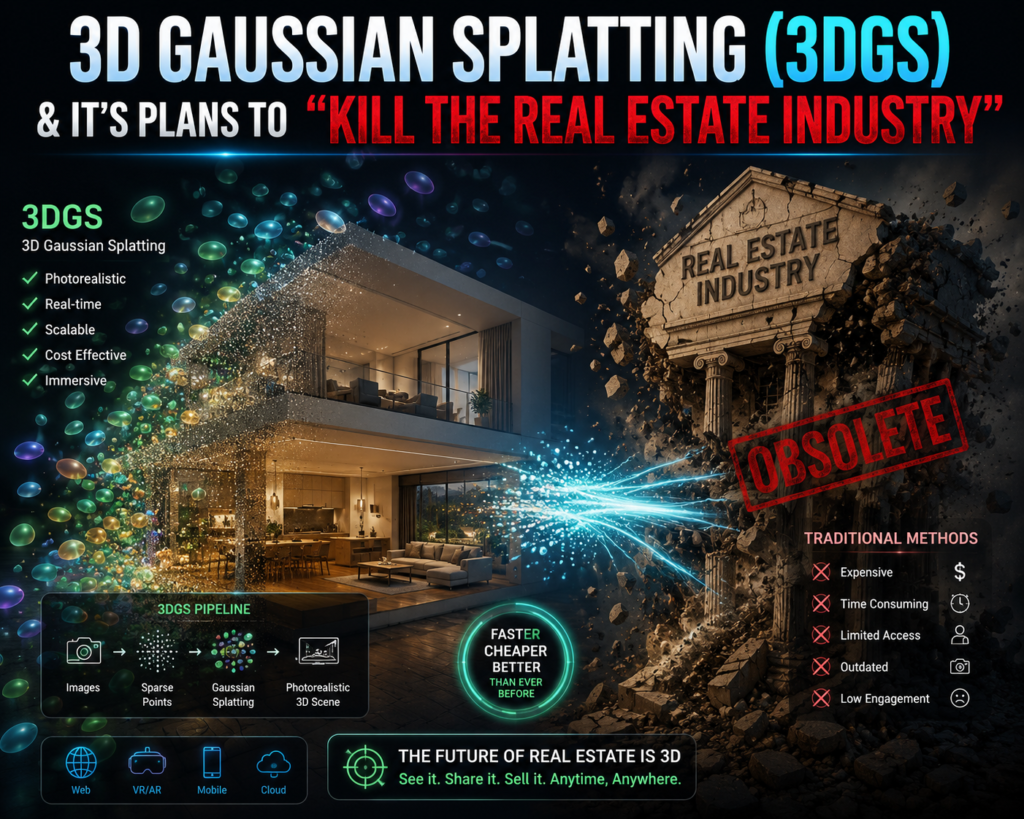
You’ve probably seen the tweet. Someone posts a video of a guy scanning a house with his phone, the camera glides through every room in photoreal quality, and the caption reads: “This technology just killed the entire real estate industry.” Seven million views overnight. Realtors panicking in the comments. Tech bros celebrating.
I watched it. I researched it. And then I spent a lot of time separating what’s actually true from what’s a well-packaged exaggeration. Here is what I found.
What Is 3D Gaussian Splatting?
Let’s start simple. You know how a regular photo is flat? You can’t look around the corner of it. And you know how Google Street View lets you look around 360 degrees, but moving through it feels like teleporting, that awkward click-and-wait like a PowerPoint slide changing?
3D Gaussian Splatting (3DGS) kills both of those problems.
Think of 3DGS as a 3D panorama you can actually walk inside of. Not click through. Not teleport around. Actually glide through, smoothly, in real-time, like you are inside a video game.
Instead of building a 3D space out of polygons (like game developers do), 3DGS uses millions of tiny, glowing “splats,” little blobs of colour and depth, and AI stitches them together from photos you took on your phone. The result is a digital ghost of the actual room that you can fly through in real-time. The lighting is captured too: the way sunlight hits a window, the reflection on a hardwood floor. It looks exactly like it did in real life.
How It Works in 3 Steps
Step 1: Point-and-Shoot Creation
You walk through a room with your iPhone, recording a normal video. Move the camera up, down, around corners. Upload that video to a website. A few hours later, a link lands in your inbox.
Step 2: Video Game Movement
You open the link and it doesn’t feel like photos. You glide smoothly through doors, look under tables, zoom into corners. No loading screens. No teleporting. No fading transitions. Just smooth, continuous movement.
Step 3: Zero-Hassle Viewing
No 2GB app to download. No VR headset needed. It runs in a regular Chrome or Safari tab, on a five-year-old phone, as smoothly as a TikTok video. That is the win.
The Numbers That Made the Internet Lose Its Mind
Here is what one person posted and why 7 million people saw it overnight:
“Someone just killed the real estate industry. A guy scanned an entire house with his phone. Uploaded it. Now anyone on Earth can walk through it in a browser tab. No app. No VR. No agent. No appointment. Click and you’re inside. Every room. Every angle. Every shadow. Photoreal.”
The numbers behind that reaction:
- $15,000 is the average agent fee on a $500,000 home
- ~$200 is the cost to produce one 3DGS scan
- One evening is all you need to virtually tour 50 houses
- Smaller than a TikTok video is the typical file size of a scan
That is not just a technology story. That is a pricing story. And pricing stories go viral because everyone immediately does the maths in their head.
Old World vs. New World: The Actual Comparison
The old way of getting a high-quality 3D scan of a building was not just expensive. It was ridiculously gated. Here is what changed:
- Cost: $50,000 to $200,000 (old) vs approximately $0 in software cost (new)
- Equipment: An $80,000 camera rig (old) vs your phone (new)
- Team size: 5 to 8 specialists (old) vs 1 person (new)
- Timeline: 6 to 12 weeks (old) vs one night (new)
- Viewing: Proprietary software (old) vs any browser tab (new)
- Quality: High-end photoreal (old) vs also high-end photoreal (new)
That last point is the uncomfortable one. It is not almost as good. According to the people building with it, the output quality is comparable. And that changes everything about who can compete in this market.
One early mover reported making $8,200 in deals overnight after posting about it. Hotels, realtors, developers, and museum directors were all reaching out asking the same question: “Can you do this for us?”
Did It Actually Kill Real Estate? The For and Against
Now we separate the hype from the reality. Because “killed the real estate industry” is a great tweet. But is it actually true?
The Case For
- Anyone on Earth can now tour a home without flying there, taking time off work, or booking an agent appointment. That is genuinely new.
- The cost collapse is real. $200 vs $15,000 for the same virtual experience is not a marginal improvement. It is a category shift.
- Freelancers are already charging $300 to $800 per scan for realtors, Airbnbs, venues, car dealers, and museums. The market formed overnight.
- Old tools like Matterport tours have that clunky teleport feel. 3DGS is genuinely smoother and more immersive, even on old phones.
- It is open source. No company can lock this behind a paywall and slow down adoption. That is historically how technologies go from cool demo to new standard very fast.
The Case Against
- People still need to physically inspect a home before buying. You cannot smell damp walls through a browser tab. Structural issues do not show in a scan.
- Real estate agents do more than show homes. They negotiate, handle legal paperwork, manage buyer emotions, and navigate local market knowledge. A scan cannot do any of that.
- The workflow is not actually plug-and-play yet. The person who went viral admitted it took weeks of failed scans, broken exports, and pipelines crashing at 3am. It is still early.
- The “18 months and it’s dead” timeline for a $2 billion industry is tech Twitter being tech Twitter. Disruption at that scale takes a decade, not a year and a half.
Who Should Actually Be Paying Attention
Real estate got the headline, but it is not the only industry in the crosshairs. These are the markets where the price-to-quality gap is wide enough that 3DGS can walk straight through it:
- Architectural Visualization: $4 billion per year
- Real Estate Media: $2 billion per year
- Museum Digitization: $1 billion per year
- Hotel 3D Tours: $800 million per year
That is roughly $8 billion in markets where the old moat was expensive equipment and specialist knowledge, not creativity, not relationships, not strategy. Just gatekeeping. And gatekeeping is exactly the kind of moat that gets swallowed by open-source tech.
The people who benefit most are not the ones replacing agencies. They are the ones who were locked out before. Freelancers, small property developers, boutique hotels, and local museums who could not afford $150,000 for a professional visualization. Now they can.
What This Means For Nigerian Real Estate
Now let us bring this home. Literally. Because while the conversation on X is about replacing $150,000 agency projects, the Nigerian real estate market has its own very specific problems, and 3DGS actually speaks to most of them directly.
Nigeria’s property market is one of the largest in Africa, valued at over $1.4 trillion in housing assets, yet it runs almost entirely on trust, word-of-mouth, and physical presence. That is exactly the kind of friction that technology eats for breakfast.
Here is the real problem in Nigerian real estate that nobody in Silicon Valley is talking about: the distance problem. Lagos to Abuja. Diaspora buyers in London, Houston, and Toronto trying to buy property back home. People relocating for work. First-time buyers who cannot afford to travel to inspect five different properties before making a decision. And the classic Nigerian solution to all of this: sending a relative to go and “check am” on your behalf.
Right now, what do they get? A few WhatsApp photos that the agent took in the best lighting possible. Maybe a shaky video call walkthrough. A cousin’s opinion who does not really know what to look for. And a whole lot of faith that what they are seeing is actually what they will get. The horror stories are legendary.
The Specific Wins for Naija
1. The Diaspora Buyer Problem, Solved
There are over 20 million Nigerians in the diaspora, and property back home is one of their biggest investments. With 3DGS, the buyer in Maryland gets the same full walkthrough as if they were standing in the living room in Lekki themselves. The family member on the ground still handles paperwork and physical formalities, but the eyes-on-the-property problem is completely solved. No flights. No delegated cousin making a decision they are not qualified to make.
2. The Off-Plan Confidence Gap
Off-plan property sales in Nigeria are a trust nightmare, and for good reason. Developers have a reputation for delivering something very different from what was promised. 3DGS can scan completed units or show rooms in other completed developments and give buyers a photorealistic reference point that is much harder to fake than a render.
3. The Short-Let Explosion
Nigeria’s short-let market in Lagos and Abuja has taken off. Platforms like Airbnb, Instagram, TikTok, WhatsApp, and local short-let agents are competing hard on aesthetics. A 3DGS scan of your apartment is an instant competitive edge. While your competitor is posting flat photos, you are giving renters a full virtual tour they can explore on their phone before booking.
4. The New Hustle for Tech-Savvy Nigerians
Freelancers are charging $300 to $800 per scan. Convert that to naira and you are looking at N450,000 to N1.2 million per job. One scan. One evening. A Nigerian with a decent iPhone, an internet connection, and two weeks of learning the workflow could be running a real business here, especially in Lagos, Abuja, and Port Harcourt where the property market is most active.
The one honest caveat for Nigeria specifically is internet infrastructure. A 3DGS file is smaller than people expect, but uploading a raw video for processing and sharing the output link still needs decent data. In areas where connectivity is unreliable, this hits a wall. That is the real friction here, not the law.
3DGS cuts straight through the inspection and marketing fraud problems. A developer can no longer show you a glossy render and deliver a shell. The scan is the property, unfiltered, un-retouched, every corner visible. But the title fraud problem, the who-actually-owns-this-land problem, requires a different tool entirely. That is where pairing 3DGS with blockchain-based digital land registries becomes genuinely powerful. A buyer in Houston can walk through a property in Lekki via 3DGS, then cross-check the title on a tamper-proof, publicly verifiable digital registry before a single naira moves. 3DGS solves the “can I trust what I am seeing” problem. Digital registries solve the “can I trust who owns it” problem. Together, they address the two most dangerous gaps in the Nigerian diaspora property experience.
3DGS does not kill the Nigerian estate agent. It kills the bad Nigerian estate agent. The one who survives on information asymmetry, blurry photos, and the fact that you had no better option. The agents who adopt this early will look like the most professional operation in the room overnight.
The Bottom Line: Disruption? Yes. Overnight Death? No.
Here is the honest take: 3D Gaussian Splatting is genuinely impressive technology. The price collapse is real. The quality is real. The new freelance market forming around it is real. Those things are not hype.
What is hype is the “500,000 people will be unemployed in 18 months” framing. Industries do not die in 18 months. They shift. The agents, agencies, and visualization studios that are paying attention right now, learning the workflow, adding it to their services, and lowering their costs, are the ones who will be fine. The ones ignoring it and assuming it is not good enough yet are the ones who should be nervous.
The technology did not kill real estate. It handed the keys to anyone willing to pick them up. Whether that is an agency, a freelancer, or a first-time homebuyer in Lagos who can now properly tour a property in London without boarding a plane, that is the actually interesting part.

Moses Oyong is a Real Estate Growth Marketing Manager and PropTech specialist with over a decade of closing residential and commercial deals worth over 200 million across Nigeria and international markets. Known for engineering AI-driven workflows that delivered a 69% uplift in sales targets and cut lead response times by 85%, Moses bridges the gap between high-performance marketing, land law, and technology to help investors, developers, and first-time buyers make confident, informed property decisions in an increasingly digital world.