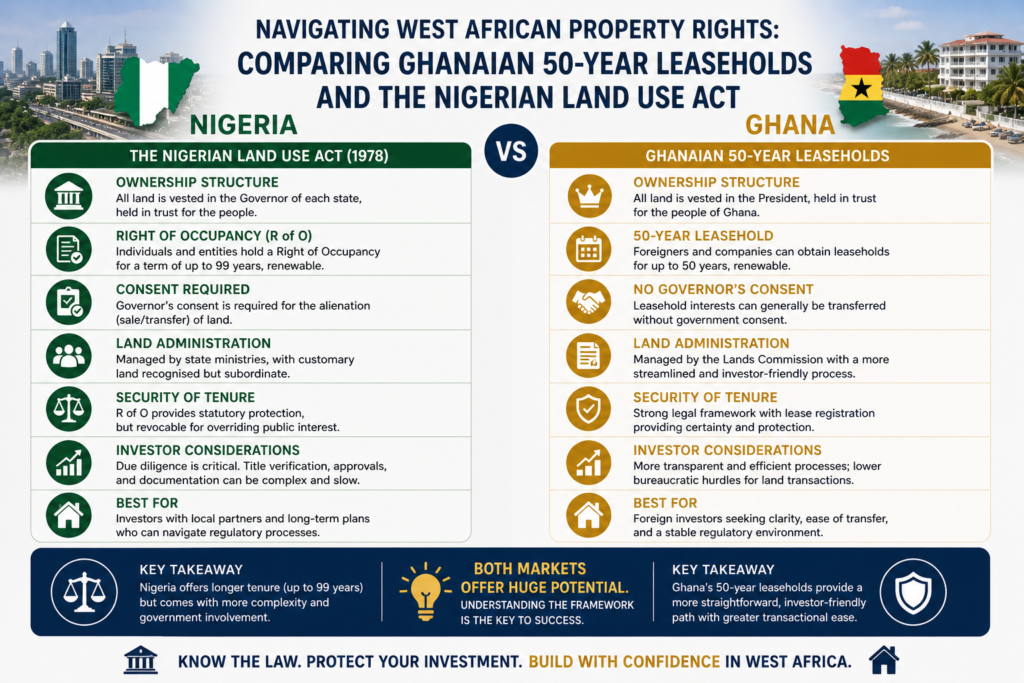
Navigating West African Property Rights: Comparing Ghanaian 50-Year Leaseholds and the Nigerian Land Use Act
For international investors, expatriates, and members of the African diaspora looking to secure a foothold in West Africa, understanding the nuances of land tenure is not merely an administrative hurdle, it is the bedrock of asset protection.
Two of the most significant economies in the region, Ghana and Nigeria, operate under distinct legal frameworks that govern how foreigners and citizens alike interact with land.
At the center of this discourse are the Ghanaian 50-year leasehold system and the Nigerian Land Use Act of 1978, which typically grants a Certificate of Occupancy (C of O) for up to 99 years.
Navigating these systems requires a deep understanding of colonial history, constitutional mandates, and the evolving nature of urban land management.
The Philosophical Foundation of West African Land Tenure
To understand the difference between Ghanaian and Nigerian land laws, one must first look at the history of land ownership in both nations.
In Ghana, land is predominantly governed by customary law, where ownership is vested in stools, skins, families, and clans.
In Nigeria, the Land Use Act effectively nationalized land, vesting it in the State Governors to be held in trust for the people.
These fundamental differences create a vastly different experience for the foreign investor.
While Ghana’s system is decentralized and rooted in traditional authority, Nigeria’s system is centralized and bureaucratic.
Whether you are navigating the property market in Lagos or Accra, the legal security of your investment depends entirely on how these systems define ownership.
The Ghanaian Context: The 50-Year Leasehold for Non-Citizens
Under the 1992 Constitution of the Republic of Ghana, the acquisition of land by non-citizens is strictly regulated.
Article 267 of the Constitution and the Lands Act, 2020 (Act 1036) establish that non-citizens cannot own freehold interest in land.
The Mechanics of the 50-Year Lease
When a foreign entity or individual wishes to acquire land in Ghana, they are restricted to a maximum leasehold period of 50 years.
This lease is not an ownership of the land itself, which remains with the traditional custodians or the state but a contractual right to use the land for a specific period.
- Customary Land Governance: In many cases, you are entering into an agreement with a Stool (the traditional office of a chief). The chief acts as a fiduciary. This makes due diligence in land title verification paramount.
- Renewal Clauses: While the initial term is 50 years, most sophisticated lease agreements include an option for renewal. However, the cost of renewal is often tied to the market value of the land at the time of renewal, which can lead to significant price escalation.
- Use Limitations: The lease usually contains covenants specifying the use of the land. Deviation from these (e.g., building a factory on land leased for residential purposes) can be grounds for termination of the lease.
Challenges for Foreign Investors in Ghana
The primary challenge in Ghana is the lack of a centralized, bulletproof registry.
Even with the ongoing digitization efforts by the Lands Commission, land disputes, often referred to as land guards issues in some regions, remain a deterrent.
Investors must ensure that the lease is properly stamped and registered to protect their interest against competing claims.
For more guidance on navigating this, see this article on how to secure land titles in Ghana.
The Nigerian Context: The Land Use Act and the 99-Year C of O
In contrast to the customary-led system in Ghana, Nigeria’s land administration is defined by the Land Use Act of 1978.
This Act was designed to unify the land tenure systems of Northern and Southern Nigeria, moving control from traditional rulers to the State Governors.
Understanding the Certificate of Occupancy (C of O)
The C of O is the legal instrument that serves as evidence of the grant of a right of occupancy by the Governor of a state.
It is generally granted for a duration of 99 years.
- The State as the Ultimate Lessor: Under the Act, all land in a state is vested in the Governor. When you buy land in Nigeria, you are technically applying for a grant of the right of occupancy.
- The 99-Year Tenure: The 99-year term is a statutory standard. Unlike the Ghanaian lease, which is often a private contract with a chief or family, the Nigerian C of O is a state-sanctioned document.
- Consent Requirements: A key feature of the Nigerian system is the requirement for Governor’s Consent for any subsequent transfer of the land. This ensures that the state remains aware of who is occupying the land, but it also adds layers of bureaucracy to real estate transactions in Nigeria.
The Dual System: Customary vs. Statutory
It is important to note that even within Nigeria, there is a distinction between land held under Statutory Rights of Occupancy (usually urban land) and Customary Rights of Occupancy (usually rural land).
Foreigners generally require a Statutory Right of Occupancy to ensure their investment is protected against administrative changes.
A Comparative Analysis: Key Distinctions
| Feature | Ghana (Foreigners) | Nigeria (Statutory) |
|---|---|---|
| Max Duration | 50 Years | 99 Years |
| Legal Basis | Constitution/Customary Law | Land Use Act 1978 |
| Primary Lessor | Traditional Chiefs/Families | State Governor |
| Renewal Path | Contractual negotiation | Statutory application |
| Regulatory Burden | High (Due diligence/stamping) | High (Governor’s Consent) |
The Security of Tenure Argument
While the 99-year Nigerian lease appears more attractive on the surface due to its length, the security of tenure is arguably similar in both nations.
In Nigeria, the power of the Governor to revoke land for overriding public interest is a point of contention that has led to significant litigation.
In Ghana, the risk is not state revocation, but rather competing customary claims (litigious title).
For an investor, both systems require a boots on the ground approach.
You cannot rely on a deed alone.
You must engage with the community, verify the history of the land title, and ensure that all municipal zoning laws are respected.
Strategic Considerations for the Foreign Investor
1. Due Diligence is Non-Negotiable
Whether you are looking at a parcel of land in East Legon or a commercial plot in Victoria Island, the first step is always verification.
In Ghana, this involves the Lands Commission and the relevant traditional authority.
In Nigeria, it involves the State Ministry of Lands and Survey.
Do not exchange funds until a search report confirms that the title is clean.
2. The Role of Professional Intermediaries
Navigating land law in these jurisdictions requires more than just a lawyer; it requires an expert in local land administration.
A local real estate advisor can help you understand the unwritten rules, such as how to build a relationship with the community elders in Ghana or how to expedite the Governor’s Consent process in Nigeria.
Check out our comprehensive real estate consultancy services to learn how to mitigate these risks.
3. Understanding Exit Strategies
An investment is only as good as its liquidity.
Because both the Ghanaian 50-year lease and the Nigerian 99-year C of O are time-bound assets, they are wasting assets.
As the lease term approaches its end, the value of the property can decline unless there is a clear pathway for renewal.
Investors should model their ROI (Return on Investment) based on the remaining years on the lease, not just the purchase price.
The Future of Land Administration in West Africa
Both Ghana and Nigeria are under pressure to reform their land administration systems to attract more Foreign Direct Investment (FDI).
In Ghana, the Lands Act 2020 represents a massive step toward harmonizing land laws, providing clearer pathways for registration and reducing the incidence of fraud.
The move toward a digital, blockchain-ready registry is the ultimate goal.
In Nigeria, there are constant calls for the amendment of the Land Use Act, with many experts arguing that it discourages investment by making the process of obtaining legal title too cumbersome.
State governments are increasingly adopting electronic systems (e-C of O) to reduce corruption and improve the speed of processing.
The Role of Technology
As the market matures, PropTech solutions will play a larger role.
Real estate professionals are now embracing the use of satellite imagery and GIS (Geographic Information System) data to verify boundaries, reducing the reliance on archaic physical markers that often lead to disputes.
Conclusion: Making an Informed Decision
Choosing between investing in Ghana or Nigeria should not be dictated solely by the length of the leasehold.
While the 99-year term in Nigeria provides a longer statutory horizon, the 50-year lease in Ghana is a well-understood, established, and functional mechanism for long-term real estate development.
The key to success in both jurisdictions is compliance.
- In Ghana: Respect the customary process, pay your ground rents, and ensure your lease is registered with the Lands Commission.
- In Nigeria: Prioritize the acquisition of the C of O, ensure you have the Governor’s Consent for all transactions, and maintain clear records of all payments to the state.
At Real Estate Moses, we believe that West Africa remains one of the most promising frontiers for real estate development globally.
However, it is a market that rewards those who take the time to understand its foundations.
Whether you are looking to purchase commercial property or residential land, prioritize legal clarity, professional guidance, and consistent due diligence.
The tenure length is just a number; your ability to defend your title is your actual asset.
By mastering these legal frameworks, you position your investment to withstand the test of time, regardless of whether it is a 50-year lease in Accra or a 99-year term in Lagos.
Disclaimer: This article is intended for educational purposes only and does not constitute legal or financial advice. Land laws are subject to frequent change. Always consult with a property professional before entering into any land purchase agreement.
For more in-depth insights into the West African property market, continue reading our Expert Blog Series, oh yeah baby!!!

Moses Oyong is a Real Estate Growth Marketing Manager and PropTech specialist with over a decade of closing residential and commercial deals worth over 200 million across Nigeria and international markets. Known for engineering AI-driven workflows that delivered a 69% uplift in sales targets and cut lead response times by 85%, Moses bridges the gap between high-performance marketing, land law, and technology to help investors, developers, and first-time buyers make confident, informed property decisions in an increasingly digital world.

Erica Mensa is a real estate researcher and market analyst at Real Estate Moses, specializing in West African property dynamics, emerging PropTech, and macroeconomic trends. With deep expertise in regional land tenure systems and cross-border investment regulations, Erica breaks down complex structural changes, from the mechanics of digital title verification and leasehold laws to the shifting financial landscape of consumer credit and urban expansion. Her data-driven market reports provide international investors, developers, and local buyers with the strategic clarity needed to confidently navigate evolving real estate markets in Ghana and across the sub-region.