The international real estate narrative surrounding remote island compounds often relies on the deep emotional appeal of complete natural integration, self-sufficiency, and absolute privacy. When a premium waterfront compound emerges within the rugged geography of the Gulf Islands, British Columbia, carrying a substantial price tag of $14,000,000 USD (approximately $19,000,000 CAD), marketing portfolios immediately deploy highly romanticized, lifestyle-centric vocabulary. They write prose detailing sustainable paradises, emotional and spiritual connections to the landscape, and hidden oasis sanctuaries, encouraging affluent buyers to view a complex piece of rural decentralized infrastructure as a simple, low-maintenance holiday getaway.
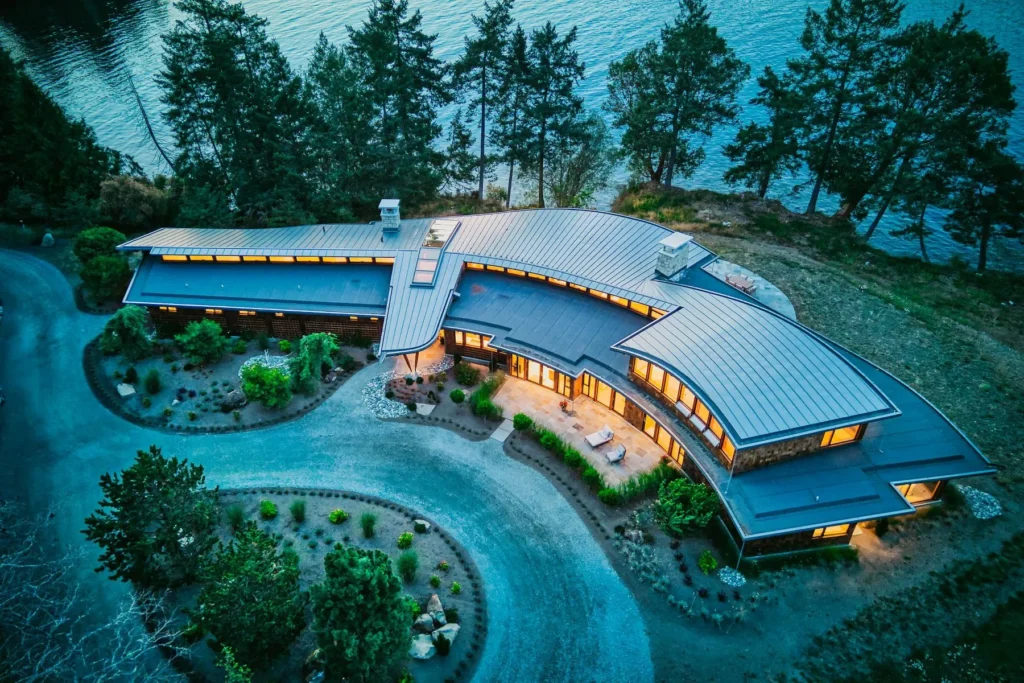
The physical property currently commanding this high-tier positioning is the Point House Estate, positioned on a sprawling 105-acre private peninsula on North Pender Island. The estate features a landmark 7,000 to 9,100 square foot primary residential compound designed by the notable West Coast Modern architects Bo Helliwell and Kim Smith of Blue Sky Architecture.
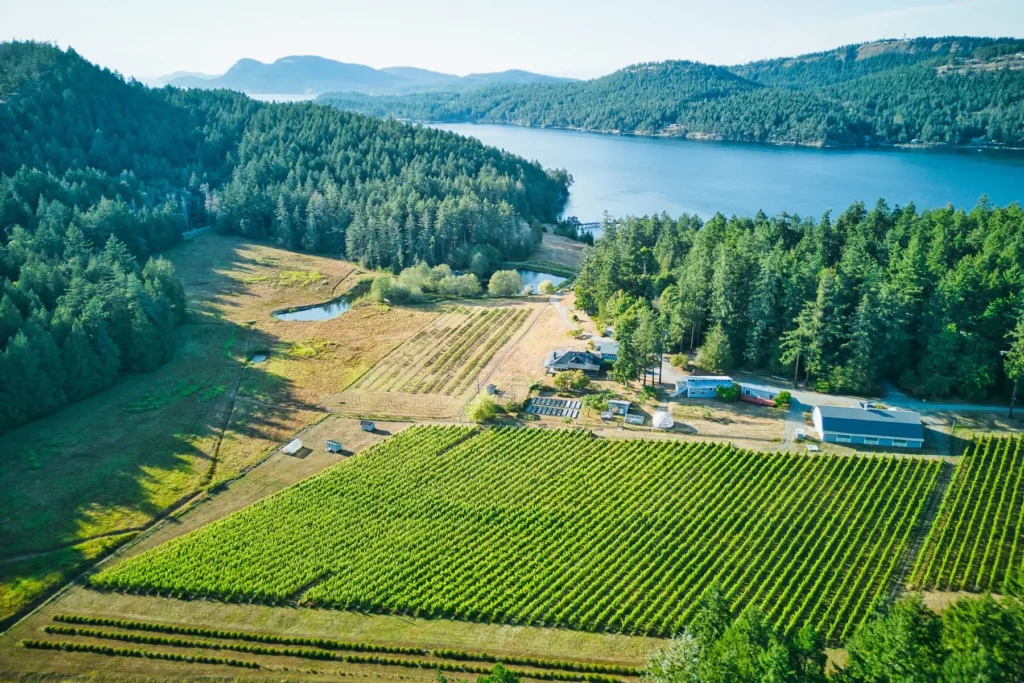
The asset profile includes over a kilometer of private shoreline along Davidson Bay, a commercial-grade 50-foot deep-water marine dock at the end of a 260-foot pier, an integrated organic farm (“Clam Bay Farm”), an active vineyard, an on-site sawmill, a private water treatment utility plant, and a heavy-duty industrial backup electrical power grid. Crucially, due to its specific rural geographical classification outside major metropolitan limits, the property carries a rare regulatory advantage: it is fully exempt from Canada’s Foreign Buyer Ban.
On a glossy real estate presentation or an international luxury brokerage portal, this property looks like an unassailable lifestyle and wealth-preservation masterstroke.
However, if you strip away the high-energy marketing text and evaluate this estate from an advanced decentralized infrastructure, remote island logistics, and capital efficiency angle, a completely different valuation profile emerges. A classic West Coast Modern structural landmark that coordinates an active organic farm, a private vineyard, an independent water treatment utility, and a deep-water commercial pier across 105 acres cannot be analyzed using standard residential real estate templates. It must be evaluated with the same precision applied to commercial agricultural enterprises, micro-utility operations, and highly technical capital portfolios. This exhaustive review looks past the standard lifestyle narrative, analyzes the maintenance mechanics of organic curved glulam timber architecture, confronts the unique logistical challenges of the Gulf Islands, and outlines the strategic parameters required to determine whether this $14,000,000 remote estate represents a true investment masterstroke or a profound, time-consuming capital drain.
1. The Undulating Glulam Roof Envelope: Structural Reality vs. Alpine-Marine Weathering
The defining architectural signature of the Point House by Blue Sky Architecture is its fluid, non-linear design language, characterized by an undulating roofline engineered to mimic the gentle curves of the island’s natural landforms. The primary structural skeleton relies on exposed Douglas Fir glued laminated timber (glulam) rafters set at prescribed heights, finished with a 2×6 Fir decking system bent mechanically into place to create sweeping, organic arches.
While this execution represents a masterclass in regional craftsmanship, exposing custom, curved engineered wood components to the aggressive marine climate of the Salish Sea introduces severe, long-term structural liabilities,
                   [ Salish Sea Marine Atmosphere ]
                                  │
         (High Ambient Humidity, Cyclic Rain Ingress, & Constant Wind)
                                  │
         ┌────────────────────────┴────────────────────────┐
         ▼                                                 ▼
[ Micro-Fissure Delamination ]                            [ Rainwater Capture Stress ]
Moisture cycles can cause edge-glue joints in              Undulating valleys concentrate water flow,
curved glulam beams to stress and separate.                putting immense pressure on drainage seals.
The Interfacial Delamination Risk: Glued laminated timber is an engineered product composed of multiple layers of wood wood-bonded together with structural adhesives. When subjected to the shifting moisture levels, dense ocean fogs, and seasonal temperature swings of North Pender Island, the exposed outer sections of these large structural timbers expand and contract. This cyclic moisture loading places continuous stress on the glue lines. Over extended holding windows, micro-fissures can develop along the lamination interfaces. If saltwater vapor penetrates these fissures, it triggers localized wood rot and structural delamination, requiring high-cost remediation by specialized timber-frame preservationists.
The Concentrated Rainwater Capture Tax: The organic curving roofs are explicitly engineered to direct rainwater in concentrated streams to specific capture points in the ground below. While this fluid water-routing system looks beautiful in a storm, it creates immense hydrostatic and structural loading pressures along the roof’s valley lines. If the custom gutter linings, copper flashing strips, or membrane seals along these curved collection troughs suffer even a minor alignment or tracking error due to building settling, standing rainwater will pool and migrate backward beneath the Fir decking, leading to hidden interior water leaks that can damage the suede-like lime-painted interior walls below.
2. The Commercial-Grade 50-Foot Dock Liability: Managing Submarine Infrastructure along Pender Island
The waterfront infrastructure of the Point House Estate features an exceptional maritime asset: over one kilometer of private shoreline encompassing Davidson Bay, supported by a commercial-grade 50-foot deep-water marine dock positioned at the end of a massive 260-foot pier jutting out through the shallows. Brokers pitch this asset as the ultimate gateway for frictionless VIP transit, allowing the owner to arrive effortlessly by private yachts or commercial seaplane charters directly from Vancouver.
From a marine civil engineering and coastal management standpoint, operating a large-scale structural pier and deep-water float within the open waters of Navy Channel introduces relentless maintenance commitments,
[ Intense Navy Channel Tidal Swells ] ──► [ Cyclic Structural Strain on Pier Piling ] ──► [ Anchor Chain Wear ]
                                                                                                 │
[ High-Cost Submarine Restoration ] ◄── [ Complex DFO Environmental Audits ] ◄── [ Barnacle & Salt Corrosion ]
The Tidal Swell and Cribbing Abyss: Navy Channel experiences strong marine tidal currents, heavy wind-driven wave actions, and regular commercial marine wake disturbances. A 260-foot pier extending through the shallows acts as a major lever arm against its underwater pilings and rock crib anchoring systems. The constant cyclic energy from changing tides puts continuous stress on the structural connectors. To prevent marine wood-boring organisms (teredos or shipworms) and saltwater corrosion from compromising the sub-surface frames, the dock infrastructure requires annual commercial dive inspections and ultrasonic metal thickness testing.
The Environmental Regulatory Minefield: The waters of the Gulf Islands are protected under strict environmental codes managed by Fisheries and Oceans Canada (DFO) and the Islands Trust ecosystem. Any structural modification, piling replacement, or maintenance dredging around your private 50-foot dock requires extensive environmental impact reviews, marine habitat assessments, and high-cost compliance engineering solutions, completely eliminating budget-friendly construction options.
3. The Decentralized Micro-Utility Operations: Saws, Water Plants, and Grid Independence
The estate profile describes the 105-acre property as a highly advanced sustainable oasis housing its own independent water treatment plant, an on-site industrial sawmill, and a powerful multi-building backup generator grid.
While providing absolute utility independence and complete peace of mind during regional power failures or winter storms, running a decentralized private utility network across a multi-building rural landmass turns you from a relaxed resident into an operational facility manager,
+-----------------------------------+-----------------------------------+
| Standard Branded Urban Penthouse  | Isolated Decentralized Utility    |
+-----------------------------------+-----------------------------------+
| Continuous connection to municipal| Total private responsibility for  |
| water treatment plants, power     | industrial water filtration,      |
| grids, and public service systems.  | sawmills, and localized generator grids.|
+-----------------------------------+-----------------------------------+
Consider the private water treatment plant. Sourcing and treating raw groundwater or pond catchments to meet safe residential and commercial agricultural health standards requires a complex automated filtration matrix, incorporating multi-stage reverse osmosis, ultraviolet sanitization loops, and continuous chemical balancing.
If the water treatment system encounters an automated sensor error or filter loading failure while you are hosting an elite international retreat, the entire multi-building compound experiences immediate utility paralysis. You must maintain a regular, highly specialized technical inspection loop, log mechanical pressure variations, and warehouse critical replacement components on-site, transforming your peaceful island escape into a demanding technical asset.
4. The Commercial Agriculture and Vineyard Overhead: Managing Clam Bay Farm
The property includes the historic “Clam Bay Farm,” established in 1874, featuring a fully operational organic farm and a planted estate vineyard producing phenomenal wine varieties. Real estate sales text frames this as a self-sufficient lifestyle opportunity that allows you to connect deeply with nature and enjoy the fresh fruits of your own manual labor.
From a wealth management perspective, operating an active agricultural and vinicultural enterprise inside a 105-acre footprint introduces significant operational management liabilities and labor complexities,
The High Financial Overhead of Viniculture: Maintaining a premium private vineyard requires continuous agricultural expertise. Grapevines are highly sensitive biological structures vulnerable to regional frost cycles, soil nutrient imbalances, and localized insect blights. To ensure the vineyard produces high-quality wine grapes, you must fund a permanent, year-round program of manual vine pruning, automated trellis wire balancing, netting deployment to deter migratory shorebirds, and specialized soil management routines.
The Labor Code and Logistics Strain: Running a fully operational organic farm demands an active, multi-person agricultural workforce. Sourcing, housing, and managing specialized agricultural laborers on a remote island within British Columbia requires navigating protective domestic labor codes and complex seasonal scheduling logistics. If your lifestyle involves frequent international travel or seasonal residency, coordinating the daily operational demands of a working farm from afar creates a persistent administrative anchor on your personal time.
5. The Foreign Buyers Ban Exemption: Analyzing the Capital Architecture Gateway
A vital marketing pillar highlighted for the Point House Estate is its explicit exemption from the Prohibition on the Purchase of Residential Property by Non-Canadians Act, universally known as the Canada Foreign Buyers Ban. While standard premium residential properties inside downtown Vancouver, Victoria, or West Vancouver are legally locked away from international capital, this property’s rural geographical classification opens a rare regulatory gateway for global wealth injection.
▲ [ Offshore Ultra-High-Net-Worth Capital Pool ] ──► [ Rare Rural Land Classification Exemption Gateway ]
                                                                      │
                                                                      ▼
                     [ Sunk Asset Value Allocation into $14,000,000 Pender Peninsula ]
                                                                      │
                                                                      ▼
▲ [ Terminal Exit Horizon Bound to the Microscopic Pool of Global Wilderness Buyers ]
From an institutional portfolio layout perspective, this exemption represents a strong entry leverage point, allowing offshore family offices, international venture syndicates, and global sovereign funds to securely deploy capital into Canada’s stable economy. However, an experienced investor must recognize that while entry is frictionless for foreign buyers, the asset remains bound by the same structural illiquidity laws upon exit.
The absolute pool of international buyers possessing the un-leveraged capacity to finalize a fourteen-million-dollar cash transaction for an isolated 105-acre remote island compound requiring marine or floatplane access is exceptionally thin. You are buying an asset with an expanded international purchase gate but a highly restricted terminal exit horizon, meaning the capital allocation must be analyzed with a long-term, multi-generational holding strategy.
6. The Spatial Redundancy Trap: High Carrying Costs for 105 Acres of Old-Growth Forest
When real estate buyers review listings like North Pender Island real estate BC or evaluate sprawling 105-acre properties, they often mistake massive acreage and vast 7,000+ square foot residential blueprints for enhanced personal comfort. The Point House features an expansive, multi-wing layout designed to elegantly separate social entertainment pavilions from private family wings, master study suites, and historical farm outbuildings.
Let us map out the real-world operational efficiency of an over-scaled, decentralized remote acreage over a standard calendar year,
                      [ Total Estate Landmass & Square Footage ]
                                         │
         ┌───────────────────────────────┴───────────────────────────────┐
         ▼                                                               ▼
[ High-Frequency Active Zones ]                               [ Low-Frequency Dead Space ]
Primary Master Wing, Main Open Living Room,                    Guest Wings, Service Corridors, Private Study,
 Davidson Bay Waterfront Meadow, Boat Dock.                     Old-Growth Forests, Sawmill, Barns, Outbuildings.
(Occupies ~15% of Total Space & Land)                         (Occupies ~85% of Total Space & Land)
In day-to-day operations outside of large-scale corporate retreats or major family gatherings, even the most active owners utilize less than fifteen percent of the available interior living square footage and land area footprint. The secondary guest wings, the isolated upper-level study suites, the service corridors, the on-site sawmill shed, the large agricultural barn, and miles of dense old-growth forest trails sit entirely silent for the vast majority of the year.
Yet, because the main residence is structured as a soaring, timber-framed concrete and glass pavilion, the entire living space must be actively conditioned, heated, and monitored around the clock to prevent remote coastal mold and moisture ingress from settling into the structures.
British Columbia’s damp coastal climate requires continuous operation of geothermal heat pumps and central climate networks to protect custom European white oak floors, Pietra Piasentina stone tiling, and expensive furniture installations. You are essentially funding the permanent operational and maintenance overhead of an entire self-contained wilderness resort while only deriving daily personal utility from a tiny sliver of the space.
7. The Gulf Island Transit Bottleneck: The Realities of Remote Coastal Logistics
To spend fourteen million dollars on a primary residential estate implies that you are purchasing a property that offers fluid, effortless mobility and immediate connectivity to your global corporate networks and travel centers.
The geographic reality of living on North Pender Island means your daily schedule is completely dependent on remote coastal marine transport logistics,
The Weather-Dependent Marine Lockout: While the estate boasts a commercial-grade 50-foot dock perfect for arriving via private yachts or floatplanes, the weather patterns across the Salish Sea can be notoriously volatile. During dense seasonal sea fogs, heavy winter storm surges, or sudden high-wind advisories through Navy Channel, landing a floatplane or docking a vessel becomes highly dangerous or physically impossible, instantly cutting off your transit to the mainland.
The BC Ferries Schedule Dependence: If you choose to travel via traditional surface infrastructure, you are completely bound to the fixed schedules, sailing delays, and seasonal peak capacity bottlenecks of the BC Ferries network connecting Pender Island to Vancouver or Victoria. A simple trip to attend an international corporate meeting or reach a major airport turns into a complex, multi-stage travel operation, stripping away the feeling of effortless executive mobility.
8. The Colossal Opportunity Cost of Fourteen Million Dollars of Dead Capital
The final, and most compelling economic argument against deploying your liquid wealth into the Point House Estate is the profound opportunity cost of capital. When you lock away fourteen million dollars of liquid wealth into a single, non-income-generating primary residence or personal legacy property, you are permanently removing that capital from the global financial landscape where it could be working to produce highly secure, compounding yields.
Let us execute a conservative, objective financial comparison of how that exact block of wealth behaves over a standard five-year investment holding window when deployed into active, liquid market instruments versus sitting inside a dead luxury remote island asset,
+-----------------------------------+-----------------------------------+
| $14M Capital Sunk in Island Asset | $14M Capital Deployed in Markets  |
+-----------------------------------+-----------------------------------+
| Generates $0 in passive cash flow.| At a conservative 6% compounding  |
| Accumulates massive annual bills  | annual yield, generates over      |
| for utility plants, farm payroll, | $840,000 in cash *every year*.    |
| and structural timber upkeep.     |                                   |
+-----------------------------------+-----------------------------------+
Over a five-year investment holding window, a professional, diversified corporate portfolio worth fourteen million dollars will effortlessly produce over four million two hundred thousand dollars in clean, highly liquid compounding profit while maintaining absolute capital mobility. Conversely, the Pender Island estate will have actively drained millions of additional dollars out of your pocket to cover high local property taxes, substantial electrical utility footprints to heat a massive timber pavilion, ongoing private water plant and generator maintenance, agricultural farm payrolls, and marine dock engineering upkeep, while its final secondary market resale value remains entirely exposed to the thin, unpredictable property cycles of the Gulf Islands luxury stratum. From a standpoint of raw wealth optimization and asset protection, spending this scale of money on a single landlocked home is an inefficient use of capital.
Comprehensive Structural Matrix: The Sales Presentation vs. Valuation Reality
To ensure your luxury property acquisitions are guided by cold investment logic rather than architectural poetry, carefully evaluate this direct contrast between what the broker’s marketing brochure promises and the real-world operational reality of the Point House Estate,
| The Hyper-Luxury Feature | The Broker’s Glamorous Pitch | The Real-World Operational & Financial Reality |
| $14,000,000 Purchase Price | An elite trophy property indicating the peak of Western Canadian success, wealth, and prestige. | Extreme capital lockup with heavy asset illiquidity and high annual fixed holding costs. |
| Undulating Douglas Fir Roof | Hand-crafted West Coast Modern architectural masterpiece designed by Blue Sky Architecture. | High exposure to marine moisture cycles; requires continuous log structural alignment audits. |
| Commercial-Grade 50-Foot Dock | Effortless VIP transit allowing you to arrive securely via private yachts or floatplanes. | Under continuous structural stress from Navy Channel tidal swells; requires complex multi-agency DFO permitting. |
| Fully Operational Organic Farm | Connect deeply with nature and enjoy the fresh fruits of your own sustainable farm and vineyard. | Substantial agricultural and vinicultural overhead requiring a permanent, specialized workforce footprint. |
| Private Water Treatment Utility | Complete independence and total peace of mind with self-sufficient on-site utility systems. | High engineering liability requiring daily manual filtration monitoring and technical component management. |
| Exempt from Foreign Buyers Ban | A rare, alluring opportunity for international buyers to deploy capital into Canadian land. | Scarce entry gateway asset that faces intense terminal illiquidity due to a very thin secondary buyer pool. |
Is the Point House Estate Worth Buying?
Despite this extensive structural, logistical, and financial critique, this property remains a stunning achievement in large-scale modern West Coast architecture. The critical step to avoiding severe investor remorse is recognizing whether your personal balance sheet and global wealth infrastructure are vast enough to absorb the severe inefficiencies of this property class.
You are completely making a mistake with this estate if,
You expect your assets to remain liquid and agile: If your investment strategy relies on rapid capital mobility and the ability to exit positions within a short calendar window.
You analyze real estate through net-yield return: If you judge your asset allocations through the strict math of opportunity cost and capital efficiency.
You demand effortless, near-instant urban access: If your executive lifestyle requires immediate proximity to major international airport hubs and central business zones without ferry or weather dependencies.
You want a zero-maintenance primary structure: If you find managing private water treatment grids, operational organic farms, and complex marine dock frameworks technically annoying.
This estate represents a justifiable acquisition only if,
Your net worth exceeds several hundred million dollars: Meaning a fourteen-million-dollar capital lockdown represents a minor fraction of your overall global wealth footprint.
You are an absolute purist for West Coast Modern organic architecture: And view living inside an uncompromised Blue Sky Architecture timber-frame design as a vital legacy or personal milestone.
You intend to operate the property as a dedicated corporate retreat or family foundation: And possess the organizational infrastructure to easily absorb the ongoing administrative and staffing logistics required to run a multi-use farm asset.
The personal value of absolute natural isolation and waterfront scarcity completely outweighs economic logic: And you possess the financial liquidity to effortlessly maintain an active, live-in property management team to run a complex remote island structure.
The Verdict: Before You Issue an Inquiry to REM
If you are currently browsing high-end search results for North Pender Island real estate BC or analyzing this spectacular entry at the Point House Estate, the final conclusion requires looking past the glamorous real estate presentation.
This multi-wing vertical residence is an architectural and geographical triumph, but as a financial investment vehicle, it carries heavy operational and regulatory liabilities. It demands a significant lifestyle and operational sacrifice from its custodian. It forces you to manage high-maintenance marine dock and private utility infrastructure, navigate complex island transit logistics, combat aggressive maritime climate elements, and accept a massive capital lockup within an illiquid price bracket.
Before you take any steps toward requesting private viewings, formal contract reviews, or structured financial terms, protect your global wealth. Work alongside an independent luxury asset advisory office to run a comprehensive multi-year operational cost projection. Physically audit the structural integrity of the curved glulam rafters against moisture delamination, and deeply calculate the true opportunity cost of moving fourteen million dollars out of the global financial markets.
For more information on the exact boundary coordinates, to review construction compliance documentation, or to arrange an independent private tour of the Pender Island sector, contact REM. Ensure you approach the negotiation table with a completely clear, realistic perspective on the long-term realities of ultra-luxury asset ownership.

Moses Oyong is a Real Estate Growth Marketing Manager and PropTech specialist with over a decade of closing residential and commercial deals worth over 200 million across Nigeria and international markets. Known for engineering AI-driven workflows that delivered a 69% uplift in sales targets and cut lead response times by 85%, Moses bridges the gap between high-performance marketing, land law, and technology to help investors, developers, and first-time buyers make confident, informed property decisions in an increasingly digital world.