Why a Constrained Brief Is the Most Honest Commission
I did not take the Holland Park commission because it was ambitious. I took it because it was difficult in the right ways.
A two-storey mews house in West London — once a 19th-century carriage house, now subject to the particular set of expectations that come with that postcode. Low ceilings. Narrow depth. The kind of brief that, handled carelessly, becomes an exercise in compensating for what the structure lacks rather than listening to what it already knows. I have received larger commissions, more complex ones, briefs with budgets that invite excess. But there is something clarifying about a space that has already decided what it will not be. The building told me, almost immediately, that it was not interested in spectacle. My task was simply not to argue with it.
That restraint — the decision to work with constraint rather than against it — has been the recurring logic of my practice for over two decades. Holland Park became the most precise expression of it I have yet produced.
Composing Light, Not Filling Space
The first decision I made was about the windows. Two large openings face the garden, and from early in the design process I understood that how light moved through those openings across a day would determine the emotional register of the entire ground floor. This is not a secondary concern for me — it is primary. Light is not illumination. It is architecture. It has mass, direction, duration. When I say that a design is halfway complete once light can move freely, I mean it literally: the room finishes itself across the hours if the surfaces and proportions are correctly calibrated.
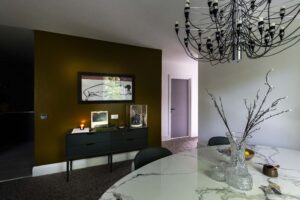
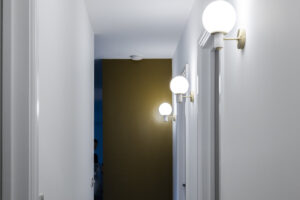
The pale walls were chosen not for their neutrality but for their receptiveness. A muted ochre accent wall on the north-facing plane releases a warmth that shifts perceptibly between morning and late afternoon — a warmth that has nothing to do with temperature and everything to do with psychological register. The white marble dining table, veined with gold, catches early light in a way that makes the surface appear almost liquid. A linear metal pendant hovers above it — nearly weightless, deliberately minimal — not to illuminate but to anchor. The furniture stays low throughout, a decision that aligns the eye with the garden line and prevents the room from folding inward.
A single red floor lamp. An orange throw. These are not decorative flourishes — they are pressure points, small calibrated intensities against an otherwise restrained ground. Colour in emotional minimalism is not decoration; it is interval. The way a rest functions in music — not absence, but structural necessity.
I work this way because I have learned to distrust rooms that feel resolved. A space that announces itself completely on first encounter has no interior life. What I am after is a room that yields something new at three in the afternoon that it withheld at nine in the morning. The Holland Park ground floor does this. The ochre wall behaves differently in October light than it does in July. That is not incidental — it is the point.
Material Honesty and the Decision to Let Time Leave a Mark
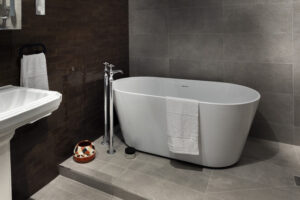
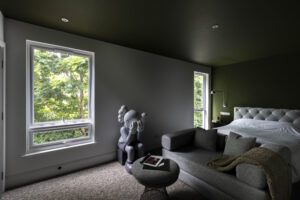
Upstairs, the design continues its logic into more intimate territory. A pale green ceiling — the colour of forest shade at midday — softens daylight in a way that no artificial lighting system could replicate. Two portraits hold the wall without dominating it. In the bathroom, matte grey and brown brick frame a white bathtub placed precisely on axis. The geometry is deliberate; the restraint is deliberate. Nothing in this residence strives to impress. Every object waits for context to give it meaning.
The materials throughout are uncoated, unfinished in the cosmetic sense — wood that will age, stone that will absorb, brushed metal that will develop a quiet patina. This is what I mean by material honesty: the acknowledgment that a material has a trajectory, and that designing with it means designing for that trajectory, not against it. So much contemporary interior work is predicated on the idea of permanence — surfaces that resist time, finishes that refuse to change. I find that position philosophically dishonest and practically futile. Time will always win. The question is whether you have designed a space that becomes richer as it ages, or merely one that becomes shabbier.
The soft carpets and curtains throughout are not purely aesthetic decisions. They absorb echo. They turn silence into something you can feel rather than simply notice. I have said before that calmness is an acoustic decision as much as an aesthetic one, and I mean this precisely — not as provocation but as method. The acoustic properties of a space shape its psychological register more directly than most designers acknowledge. A room with hard, reflective surfaces generates a low-level ambient anxiety that the occupant may never consciously identify but will always feel. Softness, in this context, is structural. It is not indulgence. It is design.
Cross-Cultural Precision: What Two Decades of International Practice Actually Teaches You
I grew up thinking about space in one context and have spent my career thinking about it in many others. That accumulation — working across dense cities and quieter ones, across cultures with very different relationships to interiority and display — has shaped what I now call cross-cultural precision.
In the dense cities, the lesson was always about subtraction: how to carve breathing room from pressure, how to make a small space feel spacious not by lying about its dimensions but by respecting them. In quieter urban environments, the lesson was different — it was about rhythm, about how a space that has room to breathe can still feel inert if the designer has not introduced enough variation to give the eye something to follow over time. Eastern design traditions — and I draw here particularly from the Japanese concept of ma, the meaningful interval — taught me that negative space is not empty but active. Western design traditions, at their best, offered a counterpoint: the confidence to commit to a gesture, to place a single object with enough conviction that it does not need company.
What I have developed over time is a practice that holds both simultaneously. The Holland Park Mews Residence is a Western spatial type — a London mews house, a specific architectural lineage — but it thinks about space in a way that owes as much to Eastern restraint as to European proportion. The ochre wall is a Western gesture: warm, declarative, present. But it is placed with an Eastern logic — set where it will not impose but will nonetheless be felt.
I call this non-attachment design: spaces that allow themselves to exist without insistence. The room does not need you to notice it immediately. It does not perform. It is simply present, and in that presence, it becomes what you need it to be.
How Spaces Are Experienced Over Time — Not Just at First Encounter
Here is something I think about that rarely appears in the coverage of my work: how a space behaves eighteen months after it is photographed.
The photographs of the Holland Park Mews Residence were taken on a clear October morning. They are good photographs. They capture what the space intends. But what interests me more is what happens to someone who lives in that space across seasons — who notices in February that the ochre wall has become something more, not less, in low winter light; who finds that the pale green ceiling upstairs has begun to feel like a personal fact rather than a design decision; who no longer thinks about the marble table as a surface but as a rhythm in their day.
Design that photographs well but fails to deepen over time is not, in my view, complete design. It is installation. The distinction matters. Spaces that we inhabit — truly inhabit — become continuous with our inner lives. They accommodate mood, they absorb grief, they amplify quiet joy. For that to happen, the designer must have left room. Not emptiness — the mistake of lazy minimalism is to confuse restraint with absence — but structural openness: surfaces that invite projection, proportions that do not foreclose, materials that change alongside you.
This is the long test I apply to my own work. Not: does it resolve? But: does it remain interesting when nothing is happening in it?
A Post-AI Design Ethic and What “Human Silence” Actually Means
We are working at a strange cultural moment. AI-generated imagery has flooded the design conversation with a kind of synthetic perfection — spaces that are impeccably proportioned, expertly lit, and completely uninhabited by the passage of time. They are beautiful in the way that still water is beautiful: completely, and without any of the complexity that comes from something actually living.
My response to this is not polemic. I am not opposed to the tools. What I am opposed to is the aesthetic — the idea that perfection is the destination, that the goal of design is to eliminate all evidence of process, material character, and temporal change. That goal produces rooms that feel like renderings even when you are standing in them.
The Holland Park Mews Residence is, among other things, a statement of method: control light density rather than add fixtures; use authentic materials rather than surface effects; treat acoustics as structure rather than afterthought; leave room for time to contribute. These are not stylistic preferences. They are a design ethic — grounded in sensory truth, resistant to novelty for its own sake.
I have named what I practice Human Silence. The phrase is deliberate. Silence, as I mean it, is not the absence of sound but the presence of attention. A silent room is one in which you become aware of yourself — your breathing, your thoughts, the quality of light on your hand. It is the opposite of distraction, which is what so much contemporary design — and so much contemporary life — provides in abundance. True luxury, as I understand it now, is not material accumulation. It is the capacity to be present in a space without being stimulated by it, and the awareness to notice that you are.
Human Silence offers something specific to this cultural moment: the proposition that design’s most radical move is not to do more but to perceive better. To slow the space down until the person in it can slow down too. To create environments that restore rhythm rather than accelerate it. In a city like London — defined by speed, by density, by the ambient pressure of too much happening — this is not a small thing. It is, I would argue, the most urgent design problem we have.
The Architecture of Stillness is not about absence. It is about attention. And attention, right now, is the rarest thing a designer can offer.

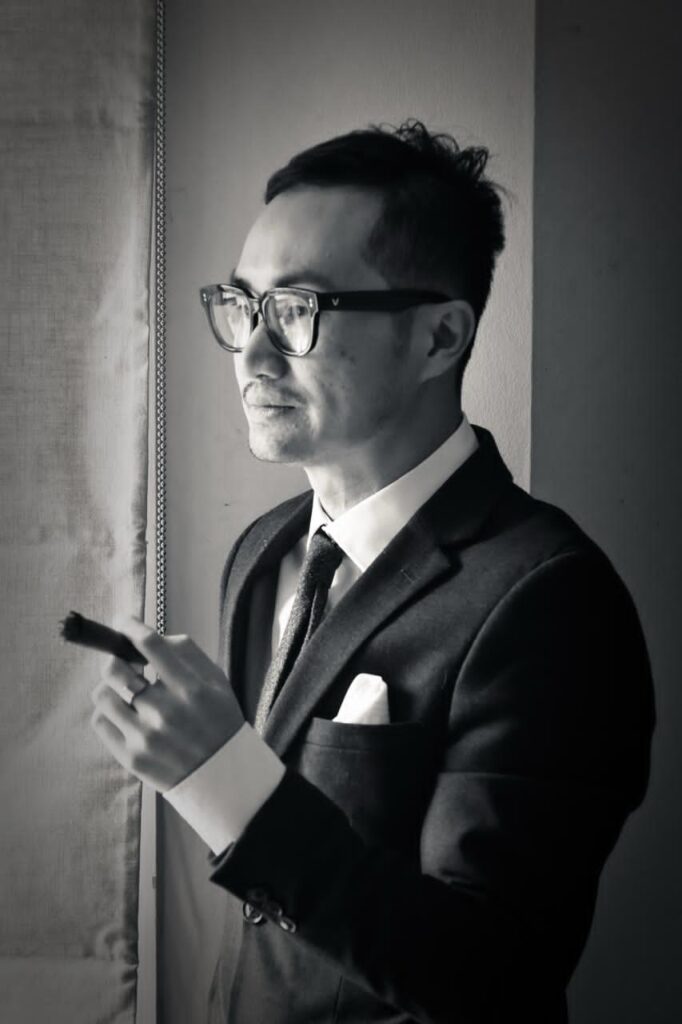
Pal Pang is an award-winning interior designer with over 20 years of experience in the industry. He is the recipient of numerous prestigious accolades, including the International Property Award for Best Interior Design and the A’ Design Award. His innovative approach to sustainable luxury has garnered recognition across the globe, setting new standards in interior design. Known for his ability to seamlessly blend elegance with environmental responsibility, Pal has worked on some of the most iconic projects, including a prestigious Mayfair apartment, consistently pushing the boundaries of what is possible in the world of interiors.