The Problem Before the Product
Picture a high-net-worth investor sitting on $1 million in USDT. The capital is liquid, the intent is clear, they want to acquire an income-producing property in Florida. But they do not want to liquidate their position and trigger a taxable disposal event.
They do not want to navigate the 30 to 60 days of a traditional closing. And they certainly do not want to route funds through a patchwork of unregulated crypto payment processors with no legal standing as settlement agents.
In May, talks between me and a Propy representative revealed more on crypto property transacting in Florida. Until recently, the intersection of cryptocurrency and real estate was largely theoretical in the United States, discussed in proptech conference panels, piloted in isolated transactions, and perpetually described as emerging. That description is no longer accurate.
There is now a licensed, institutionally backed, operationally repeatable infrastructure enabling crypto-based real estate closings in Florida. It is called Propy. This post unpacks how it works, who it is designed for, and what it means for real estate professionals and investors operating across the US and internationally, including from Nigeria and the broader African market.
What Propy Actually Is
The first thing worth establishing is what Propy is not. It is not a cryptocurrency exchange. It is not a payment processor. It is not a blockchain project looking for a real estate use case.
Propy is a US-licensed title and escrow company. It holds legal standing as a settlement agent in Florida, Arizona, and Colorado, operating within the same regulatory framework as any conventional title agency. That distinction matters enormously when evaluating the credibility of crypto-enabled transactions. A licensed title company is accountable to state regulators, bound by fiduciary obligations, and critically legally authorised to hold and disburse funds in a real estate transaction.
Founded in 2017, Propy was among the earliest companies to apply smart contract technology to real estate settlement. In October 2024, it launched its dedicated Crypto Escrow Service in partnership with Coinbase Prime, the institutional arm of Coinbase using institutional-grade custody infrastructure for Bitcoin, Ethereum, USDC, and USDT. The platform manages the full transaction lifecycle: purchase contract, title search, escrow holding, disbursement, and optional on-chain deed recording.
The high-profile signal of market confidence came in mid-2024, when real estate investor Grant Cardone listed a $42 million property in Golden Beach, Florida on Propy’s platform, accepting cryptocurrency as a mode of purchase. This was not a novelty listing, it was a sophisticated investor signalling trust in the platform’s infrastructure at the luxury end of the market.
The analytical point worth anchoring: the key differentiator between Propy and an unregulated crypto payment bridge is regulatory legitimacy. Propy is, legally and operationally, a title company that accepts crypto, not a crypto company attempting to enter real estate.
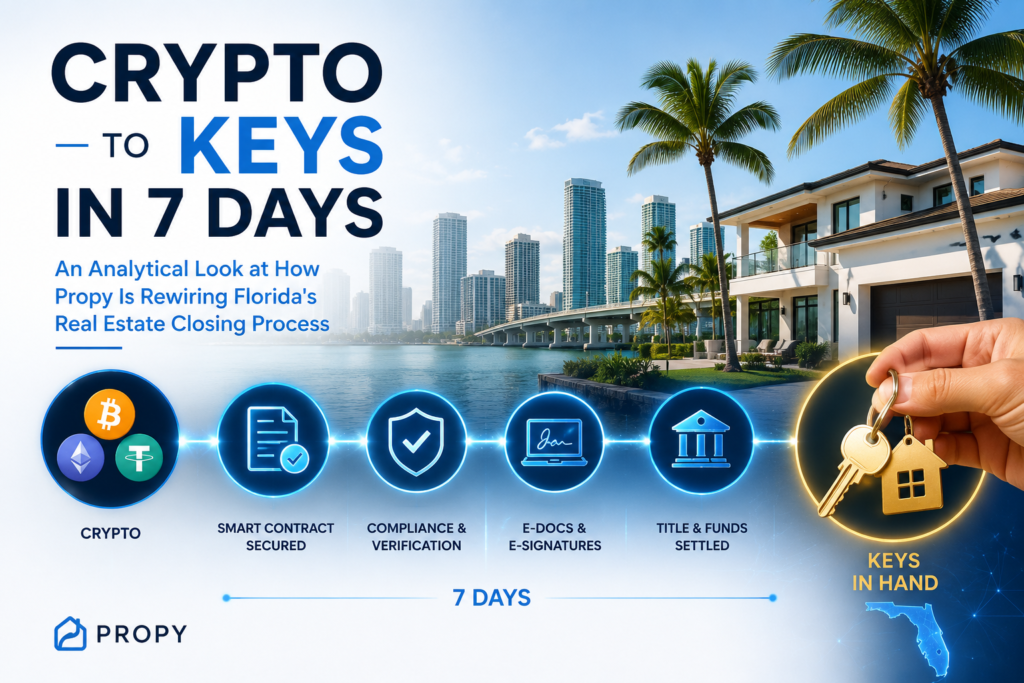
Anatomy of a Crypto Real Estate Transaction: The 7-Day Closing
How the Deal Actually Works: A Step-by-Step Breakdown
Based on the operational account of an agent currently working with Propy’s team, the following is a structured analysis of how a crypto-enabled closing unfolds from contract to deed.
- Purchase Contract Execution — Buyer and seller execute a standard real estate purchase agreement. There is nothing exotic about the contract itself. The document is submitted to Propy, which is designated as the escrow and title agent, the same role a conventional title company would fill.
- Wallet Address Issuance — Propy contacts the buyer and issues a verified, institutional-grade crypto wallet address. This wallet is secured through Coinbase Prime’s custody infrastructure. The buyer is not sending funds to an anonymous or unverified address, the process mirrors receiving a wire transfer instruction from a licensed title company.
- Crypto Transfer — The buyer transfers the agreed amount of USDT or other accepted cryptocurrency to Propy’s escrow wallet. Functionally, this is the equivalent of wiring funds to a title company’s escrow account. The currency is different; the rail is different; the legal architecture is the same.
- Funds Held in Escrow — Propy holds the cryptocurrency in escrow for the duration of the closing period. For straightforward transactions, this is approximately seven days. Funds remain inaccessible to both buyer and seller until all closing conditions are satisfied.
- Closing Day Disbursement — Two paths exist at closing. If the seller prefers fiat, Propy converts the cryptocurrency to USD and wires the proceeds directly to the seller’s bank account. If the seller prefers crypto, Propy transfers the agreed digital asset directly to the seller’s wallet. The seller’s preference is established in advance.
- Title Recording — Title is recorded with the relevant county, providing the conventional legal basis for ownership. Propy additionally offers optional on-chain deed recording via its blockchain protocol, creating a verifiable, immutable ownership record.
The 7-day timeline compares to an industry average of 30 to 45 days for traditional US real estate closings, a structural compression that reflects the efficiencies of removing correspondent banking from the disbursement chain.
Two analytical observations deserve emphasis. First, holding cryptocurrency in escrow rather than converting it to fiat at the point of contract means the buyer does not trigger a capital gains tax event until the actual closing.
This is not a tax avoidance strategy; it is a timing consideration that any crypto-literate tax professional would recommend accounting for. Second, Coinbase Prime’s institutional custody infrastructure which processes in excess of over $130 billion in quarterly institutional trading volume provides counterparty-risk protections comparable to a bank holding fiat escrow. The risk profile of the escrow itself is not meaningfully different from a conventional title company arrangement.
The Market Context: Who Is This Really For?
A common misreading of crypto real estate products is that they are designed for speculative cryptocurrency traders looking for a novel way to spend digital winnings. The actual buyer profile is considerably more substantive.
The data supports a different picture. More than 50 million Americans held or used cryptocurrency in 2023, and over 400 million wallets are actively in use globally. In 2021, Redfin survey data referenced in Propy’s own platform announcements found that 12% of first-time homebuyers in the US used cryptocurrency to help fund their purchase. The Henley & Partners Crypto Wealth Report for 2025 estimated approximately 241,700 crypto millionaires worldwide. These are individuals whose primary wealth vehicle is on-chain, and who face a specific strategic problem: how to deploy that wealth into hard assets without liquidating positions they expect to appreciate further.
The buyer profile for a Propy-facilitated deal is not a trader. It is a wealth-preservation investor. They have accumulated significant crypto holdings through early positions, mining, business income denominated in digital assets, or institutional allocations and they want to convert that value into real property without sacrificing their crypto exposure at what may be an unfavourable moment for disposal. For that investor, a USDT-denominated Florida property acquisition through a licensed escrow agent is not a novelty; it is a structurally rational financial decision.
Florida’s luxury market; particularly Miami, Wynwood, and Golden Beach has seen measurable appetite for this model. The market dynamics are reinforcing: international buyers who hold crypto but face barriers to conventional USD mortgage products from outside the US are among the most motivated participants.
Propy’s platform is borderless at the point of transaction, even if US regulatory requirements apply uniformly. FIRPTA withholding obligations, KYC documentation, and source-of-funds verification still apply to all international buyers, crypto does not bypass US real estate law. But it does remove the correspondent banking layer that often makes cross-border fiat transfers slow, expensive, and prone to failure.
Key data points:
- Americans holding crypto (2023): 50 million+ — Source: Propy/Coinbase Prime launch data, Oct 2024
- Active crypto wallets globally: 400 million+ — Source: Propy launch data
- First-time US homebuyers using crypto (2021): 12% — Source: Redfin survey, cited in Propy releases
- Crypto millionaires worldwide (2025 est.): 241,700 — Source: Henley & Partners Crypto Wealth Report 2025
- Grant Cardone’s Propy listing — Golden Beach, FL: $42 million — Source: Propy / PRNewswire, July 2024
- Miami studio closed via Bitcoin (2025): $528,900 — Source: Vaster Blog / Miami crypto real estate data
- Largest Propy crypto closing (as of mid-2026): $14 million — Source: Agent working relationship account
- Coinbase Prime quarterly institutional volume: $130 billion+ — Source: Propy/Coinbase Prime documentation
Scale, Precedent, and What $14 Million Tells Us
The $14 million figure matters analytically not as a marketing milestone, but as a signal about the transaction ceiling the infrastructure can support. A $14 million crypto closing is not a residential exception.
It is squarely within the range of hotel acquisitions, multi-family portfolios, and commercial real estate transactions. The agent account in question specifically referenced the potential to break the record on a hotel-level purchase, which reflects real and active appetite at the top of the Florida hospitality market.
Why does scale matter? Because the most common objection to crypto real estate infrastructure has always been liquidity, the assumption that institutional buyers moving tens of millions of dollars of cryptocurrency would overwhelm platform capacity, create adverse price impact during conversion, or lack the regulatory backing to close. Coinbase Prime’s position as one of the deepest institutional liquidity providers in the crypto market addresses each of these concerns. A $14 million USDT-to-USD conversion on closing day is a routine operation for an institution processing $130 billion in quarterly volume.
The broader market provides additional context. In Miami alone, a studio unit closed via direct Bitcoin wallet-to-wallet transfer for $528,900 in 2025, and properties in Wynwood now routinely accept Bitcoin and Ethereum for condo purchases.
The question is no longer whether crypto real estate transactions are possible. The question for agents and investors is whether the infrastructure is regulated, insured, and repeatable. On each of those criteria, Propy’s model backed by a licensed Florida title agency and an institutional custodian represents the most credible operational answer in the US market.
Risks, Considerations, and Due Diligence
A credible analysis cannot end at the opportunity. The following considerations are not arguments against crypto real estate transactions; they are the professional framework that any serious investor or agent should apply before proceeding.
Crypto Volatility Risk
Where the purchase price is denominated in a non-stable cryptocurrency: Bitcoin or Ethereum, for instance, market value can shift materially between contract execution and closing. If the asset declines in value during that period, the seller may receive a lower USD equivalent than anticipated, absent price-adjustment provisions in the contract. The preferred mitigation in Propy-facilitated transactions is to denominate in stablecoins: USDT or USDC, which eliminates intra-period volatility as a variable. This is why the agent account specifically referenced USDT as the standard transfer currency.
Tax and Reporting Obligations
The US Internal Revenue Service classifies cryptocurrency as property. Using cryptocurrency to purchase real estate constitutes a taxable disposal event, potentially triggering capital gains liability on any appreciation in the crypto asset from its original acquisition price. The 2024 IRS broker reporting regulations introduced additional compliance dimensions for crypto transactions. Any buyer considering a crypto-enabled real estate purchase should engage a tax professional with specific expertise in digital asset taxation before initiating the transaction.
Enhanced KYC / AML Documentation
Crypto transactions do not bypass know-your-customer or anti-money laundering requirements. In practice, they often attract heightened scrutiny. Propy, as a licensed title agent operating in a regulated market, will require source-of-funds documentation, wallet provenance, and transaction history for review. Buyers should anticipate more intensive documentation requirements than a conventional cash purchase, not less.
Foreign Buyer Considerations
International purchasers face an additional compliance layer. FIRPTA withholding obligations apply to non-US sellers in US real estate transactions. Cross-border fund transfer restrictions, currency control regulations in the buyer’s home jurisdiction, and varying tax treaty positions across countries can materially affect the structure of a transaction. Legal counsel with dual competency in US real estate law and the buyer’s home jurisdiction is not optional for international crypto buyers, it is essential.
These risks are manageable with the right professional team: a crypto-literate attorney, a digital asset tax advisor, and an agent with working knowledge of Propy’s process. They are not arguments against the transaction class; they are the conditions of doing it responsibly.
Implications for Real Estate Professionals in Nigeria and Emerging Markets
Florida is consistently among the most internationally accessible US real estate markets. Nigerian diaspora investors, African high-net-worth individuals, and global crypto holders represent a meaningful and growing segment of demand, particularly for income-producing residential and hospitality assets in Miami and the surrounding area.
The significance of Propy’s model for this audience is specific. Many Nigerian and African investors who hold significant crypto assets face genuine barriers to conventional USD-denominated real estate acquisition from outside the US: restricted access to US mortgage products for non-residents, correspondent banking friction on large international wire transfers, and currency conversion costs that erode returns before a transaction even closes. The ability to purchase Florida property: residential, commercial, or hotel-grade using USDT removes several of those barriers simultaneously.
This is now a practical professional competency, not an academic exercise. Real estate professionals in Nigeria who work with clients interested in offshore investment or wealth preservation should understand Propy’s infrastructure with the same fluency they would apply to understanding US mortgage pre-qualification, FIRPTA obligations, or the mechanics of a 1031 exchange. The clients who hold meaningful crypto positions already exist. The infrastructure to serve them now exists. The gap is agent knowledge.
The longer-term proptech implication is harder to ignore. If licensed crypto escrow infrastructure scales in the US, it previews what a similar framework could look like in African markets, where fragmented land registries, naira volatility, informal titling systems, and banking gaps create an arguably stronger structural case for blockchain-based settlement than exists in Florida. Watching how Propy’s model develops offers a reference architecture for what regulated proptech could eventually deliver across the continent.
Conclusion: The Infrastructure Has Arrived
The conversation in real estate has moved. It is no longer can cryptocurrency buy property? That question has been answered repeatedly, at scale, in regulated markets. The question that now separates sophisticated market participants from bystanders is: which infrastructure do you trust to close the deal?
Propy’s answer: a licensed Florida title agency, Coinbase Prime institutional custody, blockchain-recorded deeds, and a seven-day closing timeline represents the most mature operational response to that question currently active in the US market. The $14 million precedent signals commercial-grade viability. The Grant Cardone listing signals luxury market acceptance. The Coinbase Prime partnership signals institutional confidence in the infrastructure.
For real estate professionals, the implication is clear. Crypto-literate agents who understand this process, who can walk a USDT-holding investor through the six steps from contract to keys, explain the tax considerations, manage the KYC documentation, and close in seven days will be positioned to serve a pool of high-net-worth buyers that conventional agents cannot access. Ignoring this process is not a neutral position. It is a competitive disadvantage in a market where the infrastructure is no longer experimental.
Have you encountered a crypto buyer inquiry? Are you an investor exploring Florida acquisitions using USDT? Share your experience with us or reach out directly via the contact at realestatemoses.com.

Moses Oyong is a Real Estate Growth Marketing Manager and PropTech specialist with over a decade of closing residential and commercial deals worth over 200 million across Nigeria and international markets. Known for engineering AI-driven workflows that delivered a 69% uplift in sales targets and cut lead response times by 85%, Moses bridges the gap between high-performance marketing, land law, and technology to help investors, developers, and first-time buyers make confident, informed property decisions in an increasingly digital world.