The Cold Outreach That Sparked a Macro Analysis
A few days ago, an inbound message landed in my inbox that perfectly encapsulates the current undercurrents shifting the African real estate landscape.
The message came from a representative of Hoydoon, an emerging property platform targeting an intriguing and highly specific corridor: Nigeria, Somalia, and Kenya.
The outreach read:
“Hi Moses, I’m part of the Hoydoon team, a growing real estate platform for Nigeria, Somalia, and Kenya. Given your network in the PropTech space, I’d love to have you or any agents you know list on our platform. We’re building something exciting and would love to have the right people on board early!”
On the surface, this looks like standard B2B networking, a new platform hunting for inventory, trying to solve the classic chicken-and-egg problem that plagues every marketplace startup. But if you look beneath the surface of this outreach, you find the blueprint for the next decade of African real estate.
The traditional models of property distribution on the continent are broken. Legacy listing portals have degenerated into digital junkyards filled with cloned listings, expired property photos, and low-intent traffic.
At the same time, macro-economic pressures: ranging from local currency devaluations in West Africa to shifting capital corridors in East Africa are forcing developers and high-performing agents to look past their immediate borders for liquidity.
To understand why a cross-border corridor like Nigeria-Kenya-Somalia matters, and why the real estate industry desperately needs a structural overhaul, we must analyze this shift through a strategic framework.
Whether you are a real estate developer looking to move high-ticket inventory, an independent agent trying to survive an increasingly volatile market, or a PropTech founder building the infrastructure of tomorrow, this analysis is the survival guide for the modern African real estate landscape.
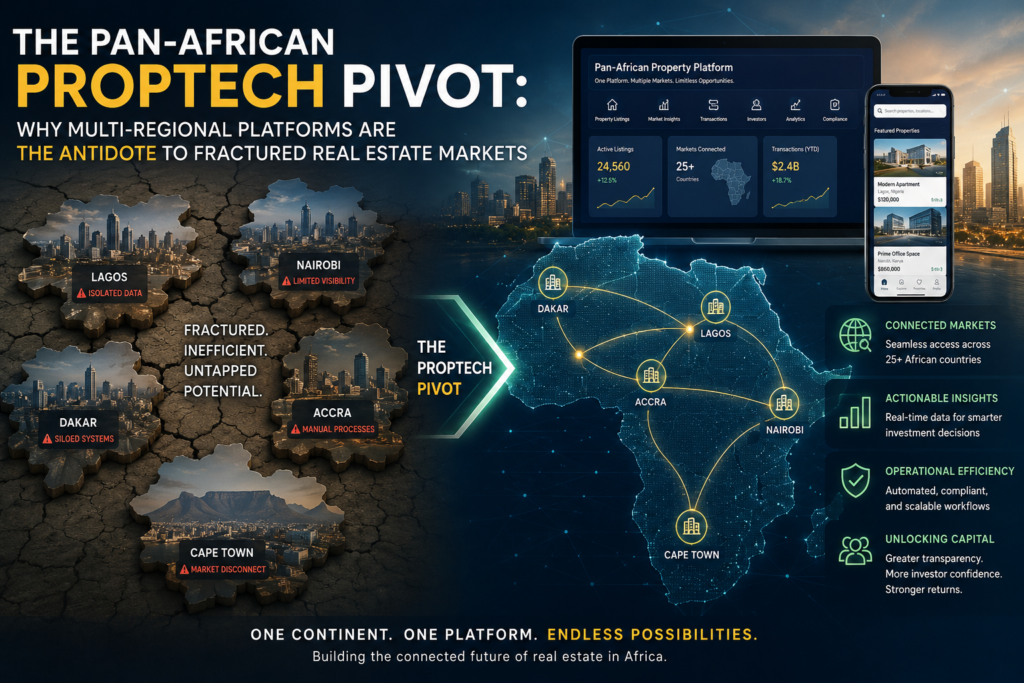
The Problem: The Fractured Architecture of African Real Estate
To understand why new platforms are emerging, we must first diagnose the deep structural rot within the legacy real estate listing model across major African markets.
For nearly two decades, the digital transformation of African real estate was limited to basic online classifieds. These platforms operated as passive digital notice boards rather than utility-grade marketplaces.
Today, this passive model has created three critical structural problems for developers, agents, and investors alike.
1. The Low-Intent Traffic Trap and the Illusion of Reach
The most significant metric that legacy listing portals boast about is monthly active users or web traffic. But for a real estate professional, raw traffic is a vanity metric.
The current ecosystem is flooded with low-intent browsing. Legacy platforms are optimized for search engine traffic, which attracts window shoppers, casual renters, and low-budget buyers who do not align with high-value developments.
Real estate agents pay steep monthly subscription fees to feature their listings on these portals, only to be inundated with unqualified inquiries, dead-end phone calls, and WhatsApp messages that lead nowhere.
The architecture of these platforms fails to separate casual interest from high-intent buyers. Because there is no native lead scoring, verification, or filtering system, the burden of data cleaning falls entirely on the agent or developer. You are not buying qualified leads; you are buying the right to sift through digital noise.
2. Hyper-Fragmentation and Missing Cross-Border Liquidity
Real estate is inherently localized, but capital is global. In the current African landscape, capital corridors are highly siloed. A developer in Lagos or Abuja building luxury high-rises operates almost exclusively within the Nigerian ecosystem, targeting local buyers or the immediate Nigerian diaspora in Western nations like the US and the UK.
However, wealth distribution on the continent is shifting rapidly. East Africa (led by Kenya) and the horn of Africa (driven by massive, highly liquid Somali diaspora networks) represent enormous pools of alternative investment capital.
Yet, because the underlying PropTech infrastructure is fragmented, there is no frictionless digital bridge connecting a West African developer with an East African institutional investor or a Somali diaspora buyer looking to diversify their portfolio into emerging mega-projects across the continent.
Traditional platforms do not talk to each other across borders. A property listed on a premier Kenyan portal is completely invisible to a high-net-worth individual (HNWI) browsing in Nigeria. This systemic lack of regional integration artificially limits market liquidity, forcing developers to over-rely on volatile domestic markets.
3. The Digital Junkyard – Inventory Degradation and Trust Erosion
Go to any major legacy real estate portal operating in Africa today, and you will encounter the digital junkyard effect. You will find listings for apartments that were sold three years ago.
You will see identical properties uploaded by twenty different agents, all featuring different prices, conflicting descriptions, and watermarked photos scraped from other sites.
This happens because legacy platforms rely on unverified, crowdsourced inventory models where volume trumps veracity. They incentivize agents to flood the platform with listings to maximize visibility. The result? Total erosion of consumer trust.
International investors, diaspora buyers, and local corporate professionals cannot verify the authenticity of a listing without physically sending someone to inspect the site. The absence of a centralized, secure digital registry or a strict platform-level verification process turns the property search experience into a minefield of potential fraud and administrative headaches.
The Bleeding Balance Sheets of Modern Real Estate Professionals
A problem left unaddressed becomes a crisis. For real estate developers and growth-oriented agencies, the structural flaws of the current listing market are not just minor inconveniences, they are actively draining profitability, blowing up customer acquisition costs (CAC), and threatening long-term survival.
Let’s observe these pain points to understand the true cost of relying on an outdated digital real estate strategy.
1. The Skyrocketing Cost of Customer Acquisition (CAC)
Because legacy portals are failing to deliver qualified leads, real estate professionals have been forced to run their own independent digital marketing campaigns. Millions of Nairas, Shillings, and Dollars are poured into Meta Ads (Facebook and Instagram) and Google Ads every single month.
But the independent advertising landscape has become a hyper-competitive bloodbath. Look at the Meta Ad Library at any given moment: hundreds of real estate brands are running almost identical ad creatives targeting the exact same lookalike audiences of high-net-worth individuals or people interested in luxury real estate.
This intense bidding war drives ad costs through the roof. Worse, because many of these campaigns lead to basic landing pages without advanced, automated nurturing funnels, developers end up paying premium prices for cold, top-of-funnel leads.
You are stuck in a vicious cycle: you burn capital on ads to bypass broken portals, but your internal team spends 90% of their time manually calling unqualified contacts who don’t remember filling out the form. Your balance sheet bleeds, while your conversion rate remains stagnant.
2. Macroeconomic Volatility and the Danger of Local Market Monogamy
Operating a real estate business with exposure to only one domestic currency or economic zone is a high-risk gamble in 2026. Look at the macroeconomic realities:
Nigeria has faced severe currency fluctuations and inflationary pressures, causing construction material costs to skyrocket and altering the purchasing power of the domestic middle class.
Kenya, while remaining a premier tech and financial hub, faces fiscal policy shifts and real estate supply-demand rebalancings in major urban centers like Nairobi.
Somalia represents a unique frontier: a hyper-entrepreneurial society with an incredibly affluent, tight-knit global diaspora that injects billions of dollars back home annually, yet remains isolated from broader continent-wide institutional investment vehicles.
If you are a developer in Nigeria relying solely on local buyers, a sudden macroeconomic shift can freeze your project’s cash flow overnight. If you cannot tap into foreign exchange liquidity or regional capital pools, you cannot hedge against domestic inflation. Staying siloed within a single national market is no longer just conservative; it is dangerous.
+-----------------------------------------------------------------------+
|                       THE VICIOUS REAL ESTATE CYCLE                  |
+-----------------------------------------------------------------------+
|                                                                       |
|   +---------------------------------------------------------------+   |
|   | 1. Rely on Broken Legacy Portals                              |   |
|   |    - Low-intent window shoppers & unverified listings         |   |
|   +-------------------------------+-------------------------------+   |
|                                   |                                   |
|                                   v                                   |
|   +---------------------------------------------------------------+   |
|   | 2. Pivot to Independent Paid Ads (Meta/Google)                |   |
|   |    - High ad spend, hyper-competition, rising CAC             |   |
|   +-------------------------------+-------------------------------+   |
|                                   |                                   |
|                                   v                                   |
|   +---------------------------------------------------------------+   |
|   | 3. Lack of Automated Nurturing Funnels                        |   |
|   |    - Sales teams overwhelmed by manual lead qualification      |   |
|   +-------------------------------+-------------------------------+   |
|                                   |                                   |
|                                   v                                   |
|   +---------------------------------------------------------------+   |
|   | 4. Bleeding Balance Sheets & Stagnant Sales                   |   |
|   |    - Market downturns & inflation wipe out profit margins     |   |
|   +---------------------------------------------------------------+   |
|                                                                       |
+-----------------------------------------------------------------------+
3. The Burnout and Inefficiency of Sales Teams
When your marketing infrastructure delivers quantity over quality, your operational efficiency plummets. Real estate sales professionals and relationship managers find themselves trapped in an exhausting loop of manual triage.
Instead of building deep relationships with verified, high-intent buyers, they spend their days chasing down leads who accidentally clicked an ad, individuals who cannot afford the down payment, or agents pretending to be direct buyers.
This structural inefficiency breeds internal frustration, lowers sales morale, and ensures that truly hot opportunities slip through the cracks because the team is too overwhelmed by noise to respond to premium leads within the critical 5-minute golden window.
The Solution: Unlocking the Pan-African PropTech Corridor
The outreach from Hoydoon highlights a clear trend: the future belongs to data-driven, cross-border real estate ecosystems that explicitly target high-value, highly liquid corridors.
The ultimate solution to the fragmentation, high CAC, and low trust in African real estate requires a dual-pronged approach: the adoption of multi-regional, high-utility marketplaces combined with advanced top-of-funnel automation and lead nurturing systems.
Let’s break down how this structural evolution solves the core pain points of the modern real estate professional.
1. The Strategic Value of the Nigeria-Kenya-Somalia Triad
Why does a platform targeting Nigeria, Kenya, and Somalia make immense strategic sense? It aligns perfectly with the flow of alternative capital across sub-Saharan Africa.
The Nigerian Engine: Nigeria possesses the largest economy and population on the continent, with an insatiable appetite for institutional real estate, commercial assets, and luxury residential properties. Nigerian developers are increasingly looking to attract institutional and diaspora capital from other regions to buffer against local currency fluctuations.
The Kenyan Hub: Nairobi is the undisputed financial and PropTech capital of East Africa. It serves as the regional headquarters for global funds, expatriates, and institutional tech investors. By bridging Nigeria and Kenya, a platform creates a powerful West-East economic corridor, allowing cross-border real estate syndication and investment diversification.
The Somali Diaspora Matrix: The Somali diaspora is one of the most financially potent and real estate-focused diaspora populations in the world. From Minneapolis and London to Dubai and Nairobi, Somali expatriates consistently funnel capital back into real estate development. They understand the mechanics of high-yield, frontier-market investments. By bringing Somalia into a unified ecosystem with Kenya and Nigeria, a platform unlocks an underutilized pool of highly liquid, hard-currency capital looking for institutional-grade property placement.
Early adoption of platforms that natively map out these corridors gives developers and agents a massive first-mover advantage. You are no longer shouting into the void of a single, overcrowded domestic market; you are positioning your inventory directly in front of cross-border capital pools.
2. Shifting from Passive Directories to Utility-Grade Search Engines
The next generation of PropTech platforms cannot just be databases of pretty pictures; they must function as high-utility search engines. For a platform to truly solve the digital junkyard problem, it must enforce:
Strict Algorithmic Verification: Deep checks that eliminate duplicate listings, old inventory, and unauthorized agents.
Multilingual and Cross-Currency Capabilities: Native support for local and international currencies (USD, NGN, KES, etc.) and localized communication preferences, ensuring that an investor in Dubai can analyze a property in Lagos or Nairobi seamlessly.
Data Transparency: Providing clear historical pricing data, regional yield projections, and development track records so that remote investors can buy with absolute confidence.
+-----------------------------------------------------------------------+
|                    THE NEW PROPTECH PARADIGM                          |
+-----------------------------------------------------------------------+
|                                                                       |
|   +---------------------------+       +---------------------------+   |
|   |     WEST AFRICAN CAPITAL  |       |     EAST AFRICAN HUB      |   |
|   |    (Lagos/Abuja Engine)   |       |     (Nairobi Tech/HQ)     |   |
|   +-------------+-------------+       +-------------+-------------+   |
|                 |                                   |                 |
|                 +-----------------+-----------------+                 |
|                                   |                                   |
|                                   v                                   |
|                   +-------------------------------+                   |
|                   |   MULTI-REGIONAL PLATFORM     |                   |
|                   |  - Enforced verification       |                   |
|                   |  - Cross-border liquidity     |                   |
|                   |  - Global diaspora targeting  |                   |
|                   +---------------+---------------+                   |
|                                   |                                   |
|                 +-----------------+-----------------+                 |
|                 |                                   |                 |
|                 v                                   v                 |
|   +---------------------------+       +---------------------------+   |
|   |  SOMALI DIASPORA MATRIX   |       |  GLOBAL HARD CURRENCY     |   |
|   |  (Global Remittance/Yield)|       |     (USD/EUR/AED Inflow)  |   |
|   +---------------------------+       +---------------------------+   |
|                                                                       |
+-----------------------------------------------------------------------+
3. The Growth Engine: Combining Platform Distribution with Internal Automation
Listing your properties on an exciting, growing platform like Hoydoon or building a presence on emerging multi-market networks is only half the battle. To truly dominate, developers and agents must re-engineer their internal marketing systems. Platform distribution must be paired with top-of-funnel lead generation, rigorous qualification, and automated nurturing.
Instead of relying on human sales reps to make cold calls to every single sign-up, forward-thinking real estate operations use AI-driven automation and software funnels to protect their brand and maximize conversion efficiency.
Step 1: High-Intent Lead Generation: You utilize advanced meta-targeting and contextual listing placement on emerging platforms to attract eyes to your development.
Step 2: Automated Lead Qualification (The Filter): The moment a lead enters your ecosystem from a platform or a private campaign, they are instantly routed through an automated qualification sequence. This can be via a conversational WhatsApp automation or an interactive quiz funnel. The system asks critical qualifying questions: What is your investment timeline? Are you looking for capital appreciation or rental yield? What is your verified budget range? Have you secured financing?
Step 3: Intelligent Lead Scoring: Based on the answers, the system scores the lead. Low-intent or unverified leads are placed into long-term automated email and SMS nurture sequences that educate them on the market without consuming human resources. High-intent, highly qualified leads; such as a diaspora investor with cash ready are instantly escalated to senior relationship managers.
Step 4: Nurturing at Scale: Real estate sales cycles are long, often spanning 3 to 12 months. Automated nurturing sequences continually drop high-value content: construction updates, market reports, tax advisory tips, and video walkthroughs. Keeping your development top-of-mind without requiring manual follow-ups from your sales team.
By removing the manual burden of top-of-funnel qualification and nurturing, your sales team can focus entirely on high-value interactions, structural deal architecture, and closing qualified prospects.
How Real Estate Professionals Should Capitalize on This Shift
If you want to transition your real estate business from a localized, low-converting operation to a high-yielding, multi-market growth engine, you need an actionable blueprint. Here is how you can apply these strategic principles right now.
Step 1: Audit and Diversify Your Digital Distribution Matrix
Stop putting all your digital inventory eggs in one basket. If you are solely relying on the dominant, legacy listing portal in your specific city, you are exposed to structural traffic decay.
Action: Identify and onboard onto emerging, highly targeted multi-regional PropTech platforms (such as Hoydoon or similar utility-grade real estate networks). Being an early adopter on a growing platform gives you disproportionate organic visibility before the space becomes saturated and ad costs rise.
Action: Clean your inventory data. Ensure that every listing you upload across the web features high-definition media, verified ownership status, clear spatial coordinates, and transparent pricing. In a digital-first world, inventory clarity equals trust.
Step 2: Deploy an Automated Qualification Protocol
Stop forcing your sales reps to act as data filters. Protect their energy and focus by installing an automated gatekeeper between your marketing channels and your sales desk.
Action: Build a multi-channel qualification funnel using tools like ManyChat for WhatsApp/Instagram or specialized real estate CRMs (like HubSpot or Salesforce customized for property development).
Action: Define your core qualification parameters. If a lead does not specify their budget range or investment objective, they do not get a phone call. They get an automated nurture track until they provide those key intent signals.
Step 3: Create Localization Content for Cross-Border Buyers
If you want to attract capital from the Kenya-Somalia-Nigeria corridor or the global diaspora, you must speak their language. An investor in Nairobi or a Somali expat in London looks at real estate through a completely different lens than a local buyer in Lagos.
Action: Develop specialized marketing collateral that addresses cross-border concerns: How do land titles work for foreign investors in this jurisdiction? What are the tax implications of repatriation of funds? What is the historic rental yield of this specific neighborhood compared to regional benchmarks?
Action: Optimize your digital footprint. Ensure your website, blog pages, and landing pages are optimized for cross-border searches, loading fast across varying mobile networks in both East and West Africa.
The Era of the Connected Market
The inbound message from Hoydoon is a clear signal of where the market is moving. The old borders are dissolving, driven by tech-enabled platforms that recognize the immense latent value in connecting disparate regional capital corridors across Africa.
The problems of legacy platforms: low-intent traffic, fragmented regional markets, and eroded trust are being aggressively challenged by a new wave of PropTech innovators building multi-market search engines and utility platforms.
But infrastructure is only as good as the strategy that powers it. To win in this new era, developers and real estate specialists cannot simply list properties and wait for the phone to ring.
You must meet these emerging platforms halfway by equipping your business with a ruthless, automated lead qualification engine and an expansive, cross-border marketing mindset.
The real estate professionals who embrace these multi-regional corridors early, protect their operational efficiency through top-of-funnel automation, and treat digital distribution as a data science rather than a billboard placement, will dominate the next economic cycle. The landscape is shifting. It’s time to build your bridge across the corridor.
Are you currently auditing your real estate lead generation strategy or looking to optimize your digital property distribution funnels for cross-border capital?
Let’s map out a high-intent marketing ecosystem that positions your inventory exactly where the liquidity is. Keep reading www.realestatemoses.com for deeper breakdowns on PropTech innovation, growth marketing mechanics, and automated operations. Oh Yeah!

Moses Oyong is a Real Estate Growth Marketing Manager and PropTech specialist with over a decade of closing residential and commercial deals worth over 200 million across Nigeria and international markets. Known for engineering AI-driven workflows that delivered a 69% uplift in sales targets and cut lead response times by 85%, Moses bridges the gap between high-performance marketing, land law, and technology to help investors, developers, and first-time buyers make confident, informed property decisions in an increasingly digital world.