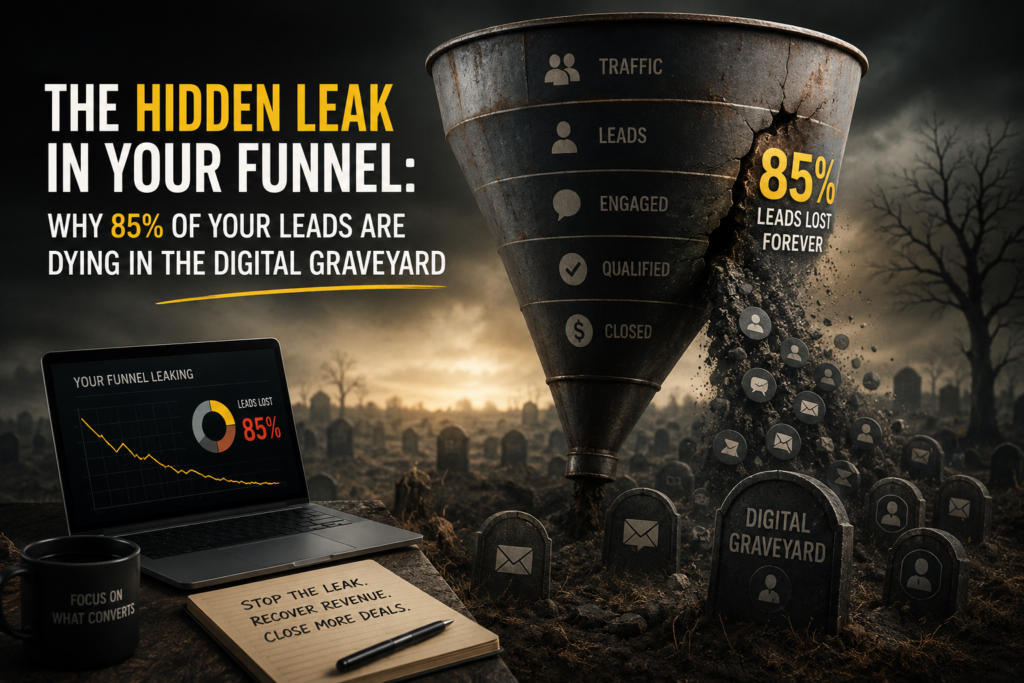
You are not losing leads because your marketing is bad. You are losing them because they are already dead by the time anyone gets around to calling.
Every month, your brokerage spends money to generate leads. Portal subscriptions. Paid ads. Landing pages. SEO content that took hours to write. And every month, most of those leads vanish into a CRM that nobody logs into, a “New Lead” folder that never gets touched, or an agent’s phone that never rings back.
This is not a lead generation problem. It is a lead management problem, and it is bleeding revenue out of your brokerage in a way most owners never see, because it does not show up as a line item. It shows up as a slow leak, a little bit of dead weight every single week, until one day you look at your numbers and cannot explain why conversion is so low when volume looks fine.
That gap is what I call the digital graveyard. And if you run a boutique brokerage with 5 to 100 agents, chances are a large chunk of your paid leads are already buried in it.
What the Digital Graveyard Actually Looks Like
The digital graveyard is not a dramatic collapse. It is quiet. It is a lead that comes in at 9:47pm, sits untouched overnight, and gets a half-hearted call the next afternoon that goes to voicemail. It is a lead status that says “New” for three weeks because nobody owns the follow-up. It is a spreadsheet tab labeled “old leads” that everyone knows exists and nobody opens.
Here is what lead decay looks like day by day inside a typical boutique brokerage:
Day 0: Lead comes in from a portal or ad. It lands in the CRM, or worse, in an email inbox that ten people have access to and nobody owns.
Day 1: An agent glances at it. If it looks “hot,” meaning the buyer mentions a budget or a timeline, someone calls. If it looks lukewarm, it gets skipped in favor of leads that seem easier to close today.
Day 3 to 7: No second or third touch. Most CRMs are technically capable of automated follow-up sequences, but most boutique shops never configured them, or configured them once and abandoned the workflow when an agent left.
Day 14: The lead is functionally dead. Not because the person does not want to buy or sell, but because nobody gave them a reason to stay engaged with your brokerage instead of the next agent who called them back.
Day 30+: The lead sits in the CRM as a cold record. It will never be called again unless someone runs a manual report, which almost nobody does, because running that report requires admitting how many leads got dropped.
Multiply that pattern across every lead source you pay for, and you start to see the size of the problem. The leads are not disappearing. They are decaying in plain sight, inside software you already pay for.
Where the 85% Number Comes From
Let me be straight with you about a stat like “85% of leads die in the funnel.” Numbers like this get thrown around a lot in marketing content, often without much rigor behind them, so it is worth explaining where a figure in that range actually comes from rather than asking you to take it on faith.
A few things are well documented in real estate and general B2C lead response research:
- Response time collapses conversion fast. Studies on lead response time consistently show that the odds of qualifying or converting a lead drop sharply after the first five to ten minutes, and continue dropping through the first hour. Real estate leads, which are often comparison shopping across multiple agents or portals at once, decay even faster than average.
- Most leads never get more than one or two follow-up attempts. Research on sales follow-up behavior across industries has repeatedly found that a large share of leads receive one contact attempt, or none at all, despite the well established finding that it typically takes multiple touches to convert a cold or lukewarm lead into a conversation.
- Agent bandwidth is the real bottleneck, not lead quality. In a boutique brokerage, agents are commission driven and time constrained. They will always prioritize the leads that feel closest to a transaction today. Everyone else in the pipeline gets deprioritized, not because they are bad leads, but because there is no system forcing anyone to work them.
When you stack these three realities together, response time decay, thin follow-up, and agent triage toward the easiest leads, you get a compounding drop off. A number in the 80 to 90 percent range for total leads that never receive adequate follow-up is not an exaggeration. For most boutique shops without a formal lead management system, it is a conservative estimate.
The exact number will vary by brokerage. What will not vary is the direction: without a system, most of your leads are dying from neglect, not disinterest.
The Four Leak Points Killing Your Pipeline
Every boutique brokerage I have looked at has some version of the same four leaks. You probably have at least two of them right now.
1. Disconnected lead sources Your Zillow leads, your Facebook ad leads, your website form leads, and your referral leads often land in different places. Some go to a CRM. Some go straight to an agent’s personal inbox. Some go to a shared spreadsheet nobody updates. If your lead sources are not funneling into one system automatically, you have already lost visibility on day one, and what you cannot see, you cannot manage.
2. No lead scoring Not all leads deserve the same follow-up intensity, but most brokerages treat every lead identically, which in practice means the loudest or most “obviously ready” leads get attention and everyone else gets ignored. Without a scoring system that flags intent, timeline, and budget signals, agents are guessing, and guessing means most leads fall through.
3. Follow-up left to memory This is the biggest one. If your follow-up cadence depends on an individual agent remembering to call someone back on day 3, day 7, and day 14, you do not have a system. You have a hope. Agents get busy, leads get forgotten, and there is no automated safety net catching what falls through.
4. No revival process for cold leads Even brokerages that do a decent job on initial follow-up almost never go back and re-engage leads that went cold 60 or 90 days ago. Buyer and seller timelines shift. Someone who was not ready three months ago might be ready now, but if there is no re-engagement campaign, that lead just sits there, permanently buried, even though the intent that brought them to you in the first place has not necessarily gone away.
Any one of these leaks is costly. Most brokerages have all four running at once, and they compound. A lead that survives the disconnected-source problem still has to survive no scoring. A lead that gets scored correctly still has to survive an agent who forgets to call on day 3. A lead that gets called on day 3 still needs someone to remember it exists 90 days later if the timeline was not yet right. Each leak point is a filter, and by the time a single lead has passed through all four, the odds of it ever converting have dropped dramatically, even if the lead itself was genuinely qualified from the start.
This is why patching one leak rarely moves the needle much on its own. Brokerages that add lead scoring but still leave follow-up to memory see modest gains at best. Brokerages that automate follow-up but never revisit cold leads still leave money on the table every quarter. The leak points need to be closed as a system, not picked off one at a time over a few years whenever there is budget or attention to spare.
What This Is Actually Costing You
Let’s put real numbers on it, using conservative, realistic assumptions for a boutique brokerage.
Say your brokerage generates 200 leads a month across all sources. Industry-wide, a well managed real estate lead funnel with strong follow-up can convert somewhere in the 3 to 5% range to closed transactions over time. A poorly managed funnel, one with the leaks described above, often converts well under 1%.
Here is the math on that gap:
- 200 leads a month, converting at 1% instead of 4%, is the difference between 2 closed deals and 8 closed deals. That is a net loss of 6 transactions every single month.
- If your average commission per deal is 8,000 USD, that gap is 48,000 USD a month in lost revenue. The 6-deal gap represents $48,000 a month in lost revenue.
- Annualized, that is over 575,000 USD a year, sitting in your CRM as dead records, not because the leads were bad, but because the system around them was broken.
Your numbers will differ. Your average commission, lead volume, and current conversion rate all shift the math. But run your own version of this calculation honestly, and you will likely find a number large enough to justify fixing this before you spend another dollar on lead generation.
This is the part that should sting a little: you already paid to acquire these leads. The graveyard is not a marketing problem. It is a revenue recovery problem, and recovery is almost always cheaper than acquisition.
Closing the Leak: What Actually Fixes This
Closing the leak is not about buying another piece of software. Most boutique brokerages already have more tools than they use well. It is about building a system around the tools you have, so leads move through a predictable process instead of depending on individual agent memory and motivation.
Here is what that looks like operationally:
Centralize every lead source into one system. Every portal, ad platform, and website form should route into a single CRM automatically. No exceptions, no manual entry, no leads sitting in someone’s personal inbox.
Build a lead scoring layer. Even a simple scoring model, based on response speed, stated timeline, and engagement with your content or listings, gives agents a clear priority order instead of gut-feel triage.
Automate the first five touches. The first 14 days after a lead comes in should not depend on any single agent remembering to follow up. Automated email and text sequences, combined with task reminders for agents, close the gap between “lead received” and “lead actually contacted.”
Run a quarterly revival campaign. Every 90 days, pull every lead marked cold or dead and run a re-engagement sequence. Timelines change. A percentage of these leads will come back to life every single time you do this, and most brokerages never bother trying.
Audit the whole funnel every quarter. Systems decay the same way leads do. An automation that worked six months ago might be broken now because an agent left, a form field changed, or an integration silently failed. Someone needs to own checking this on a schedule, not waiting for a dry spell in closings to notice.
None of this requires expensive new technology. It requires discipline, ownership, and a system design that does not rely on any one person’s memory or bandwidth. That is the actual fix. Not more leads. Better custody of the ones you already have.
Your Funnel Has a Leak. The Question Is How Big.
If you read through the four leak points above and recognized your brokerage in more than one of them, you are not alone, and you are not doing anything unusually wrong. This is the default state of most boutique shops, because nobody built these businesses to run lead management like a revenue operations function. They built them to sell houses.
But the brokerages quietly outperforming their market size are almost always the ones who treated their pipeline like an asset to be managed, not a mailbox to be checked when there is time.
If you want to know how much revenue is actually trapped in your own CRM right now, that is exactly the kind of audit I run for boutique brokerages. If this article made you uncomfortable enough to want a real number instead of a guess, that discomfort is worth listening to.
Find out how much your dead database is costing you, use our FREE CRM Decay Calculator. Click here.

Moses Oyong is a Real Estate Growth Marketing Manager and PropTech specialist with over a decade of closing residential and commercial deals worth over 200 million across Nigeria and international markets. Known for engineering AI-driven workflows that delivered a 69% uplift in sales targets and cut lead response times by 85%, Moses bridges the gap between high-performance marketing, land law, and technology to help investors, developers, and first-time buyers make confident, informed property decisions in an increasingly digital world.