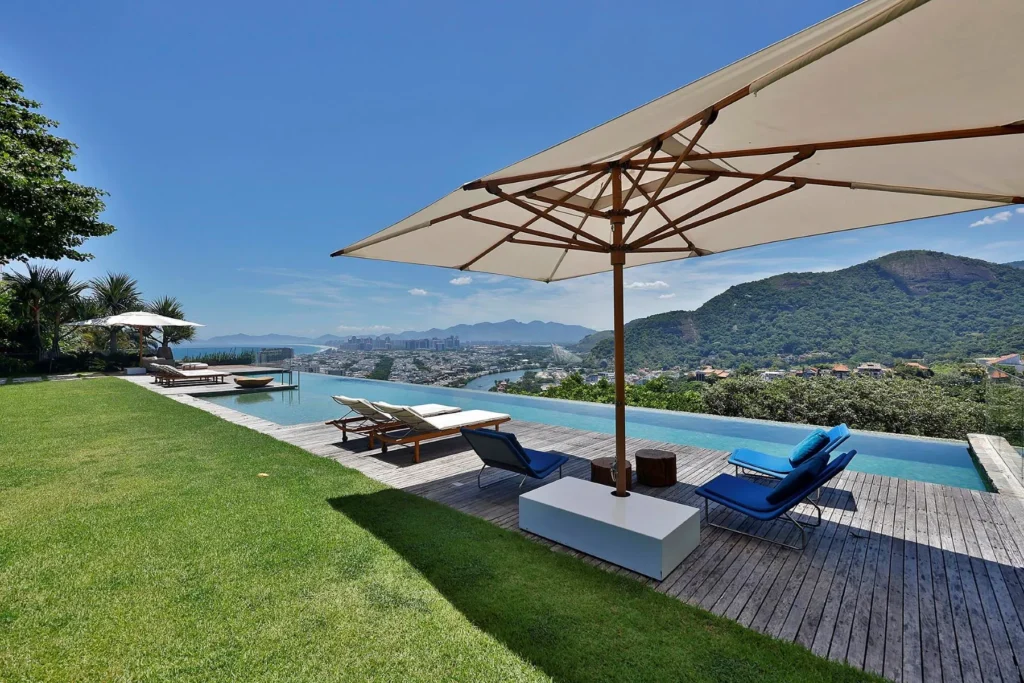
The international ultra-luxury real estate market loves to sell the ultimate fantasy of absolute isolation, a private island. When a property listing claims to offer a private island experience attached to Leblon, universally recognized as the most expensive, prestigious, and fashionable neighborhood in Rio de Janeiro, global investors lose all financial objectivity. Brokers across Latin American wealth hubs fill their brochures with poetic descriptions of coastal drama, calling Princess Island House an unassailable paradise where you can escape the world while remaining steps away from Rio’s elite cultural core.
The property currently commanding this hyper-exclusive marketing focus is a massive estate priced at a staggering $14,000,000, approximately 70 million Brazilian Reais. Marketed as a five-bedroom private island compound, this development features an array of resort-grade amenities, including a private beach, a heated swimming pool, a structural sauna room, an outdoor Brazilian barbecue pavilion, an open balcony overlooking the open ocean, a private jogging track wrapping around the island’s perimeter, a professional cinema room, a marine boat dock, and a dedicated structural helipad.
On an international luxury portal, this property looks like the ultimate real estate achievement.
But if you pull back the heavy layers of marketing prestige, step off the boat dock, and analyze this development through the cold, calculated metrics of maritime engineering, macroeconomics, coastal logistics, and local security footprints, a completely different reality emerges. At fourteen million dollars, this property represents one of the most structurally complex and financially inefficient asset allocations in the modern South American market.
Unless you understand the heavy operational liabilities that come with managing private island infrastructure on the coastline of Rio de Janeiro, you risk transforming an ultra-luxury dream into an absolute financial anchor. Here are 7 comprehensive, structurally grounded reasons why you should not buy the Princess Island House.
1. The Geographic Incongruity and Logistical Isolation of an Island Dock Layout
The headline marketing pitch for Princess Island House is its impossible location, a private island nestled within the exclusive Leblon neighborhood. To any seasoned traveler or real estate professional familiar with the actual topography of Rio de Janeiro, this positioning raises immediate geographical questions. Leblon is a dense, high-end urban beach neighborhood defined by a linear coastline, high-end apartment blocks, and inland lagoons. It does not possess natural, independent private islands sitting immediately off its sandy shores.
+-----------------------------------+-----------------------------------+
| Traditional Mainland Luxury Asset | Reclaimed or Isolated Island Asset|
+-----------------------------------+-----------------------------------+
| Direct connection to local power  | Complete dependence on maritime   |
| grids, municipal water, and paved | transport, private boats, or      |
| emergency road networks.          | helicopter transfers for basic use|
+-----------------------------------+-----------------------------------+
If this property sits on an isolated rock or small outcropping requiring a marine boat dock and a helipad for access, you are entering a world of extreme logistical friction,
The Weather Transit Lockout: The Atlantic Ocean currents off the coast of Rio de Janeiro can be notoriously volatile. During sea swells, heavy coastal storms, or sudden shifts in wind patterns, navigating a boat toward a private marine dock becomes highly dangerous or physically impossible. Your transition between your island sanctuary and the mainland can be instantly cut off for days at a time, trapping your family or your guests offshore.
The Mainland Commute Strain: While the brochure promises easy reach of the city’s vibrant culture, the physical necessity of embarking on a boat, securing it at a mainland marina, and then transferring to a luxury vehicle transforms a simple trip to a Leblon restaurant or a business meeting into a complex, multi-stage travel operation.
Emergency Service Paralysis: In the event of a sudden medical emergency, a structural fire, or a critical utility failure on the island, standard municipal emergency services cannot simply drive to your front door. The time required to coordinate helicopter medical evacuation or dispatch private maritime support completely compromises your family’s baseline logistical safety.
2. The Colossal Operational Nightmare of Marine Infrastructure Maintenance
Managing a luxury property on the mainland requires standard maintenance. Managing a five-bedroom compound on an isolated private island surrounded by the open Atlantic Ocean is a non-stop, industrial-scale battle against the elements.
[ Constant Saline Air Exposure ] ──► [ Accelerated Corrosion of Electrical & Plumbing ] ──► [ Boat Dock Erosion ]
                                                                                                      │
[ Structural Foundation Undermining ] ◄── [ Constant Sea Wall Maintenance ] ◄── [ High Energy Utility Bills ]
Consider the specific features listed, a marine boat dock, a private beach, a heated pool, and a perimeter jogging track. The coastal climate of Rio de Janeiro subjects these assets to an intense chemical assault,
The Boat Dock and Sea Wall Abyss: A private boat dock is under continuous mechanical stress from tidal shifts, wave action, and barnacle growth. To prevent wood rot or structural concrete carbonation, the dock requires constant underwater inspections, specialized protective anti-fouling coatings, and structural reinforcing. Furthermore, the island’s sea walls must be continuously maintained to prevent the open ocean from slowly eroding the foundations of your perimeter jogging track and private beach.
The Heated Pool and Sauna Contamination Paradox: An outdoor heated pool sitting directly adjacent to a private beach acts as a giant catchment basin for fine marine sand, salt spray, and organic debris blowing off the open ocean. Your pool filtration systems will require daily manual backwashing, and the heating elements will suffer accelerated scale buildup and corrosion from airborne salinity, requiring frequent professional replacements.
Corrosive Air Penetration: The high humidity and salt content of the open sea air will continuously penetrate into the mansion’s central HVAC chillers, the mechanical ventilation loops for the cinema room, and the automated wiring networks, keeping your property management team on a perpetual cycle of high-cost emergency repairs.
3. The Private Helipad Regulatory Nightmare in Brazil
The presence of a private helipad is highlighted by luxury agents as the ultimate symbol of VIP status and frictionless executive mobility, allowing the owner to bypass Rio’s notorious traffic by flying directly from their island estate to international transport hubs.
In reality, operating an active helicopter landing zone within the urban coastal airspace of Rio de Janeiro is an administrative and regulatory minefield,
The National Civil Aviation Agency of Brazil (ANAC) and the Department of Airspace Control (DECEA) enforce incredibly strict environmental, noise, and flight path restrictions over dense residential zones like Leblon.
[ Intended Executive Flight ] ──► [ Meticulous Flight Plan Submission ] ──► [ Space & Noise Clearances ]
                                                                                   │
[ Helicopter Sits Grounded ] ◄── [ Environmental Action Vetoes ] ◄── [ Local Regulatory Sign-offs ]
You cannot simply land an aircraft at your personal convenience. Every single flight path requires pre-cleared flight plans, slot allocations, and meticulous safety manifests. Because Leblon is a highly organized, dense neighborhood filled with residents who prioritize their quiet privacy, any frequent acoustic disturbance from a heavy turbine helicopter landing on a private island outcropping will trigger immediate legal challenges, municipal noise code investigations, and environmental group actions. You are paying a significant engineering premium to construct and reinforce a helipad structure that will likely face severe operational restrictions, reducing it to nothing more than an expensive concrete pad.
4. The Extreme Financial Vulnerability to Volatile Emerging Market Currencies
Investing fourteen million US dollars into a highly complex, illiquid physical asset inside an emerging market economy exposes your global capital to severe, unpredictable foreign exchange risk. The underlying valuation of Rio de Janeiro ultra luxury real estate is fundamentally denominated in the local currency, the Brazilian Real (BRL).
Consider the historical volatility that emerging market currencies experience against the global benchmark of the US Dollar,
[ Your $14M Capital Frozen in BRL Asset ]
                  │
   (Global Economic Shifts / Local Political Cycles)
                  │
[ Sharp Devaluation of the Brazilian Real ]
                  │
[ Capital Buying Power Shrinks on the Global Stage Upon Exit ]
If the Brazilian Real undergoes a significant devaluation cycle against the US Dollar during your investment holding window, the physical property must achieve massive, unprecedented nominal price appreciation in local markets just for your capital to break even in global USD terms. Even if the local real estate market shows steady growth in Reais, when you eventually liquidate the asset and convert the proceeds back into your primary global currency, you can easily discover that currency depreciation has erased millions of dollars of your initial purchasing power, transforming an elite trophy investment into a severe wealth-destruction vehicle.
5. The Permanent Domestic Workforce Management Burden
You cannot run a private island compound that contains a five-bedroom residence, an automated cinema room, a structural sauna, a heated pool, landscaped grounds, a jogging track, and a marine dock with an occasional cleaning schedule.
By acquiring Princess Island House, you are effectively appointing yourself as the managing director of a highly active, specialized domestic operations team,
The On-Site Staff Footprint: To keep this island estate from physically deteriorating, you will need a permanent, multi-person resident staff workforce. This includes an estate captain or property manager to handle marine logistics, specialized housekeepers trained to combat mold and humidity, an electrical automation engineer, a pool and maritime dock technician, and round-the-clock private security personnel.
The Loss of Personal Isolation: True luxury is ultimately defined by personal freedom, quiet solitude, and absolute boundary control. However, because this private island requires non-stop maintenance and logistical oversight, your private sanctuary will permanently host staff members and external technical contractors moving through the living spaces and docks, altering the intimate privacy of your personal life.
Brazilian Labor Code Complexity: Employing a dedicated domestic team under the highly protective and rigid legal structures of Brazilian labor law (CLT) introduces significant regulatory risks. Minor management missteps, overtime scheduling disputes, or termination errors can rapidly escalate into lengthy, expensive labor lawsuits, turning your private residential retreat into a source of ongoing administrative stress.
6. The Spatial Efficiency Deficit of an Isolated Resort Layout
When analyzing high-end listings like Leblon Rio de Janeiro houses for sale, buyers often equate a high volume of specialized rooms and amenities with an enhanced lifestyle experience. Princess Island House features a layout designed for large-scale resort entertainment, separating its cinema room, sauna, barbecue pavilion, and expansive living lounges across a large footprint.
Let us map out the real-world operational efficiency of an over-scaled, isolated residential layout over a standard calendar year,
                      [ Total Residential Square Footage ]
                                       │
         ┌─────────────────────────────┴─────────────────────────────┐
         ▼                                                           ▼
[ High-Frequency Active Zones ]                             [ Low-Frequency Dead Space ]
Master Suite, Main Living Zone,                             4 Secondary Guest Suites, Cinema,
Kitchen, Boat Dock.                                         Sauna, Barbecue Pavilion, Track.
(Occupies ~35% of Total Space)                              (Occupies ~65% of Total Space)
In day-to-day operations, even the most active owners utilize less than thirty-five percent of the available physical space. The secondary guest suites, the dark cinema room, the high-heat sauna chamber, and the perimeter jogging track sit completely empty for ninety percent of the year.
Yet, because the property sits on an isolated island outcropping exposed to intense coastal humidity, you must continuously cool, dehumidify, light, and structurally monitor the entire 100% of the property around the clock to prevent salt and moisture from destroying the finishes. You are essentially funding the permanent operational overhead of a boutique eco-resort while only deriving personal utility from a tiny sliver of the space.
7. The Apex Illiquidity Trap: The Multi-Year Exit Horizon
The broader property market in Rio de Janeiro possesses areas of steady transaction speed and high capital liquidity, particularly for premium frontline apartments along the main avenues of Ipanema and mainland Leblon. However, the exact millisecond an asset transitions into a highly customized, structurally complex $14,000,000 private island compound, it exits the fluid real estate market entirely and enters an incredibly sticky, frozen asset layer.
▲ [ $14M Apex Stratum: Princess Island House ] ──► Buyer Pool: Handful of Global Sovereigns/Billionaires (Years to Exit)
■ [ Mid-Tier: Mainland Leblon Penthouses ] ──► Buyer Pool: Affluent Domestic Corporate Elite (Steady Velocity)
● [ Base Market: Mass Residential Condos ] ──► Buyer Pool: General Domestic Retail Market (High Capital Liquidity)
If your primary business operations, international ventures, or global equity portfolios encounter an unexpected requirement for rapid liquidity, you cannot easily or quickly flip a custom private island compound on the Rio coast. The absolute pool of international or domestic buyers possessing the liquid net worth to write an un-leveraged check for fourteen million dollars for an isolated island outcropping requiring boat access is exceptionally small.
A property of this magnitude frequently requires twelve, twenty-four, or thirty-six months of active, highly private marketing across specialized family offices before a transaction can be closed. If you must exit the asset quickly due to shifting market conditions, you will be forced to accept a staggering capital markdown just to attract a predatory opportunistic buyer capable of closing a complex maritime transaction.
Comprehensive Feature Matrix: Marketing Presentation vs. Capital Reality
To ensure your luxury real estate acquisitions are guided by cold financial logic rather than romantic lifestyle storytelling, carefully evaluate this direct contrast between what the broker’s marketing brochure promises and the real-world operational reality of Princess Island House,
| The Hyper-Luxury Feature | The Broker’s Glamorous Presentation | The Real-World Operational & Financial Reality |
| $14,000,000 Purchase Price | An elite trophy indicating the absolute pinnacle of Rio wealth, prestige, and success. | Extreme capital lockup with heavy asset illiquidity and high annual fixed overhead costs. |
| Exclusive Leblon Island Location | Unparalleled privacy, security, and prestige on an exclusive offshore paradise. | High exposure to aggressive saltwater corrosion and severe maritime transit bottlenecks. |
| Private Marine Boat Dock | Seamless coastal transit to allow effortless arriving and departing by water. | Under continuous structural stress from wave action, requiring non-stop underwater maintenance. |
| Private Rooftop Helipad | Effortless VIP transit to bypass city traffic and fly directly to international airports. | Stringent urban civil aviation controls and local neighborhood noise laws make active use restricted. |
| Heated Pool & Sauna Room | A private, five-star resort wellness sanctuary tailored exclusively for your relaxation. | High structural engineering liability regarding permanent moisture control and sand contamination. |
| Perimeter Jogging Track | A dedicated fitness asset promoting health and wellness amidst natural ocean views. | Exposed to continuous coastal erosion, requiring active sea wall reinforcement to protect. |
Is Princess Island House Right for Anyone?
Despite this extensive structural, logistical, and financial critique, this property remains a highly unique monument to custom coastal architecture. The critical step to avoiding severe investor remorse is recognizing whether your personal balance sheet and global wealth infrastructure are vast enough to absorb the severe inefficiencies of this property class.
You should absolutely NOT buy this property if,
You expect your real estate portfolio to remain liquid, agile, and capable of rapid capital extraction within a short calendar window.
You analyze your real estate decisions through the structural math of opportunity cost, capital efficiency, and currency stability.
You value complete family privacy and personal freedom without a permanent, multi-person staff presence operating within your daily environment.
You want a low-maintenance, lock-and-leave international holiday home that can sit completely unattended for months at a time without an active maintenance team.
This estate represents a justifiable acquisition only if,
Your global net worth exceeds several hundred million dollars, meaning a fourteen million dollar capital lockdown represents a minor fraction of your overall wealth footprint.
You are an absolute collector of rare maritime real estate art and view living inside an uncompromised custom offshore piece as a personal legacy milestone.
You maintain an international diplomatic or corporate lifestyle that requires an isolated, highly secure fortress estate to routinely host foreign world leaders and high-profile delegations.
The personal ego validation of owning a private island attached to the most expensive neighborhood in South America completely outweighs any practical or economic considerations.
The Verdict: Before You Issue an Inquiry to REM
If you are currently browsing high-end search results for Leblon Rio de Janeiro houses for sale or analyzing this spectacular entry at Princess Island House, the final conclusion requires looking past the glamorous brand names.
This five-bedroom private island compound is an architectural triumph, but as a financial investment vehicle, it carries heavy operational liabilities. It demands an immense lifestyle and operational sacrifice from its custodian. It forces you to operate a high-maintenance domestic team, navigate complex civil aviation boundaries, manage aggressive maritime weathering elements, and accept a massive capital lockup within an emerging market economy.
Before you take any steps toward requesting private viewings, formal contract reviews, or structured financial terms, protect your global wealth. Work alongside an independent luxury asset advisory office to run a comprehensive multi-year operational cost projection. Physically audit the structural insulation performance of the coastal foundations, and deeply calculate the true opportunity cost of moving fourteen million dollars out of the global financial markets.
For more information on the exact architectural layout files, to review construction compliance documentation, or to arrange an independent private tour of the Leblon sector, contact REM. Ensure you approach the negotiation table with a completely clear, realistic perspective on the long-term realities of ultra-luxury asset ownership.

Moses Oyong is a Real Estate Growth Marketing Manager and PropTech specialist with over a decade of closing residential and commercial deals worth over 200 million across Nigeria and international markets. Known for engineering AI-driven workflows that delivered a 69% uplift in sales targets and cut lead response times by 85%, Moses bridges the gap between high-performance marketing, land law, and technology to help investors, developers, and first-time buyers make confident, informed property decisions in an increasingly digital world.