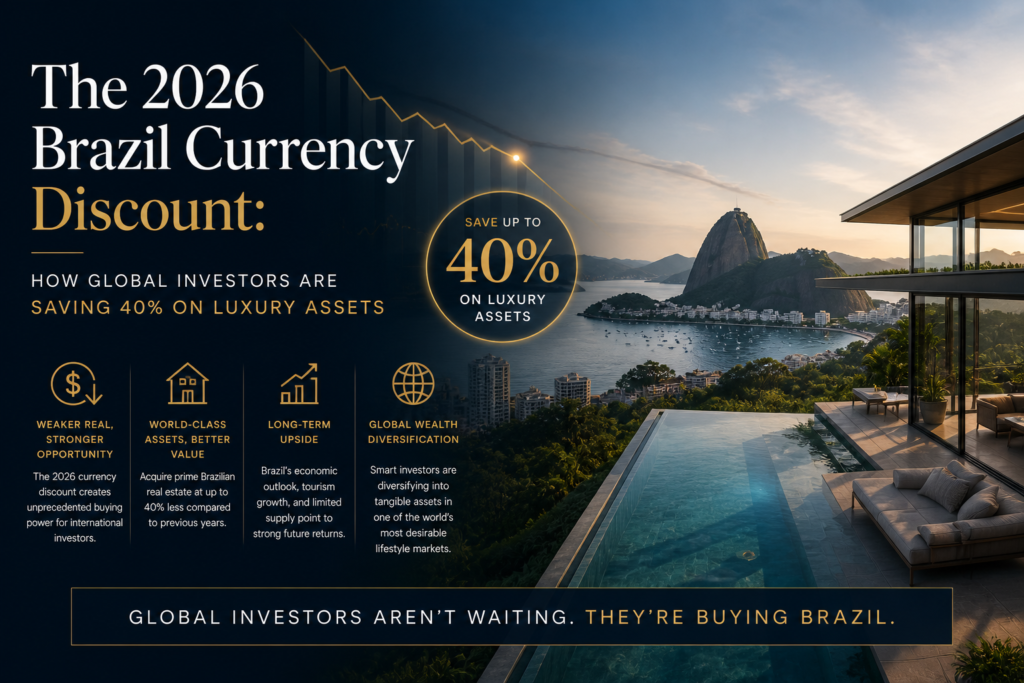
The 2026 Brazil Currency Discount: How Global Investors Are Saving 40% on Luxury Assets
The Brazilian real’s prolonged weakness has handed foreign buyers holding dollars or euros an effective 30 to 50 percent discount on luxury property, coastal villas, and investment-grade assets. It may be the most consequential arbitrage window the global property market has seen in a decade — and most investors are still not paying attention.
Beachfront towers in Balneário Camboriú, the so-called “Brazilian Dubai,” have attracted surging foreign capital as the weakened real amplifies purchasing power for dollar- and euro-denominated buyers. Credit: Rocks Investments / Santa Catarina, Brazil.
In the fall of 2024, a British entrepreneur named Marcus Holloway flew into Florianópolis with a modest budget by London standards — roughly four hundred thousand pounds — and an open mind. He had recently sold a flat in Hackney and was looking, as he put it, for “somewhere the money still means something.” What he found stunned him. For the equivalent of his London sale price, he could choose between a penthouse with ocean views in the island city’s booming Jurerê Internacional neighborhood, a designer villa near the surf-famous Praia Mole, or a beachfront pousada — a boutique guesthouse — generating steady rental income in the Northeast. He bought two properties. “I felt like I had walked into the wrong decade,” he said. “Everything was impossibly cheap.”
Holloway’s experience is not an outlier. It is the defining story of global property investment in 2026. The Brazilian real, South America’s most widely traded emerging-market currency, has endured a years-long devaluation cycle that has, by most calculations, left it trading between 30 and 50 percent below where purchasing-power-parity models suggest it should be. For foreign investors holding dollars, euros, or British pounds, that gap is not merely interesting — it is structural, compounding, and, for those who move now, potentially transformative.
The exchange rate mechanics are not complicated. As of late April 2026, one U.S. dollar buys approximately 4.98 Brazilian reais — near a two-year high for the real, and still far above the historic long-run average. At the depths of the devaluation cycle in December 2024, the real touched 6.08 per dollar, its weakest recorded level. Even with the modest recovery of early 2026, a dollar still buys roughly 40 percent more in Brazilian luxury real estate than it did in 2014, when the country last hosted the World Cup and the currency traded closer to 2.3 per dollar. In euro terms, the rate stood at approximately 6.25 reais per euro as of April 2025, meaning a European buyer writing a check in euros is operating with extraordinary leverage over local prices.
The result is a property market that, when priced in hard currency, resembles nothing so much as a fire sale in one of the world’s most spectacular natural environments. The national average property price in Brazil sits at roughly R$9,366 per square meter — which, at current exchange rates, translates to approximately $1,700 USD per square meter. Compare that to Lisbon at $4,500, the French Riviera at $12,000, or Singapore at $20,000, and the gap becomes almost surreal. Prime beachfront in Florianópolis, one of Brazil’s most desirable cities, can be acquired for what a studio in central Lisbon would cost.
Exchange Rate Context: What $1 USD Buys in Property (Per Square Meter, 2026)
- Brazil — Prime Coastal (avg.)~$1,700 USD/m²
- Portugal — Lisbon~$4,500 USD/m²
- Spain — Barcelona~$5,200 USD/m²
- France — Côte d’Azur~$12,000 USD/m²
- Dubai — Prime Districts~$6,500 USD/m²
- Singapore — Core Central~$20,000 USD/m²
The Architecture of a Devaluation
To understand why the real has weakened so dramatically, and why many economists believe the discount will persist into the near-term, it helps to trace the currency’s trajectory over the past decade. The real’s decline is not the story of a failed state or a basket-case economy — Brazil is the world’s ninth-largest economy by nominal GDP, a G20 member, a leading agricultural exporter, and a growing force in renewable energy. The story is more nuanced, and in many ways more instructive.
Fiscal policy credibility has been a persistent concern. In April 2024, the Brazilian government revised its fiscal target from a 0.5 percent GDP surplus to zero, triggering an immediate 4 percent depreciation of the real. Later that year, delays in announcing credible fiscal consolidation measures compounded the pressure. The central bank, the Banco Central do Brasil, has responded with aggressive monetary tightening — the Selic benchmark interest rate reached 14.75 percent in early 2026 — a level that has supported the currency through carry-trade demand while also suppressing domestic credit growth.
Global factors have played an equally significant role. According to BBVA Research’s December 2025 economic outlook, Brazil’s real is expected to face further, if modest, depreciation through 2026, reflecting a more hawkish Federal Reserve in Washington, a gradually declining Selic rate, and pre-election uncertainty ahead of Brazil’s fourth-quarter 2026 general elections. For the foreign investor, the implication is clear: the window of currency advantage is real, present, and finite. It will not last forever.
UBS analysts, writing in late 2025, forecast the USD/BRL exchange rate reaching 5.50 by mid-2026 before recovering — suggesting that even as the real gradually strengthens over the medium term, it will remain well above its purchasing-power-parity fair value. Historical data confirms the scale of the shift: the average exchange rate for Brazil between 2000 and 2026 was approximately 3.19 reais per dollar. At the current rate of roughly 5.00, the real is trading nearly 57 percent weaker than its long-run mean.
“For an American or European investor, the cost of acquiring a high-quality Brazilian asset remains significantly lower than comparable properties in Miami, Lisbon, or the French Riviera. This effective discount of 30 to 50 percent makes Brazilian real estate a compelling value proposition.”
— Esales International, Brazil Property Market Predictions 2026Where the Money Is Going: The New Geography of Luxury
The inflow of foreign capital is not spread evenly across Brazil’s vast territory. It concentrates, with remarkable predictability, in a handful of destinations that combine natural beauty, international infrastructure, and a proven track record of capital appreciation. Understanding the geography of this investment wave is essential for anyone seeking to participate in it.
Balneário Camboriú — The Southern Hemisphere’s Vertical Frontier
No single city better illustrates the paradox of Brazil’s currency discount than Balneário Camboriú, a 150,000-person coastal city in the state of Santa Catarina that has, without fanfare, developed the tallest residential skyline in the Southern Hemisphere. Known internationally as the “Brazilian Dubai,” the city’s oceanfront towers have attracted buyers from Europe, the Middle East, and the Americas in growing numbers.
The numbers are striking. Premium apartments in Balneário Camboriú range from R$1.5 million for a high-floor two-bedroom unit to R$30 million or more for penthouse residences in landmark developments. The Yachthouse by Pininfarina — yes, designed by the same studio that shaped Ferrari — features apartments running from 250 to 700 square meters, with a private marina, sky pool, helipad, and panoramic observatory. Units are priced between R$5 million and R$25 million. At current exchange rates, that translates to roughly $1 million to $5 million USD for what would cost multiples of that in comparable developments in Miami or Dubai. Premium coastal locations in Balneário Camboriú have reached prices up to R$60,000 per square meter — extraordinary by Brazilian standards, but still deeply competitive in dollar terms against equivalent global luxury markets.
Capital appreciation in the city has run at 15 to 20 percent annually in recent years, fueled by a combination of domestic wealth accumulation and surging international interest. For a foreign buyer who entered in 2022, the combined effect of local price appreciation and currency recovery could, in theory, deliver a dollar-denominated return exceeding 50 percent over four years — before accounting for any rental income generated along the way.
Florianópolis — Quality of Life Meets Investment Return
If Balneário Camboriú represents the maximalist pole of Brazil’s luxury property spectrum, Florianópolis — the capital of Santa Catarina, set across a dramatically beautiful island — occupies the other end: refined, livable, safe, and increasingly sought after by foreign buyers seeking a genuine lifestyle relocation rather than a purely speculative play.
“Floripa” consistently ranks among Brazil’s most desirable cities for quality of life, safety, and economic dynamism, home to a growing technology sector that has attracted both Brazilian and international talent. Property prices in Jurerê Internacional, the city’s most exclusive enclave, command R$8,200 to R$10,400 per square meter. Rental yields for vacation properties here are exceptional: Florianópolis leads Brazil’s rental yield markets, with vacation rental potential reaching 10 to 11 percent annually due to its combination of year-round resident demand and heavy tourist traffic during summer and Carnival season.
Rio de Janeiro, Trancoso, and the Northeast: Three Very Different Entry Points
Beyond Santa Catarina, the investment map fans out across Brazil’s extraordinary coastline. Each major destination offers a distinct risk-return profile, and understanding the differences is as important as understanding the underlying currency advantage that makes all of them appealing.
Rio de Janeiro remains the most globally recognizable Brazilian address, and its prime neighborhoods — Ipanema, Leblon, Lagoa, and the revitalized Port Zone — continue to attract luxury buyers from Europe, the United States, and the Middle East. Average prices in these neighborhoods range from R$9,800 to R$12,500 per square meter, with trophy penthouses and ocean-view apartments at the upper end commanding significant premiums. International buyers in 2025 concentrated specifically on luxury apartments, waterfront properties, and turnkey penthouses, prompting developers to accelerate upgrades in building design, amenities, and finishes to international standards. The city’s systemic security challenges in peripheral areas remain a real concern for investors, but the prime luxury micro-markets have proven resilient and maintain strong international resale value.
Trancoso, a remote village on the southern coast of Bahia, operates in an entirely different register. Often called Brazil’s hidden luxury hotspot, Trancoso has developed a global reputation among the ultra-high-net-worth crowd — European fashion designers, South American industrialists, and a scattering of celebrities — drawn by its extraordinary natural beauty, bohemian atmosphere, and strict anti-development ethos that has kept the village relatively unspoiled. Designer villas and estate-sized plots here are priced in local reais but traded at values that, in dollar terms, still represent a fraction of what comparable privacy and exclusivity would cost in Mustique, Saint-Barthélemy, or Forte dei Marmi. The rental yield story in Trancoso is compelling: boutique villas here command some of the highest daily rates in Brazil during peak season, with occupancy rates that make the math sing for a well-managed asset.
The Northeast of Brazil — encompassing the states of Ceará, Bahia, Pernambuco, and Rio Grande do Norte — is perhaps the most dynamic frontier for international property investment. The northeastern coast has seen a 15 percent increase in property sales over the past year, driven by both domestic and international interest, while secondary coastal cities in the region — Salvador, João Pessoa, Fortaleza — recorded the strongest price appreciation nationally at 17 to 21 percent annually. Entry prices here are the most accessible on Brazil’s desirable coast: Fortaleza averages R$5,800 per square meter, and for investors willing to accept longer holding periods and the minor logistical complexities of operating in a less established market, the return potential is exceptional.
Key Markets: Average Property Prices & Annual Appreciation (2025–2026)
- São Paulo — Prime DistrictsR$10,500–11,800/m² · +8–12%/yr
- Rio de Janeiro — Ipanema/LeblonR$9,800–12,500/m² · +8–12%/yr
- Florianópolis — Jurerê InternacionalR$8,200–10,400/m² · +10–15%/yr
- Balneário Camboriú — BeachfrontUp to R$60,000/m² · +15–20%/yr
- Fortaleza — Coastal DistrictsR$5,800–6,800/m² · +17–21%/yr
- Salvador — Bay DistrictsR$5,500–8,200/m² · +17–21%/yr
The Rental Yield Calculus: Why the Numbers Work Even Before the Currency Normalizes
Currency arbitrage alone does not make a sound investment. What makes Brazil’s current moment genuinely exceptional is the confluence of that exchange-rate discount with rental yields that, in key markets, rank among the most compelling of any major global destination. The math, for a dollar-denominated investor, is particularly striking.
Consider a typical luxury beachfront apartment in Florianópolis, priced at R$2.5 million — approximately $500,000 USD at current rates. That same apartment, listed on Airbnb during peak Brazilian summer (December through February) and Carnival week, commands nightly rates equivalent to $300 to $500 USD. With strong year-round occupancy driven by domestic tourism and an expanding international visitor base, net annual yields in specific micro-markets run between 6 and 10 percent. For an international investor who acquired the property at a discounted BRL exchange rate, the real dollar-based return is even more compelling, because rental income is generated partly in the local market and partly from international guests paying in hard currencies.
Coastal vacation destinations including Balneário Camboriú, Bombinhas, and select João Pessoa beachfront areas can generate exceptional short-term rental returns of 10 to 15 percent during peak seasons, though they require active management and thorough local market knowledge to achieve those headline figures. For investors unable to manage properties directly, a growing professional property management sector has emerged in Brazil’s main tourist cities, modeled on international standards and charging management fees broadly comparable to those in Europe or Australia.
The short-term rental market, spearheaded by platforms including Airbnb and VRBO, has become the single most powerful driver of foreign investment in Brazilian residential property. Brazil’s tourism sector is expanding significantly: the country welcomed record numbers of international visitors in 2024 and 2025, supported by new direct international flight routes into Fortaleza, Florianópolis, Recife, and Salvador. This growing inbound tourism is sustaining occupancy rates at Brazilian holiday properties even through shoulder seasons that once saw significant empty periods.
“For an international investor who acquired the property at a discounted BRL exchange rate, the real dollar-based return is even more compelling — the yield is generated in an asset that already cost you 40 percent less.”
— Esales International / Latin Exclusive, 2026Beyond Real Estate: Yachts, Pousadas, and the Wider Luxury Asset Discount
The currency advantage that is reshaping Brazil’s real estate market does not stop at property. For global investors with broader appetites, Brazil’s devalued real has created meaningful pricing advantages across a wider range of luxury assets — from marine vessels and boutique hospitality businesses to agricultural land and private aviation support infrastructure.
Brazil’s marina infrastructure, particularly along the Santa Catarina coast and around Rio de Janeiro’s Angra dos Reis archipelago — one of the world’s genuinely stunning cruising grounds — supports a growing market for luxury vessels priced in reais. Prices for yachts listed in Brazil currently start at $330,000 and extend to $19 million for the most luxurious superyachts, with an average listing value of approximately $4 million. Brazilian shipbuilders, particularly INACE in Fortaleza, have long supplied the global market with high-quality expedition and motor yachts — and for a foreign buyer, acquiring directly from a Brazilian yard in reais represents a structural cost advantage over equivalent European or American builds.
The boutique hospitality sector — the distinctively Brazilian category of the pousada, ranging from a modest beachside inn to an architecturally extraordinary eco-lodge — is another area where the currency discount is producing unusual opportunities. A full guide to pousadas for sale in Brazil published in late 2025 described a market where foreign buyers, particularly from Europe, were acquiring established income-producing properties for sums that would not cover the fitout costs of a comparable hospitality asset in Portugal or Spain. The operational complexity of running a Brazilian hospitality business — managing local staff, navigating tax obligations, maintaining quality standards — is real, but for buyers willing to engage professional management, the investment case is genuinely compelling.
In 2026, the investment case for luxury assets more broadly has evolved from a purely lifestyle-driven decision into a sophisticated component of high-net-worth portfolio construction, with tangible assets offering both experiential benefits and potential financial returns. In Brazil’s specific context, that evolution is supercharged by the currency factor: not only do these assets offer the usual diversification and inflation-hedging properties, they do so at a cost basis that is structurally discounted relative to comparable acquisitions in developed markets.
The Golden Visa Factor: Residency, Citizenship, and the Passport Premium
For many global investors, the financial calculus of Brazil’s currency discount is inseparable from a second, increasingly important consideration: the value of a Brazilian residency permit — and, eventually, a Brazilian passport. As European “golden visa” programs in Portugal, Spain, and Greece have faced increasing restrictions or outright closure, Brazil has emerged as the premier alternative for residency-by-investment among international capital flowing from the United States, the European Union, and the UAE.
Brazil’s program, formally known as the VIPER (Visto de Investimento Permanente para Estrangeiros em Residência), offers foreign nationals legal residency through qualifying real estate investment. The baseline requirement is R$1,000,000 — approximately $200,000 USD — in urban real estate, with a 30 percent lower threshold of R$700,000 applying to properties in the North and Northeast regions of Brazil. That makes it one of the most affordable residency-by-investment programs in the world, particularly when adjusted for the purchasing-power advantage conferred by the exchange rate.
The VIPER pathway leads, after four years of maintained investment and minimal physical presence requirements, to permanent residency — and ultimately to Brazilian citizenship and one of the Western Hemisphere’s most powerful passports. Brazilian passport holders can travel visa-free or with visa-on-arrival to 164 countries, including the United Kingdom, UAE, Singapore, and the EU Schengen Zone. The Brazilian passport ranks fourth on the Global Passport Index among countries in the Americas. For a high-net-worth individual seeking a “Plan B” residency in a G20 country with a vast consumer market, extraordinary natural environment, and genuine international mobility, the VIPER represents extraordinary value.
The program’s flexibility is notable. Investors may aggregate multiple properties to reach the minimum threshold, diversifying their exposure across different Brazilian markets while securing residency in a single application. The physical presence requirement is exceptionally accommodating: a minimum of just 14 days spent in Brazil every two years satisfies the residency obligation. For an internationally mobile investor who might spend weeks each year on the Brazilian coast for personal enjoyment, this requirement is essentially invisible.
Brazil VIPER Golden Visa — Key Parameters (2026)
- Minimum real estate investment (South/Southeast/Center-West)R$1,000,000 (~$200,000 USD)
- Minimum investment (North/Northeast regions)R$700,000 (~$140,000 USD)
- Minimum physical presence14 days every 2 years
- Initial residency term4 years (renewable)
- Path to citizenship4 years continuous residency
- Visa-free travel (Brazilian passport)164 countries
- Business investment alternativeR$500,000 (~$100,000 USD)
The Legal Architecture: How Foreign Buyers Actually Do This
One of the persistent misconceptions about investing in Brazil is that the legal and administrative complexity is prohibitive. The reality, for an investor with proper professional guidance, is considerably more manageable — particularly for the urban and coastal real estate that represents the bulk of international buyer interest.
Foreigners face essentially no restrictions on purchasing urban real estate in Brazil. The fundamental legal requirements are limited: a CPF (Cadastro de Pessoas Físicas, Brazil’s taxpayer identification number), which can be obtained by any foreign national at a Brazilian consulate or in-country; international capital transferred through authorized Brazilian banking channels and registered with the Banco Central do Brasil; and the formal registration of the title deed (escritura) with the local Real Estate Registry (Cartório de Registro de Imóveis). Residency is not required to acquire urban real estate; a foreign buyer can complete an acquisition entirely remotely, subject to appropriate power of attorney arrangements with a local attorney.
The critical importance of registering the initial capital transfer with the Central Bank cannot be overstated. This registration — known as the RDE (Registro Declaratório Eletrônico) — is what legally entitles the investor to repatriate both the original capital and any profits when they eventually exit the investment. “Securing the property is only half the battle. Registering the investment correctly with the Central Bank is what guarantees your legal right to residency and your ability to repatriate funds,” noted Dr. Iure Pontes Vieira, an international lawyer specializing in cross-border real estate investment in Brazil.
Costs at acquisition include the ITBI (property transfer tax), which varies by municipality but typically runs between 2 and 3 percent of the transaction value; notary and registry fees of approximately 1 to 1.5 percent; and legal fees for professional advisory services. Annual holding costs include the IPTU (urban property tax), which is low by international standards — typically 0.5 to 1.5 percent of official assessed value, which in turn is usually well below market value. For foreign buyers accustomed to the property tax regimes of New York, London, or Singapore, Brazil’s annual carrying costs will feel almost negligible.
Developer financing represents the most accessible and flexible path to property ownership for most foreign investors, particularly for off-plan acquisitions where developers offer structured payment plans that bypass the complexities of Brazilian bank lending. Pre-construction projects in cities like Balneário Camboriú and Florianópolis frequently offer payment terms extending 100 to 120 months — eight to ten years — with only modest initial deposits required, allowing investors to secure assets at today’s exchange rate while staging their capital outflows over a prolonged period.
The Risks Are Real: What Careful Investors Must Understand
No honest account of Brazil’s investment opportunity can proceed without a frank assessment of the risks. They are genuine, and they are distinct from those that characterize property investment in Western Europe or developed Asia-Pacific markets. Dismissing them is the first step toward a painful experience; understanding them is the prerequisite for a rewarding one.
Currency risk is the most obvious and the most double-edged. The same dynamic that creates today’s discount — a structurally weak real — can, if it persists or deepens, erode the local currency value of a dollar-denominated investment when calculated in reais. An investor whose rental income is collected primarily in reais and whose eventual exit is in the local market is exposed to continued BRL weakness in a way that pure dollar-in, dollar-out investors are not. The BBVA Research forecast of further modest BRL depreciation through 2026, driven by pre-election fiscal uncertainty and a potentially hawkish Federal Reserve, is a real concern. The optimal investor profile is one who can hold assets through a full currency cycle and exit when conditions have normalized.
Political risk, while frequently overstated in media accounts of Brazil, remains a factor. The Lula administration’s fiscal trajectory — spending has outrun revenues in ways that have repeatedly spooked currency markets — and the approaching 2026 general elections introduce genuine uncertainty about the policy environment. Western Asset Management noted that a split decision within the Banco Central’s monetary policy committee in 2024, with Lula-appointed members voting against the majority, created negative market sentiment and further pressure on the real — a reminder that institutional independence cannot be taken entirely for granted.
Legal complexity is manageable but requires professional navigation. Due diligence in Brazil is not the light-touch process that characterizes mature markets. Property chains must be thoroughly verified, seller documentation carefully reviewed, and local attorneys engaged who understand both the bureaucratic requirements and the practical realities of the specific market being targeted. The risks of purchasing without adequate local professional support are not theoretical — there have been documented cases of foreign buyers acquiring properties with undisclosed liens, environmental restrictions, or disputed ownership histories that created costly legal entanglements.
Market liquidity in secondary and tertiary markets is more limited than in major cities. Luxury properties and provincial markets see extended sales periods of 120 to 180 days, with properties above R$5 million sometimes requiring even longer marketing periods. An investor who anticipates needing to exit quickly in a downturn should factor this illiquidity premium into their initial decision calculus.
The Investor Playbook for 2026: How to Position Yourself in This Market
For the investor who has absorbed both the opportunity and the risks, the question becomes practical: how does one actually execute in this market, and what does a well-constructed Brazilian luxury asset portfolio look like in 2026?
The consensus among experienced Brazil-focused advisors is that the entry strategy should prioritize three elements above all others: location quality, asset liquidity, and rental yield potential. A beautiful property in a market with thin secondary demand and no rental income is a lifestyle purchase; a well-located asset in a high-demand tourism corridor with professional management in place is an investment. The distinction matters enormously when currency dynamics eventually normalize and the structural discount that today makes everything look attractive begins to compress.
The strategic imperative for international buyers is clear: lock in assets while the BRL remains favorable, focus on high-demand tourism hubs — especially the Northeast and prime Southern beaches — and ensure the property is optimized for the lucrative short-term rental market to generate high dollar-based yields. Legal certainty, professional property management, and strategic tax planning are the keys to successful execution.
The off-plan market deserves particular attention from investors willing to accept development risk in exchange for maximum entry-price leverage. Pre-construction apartments in Balneário Camboriú, Florianópolis, and the emerging Northeast corridor can frequently be secured with 10 to 20 percent deposits and extended payment schedules, allowing the investor to commit at today’s currency rate while the asset is built and appreciates over two to three years. The delivery price, fixed in reais at contract, becomes progressively cheaper in dollar terms if the real continues to weaken, and progressively more valuable in dollar terms the moment the currency begins its anticipated recovery.
The VIPER visa consideration is not merely administrative — it should inform the asset selection itself. Investors targeting the real estate pathway to residency should ensure their acquisition meets the minimum investment threshold, consists of eligible urban property, and is properly registered through official foreign investment channels with the Central Bank. Those targeting the Northeast’s lower threshold — R$700,000 — can secure both residency eligibility and genuine investment-grade assets simultaneously, for a dollar outlay of approximately $140,000 at current rates. There are few residency-by-investment programs anywhere in the world that offer this combination of passport quality, investment performance potential, and entry cost.
The Broader Pattern: What Brazil Tells Us About Emerging Market Opportunity
Brazil’s currency discount story is not unique in kind — it belongs to a well-established pattern in global investment history, in which prolonged currency weakness in large, fundamentally sound emerging economies creates windows of opportunity for foreign capital that are, in retrospect, obvious but that few exploit in real time.
Japan in the early 1990s, following the Nikkei collapse and the prolonged weakness of the yen. Thailand in the late 1990s, after the baht crisis. Portugal and Spain in the wake of the 2012 eurozone crisis, which gave birth to the golden visa programs that subsequently attracted hundreds of billions in foreign real estate investment and produced extraordinary returns for early movers. In each case, investors who arrived early — willing to navigate unfamiliar regulatory environments and tolerate the uncertainty of currency volatility — were handsomely rewarded when macroeconomic normalization eventually arrived.
Brazil’s case is arguably more structurally robust than any of these precedents, because the country’s underlying fundamentals — its natural resource wealth, its agricultural productivity, its renewable energy trajectory, its demographic profile, its extraordinary geographic diversity, and its enormous domestic consumer market — have never been seriously impaired. What has been impaired, periodically and sometimes dramatically, is confidence in the country’s fiscal management and political stability. That confidence is, by its nature, cyclical. When it returns — and historical precedent suggests it always does — the currency recovers, and the assets acquired at a discount become worth substantially more in the currencies of those who bought them.
In the middle of what some observers call a new transatlantic crisis between the United States and Europe, with strains on global economic stability and political certainty, Brazil is increasingly considered as a safe haven — an anchor in uncertain times. That perception is gaining traction among a global investor class that is increasingly skeptical of overvalued developed-market real estate, frustrated with the regulatory complexity of European golden visa programs, and searching for markets where money still commands respect.
Conclusion: The Clock Is Running
When Marcus Holloway, the British entrepreneur, flew back from Florianópolis with two Brazilian properties to his name, he was asked by friends what had convinced him to take the leap. His answer was characteristically practical. “I did the numbers,” he said. “And then I asked myself: what am I waiting for?”
It is the question that every global investor with dollar, euro, or pound exposure should be sitting with in the spring of 2026. Brazil’s luxury asset market is not cheap because it is poor quality — it is cheap because a major emerging economy’s currency has undergone a decade-long devaluation that, history strongly suggests, will eventually mean-revert. When it does, the assets acquired at today’s 40 percent discount will be worth considerably more in the currencies of those who had the foresight to act.
“For investors, 2026 is the perfect moment to enter the market before the next appreciation wave,” is how one leading Brazil property advisory summarized the opportunity. It is a line that real estate advisors everywhere say routinely, and that is occasionally, actually true.
In Brazil, right now, the evidence suggests they mean it. The country’s tourism is expanding, its coastal markets are appreciating at double-digit rates in local currency, its Golden Visa program remains one of the world’s most accessible, and its exchange rate is offering one of the most significant hard-currency discounts in global luxury real estate. The clock, in every sense, is running.
The question is not whether Brazil represents an opportunity. The question — as it always is in moments like this — is whether you will be the investor who recognized it in 2026, or the one who, five years from now, explains to friends exactly when you thought about it and decided to wait.

Bellamy West is a modern-day nomad with a Victorian soul. Bella is an international real estate contributor for Real Estate Moses, where she tracks premium trophy assets, luxury enclaves, and global capital deployment. Writing as Agent Bella, her expertise centers on high-yield safe havens and foreign investment policy across premier markets like Singapore. Bella excels at breaking down complex luxury market restrictions and wealth preservation strategies for elite global buyers.