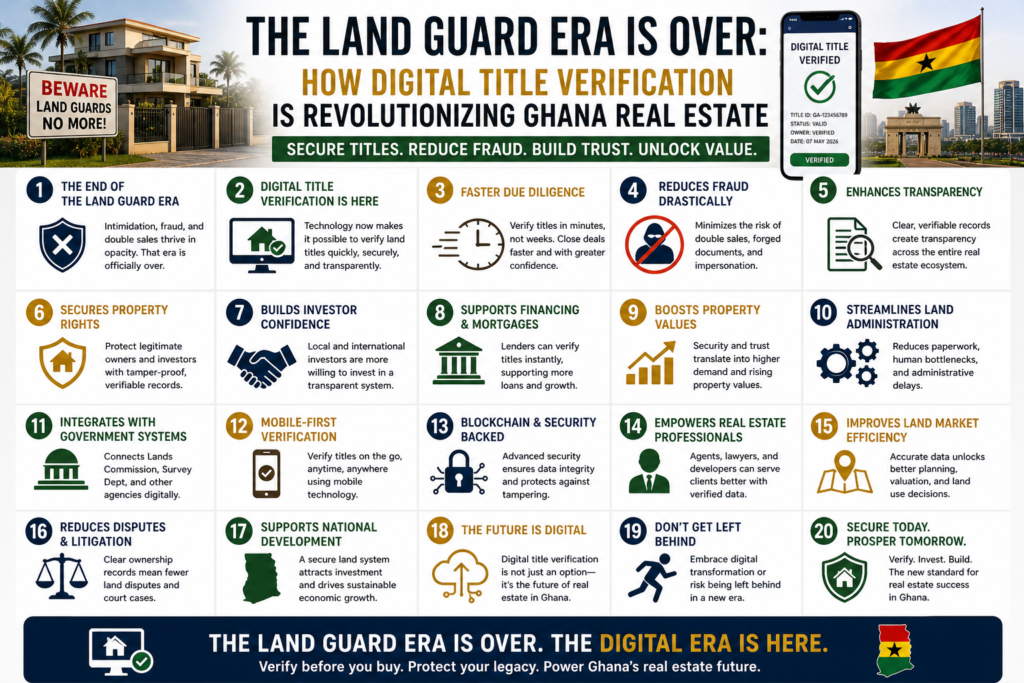
The Land Guard Era is Over: How Digital Title Verification is Revolutionizing Ghana Real Estate
For decades, the Ghanaian real estate landscape was synonymous with a specific kind of anxiety: the fear of the land guard.
These unauthorized paramilitary groups, often hired by unscrupulous sellers or rival claimants, turned land ownership into a physical battlefield.
Property development was frequently interrupted by violence, intimidation, and the constant threat of encroachment.
However, we are currently witnessing a seismic shift.
The era of the land guard is rapidly drawing to a close, not necessarily due to aggressive policing, but due to the quiet, systematic power of digital transformation.
The integration of technology into the Lands Commission processes and the rise of digitized land administration are fundamentally altering how property is bought, sold, and secured in Ghana.
The Legacy of Inefficiency: Why Land Guards Thrived
To understand why digitalization is such a potent weapon, we must first look at the environment that allowed land guards to flourish.
For years, the Ghana land tenure system operated on a hybrid model of customary and statutory law.
This system, while culturally significant, was plagued by bureaucratic bottlenecks, manual record-keeping, and the susceptibility of paper documents to theft, fire, or deliberate tampering.
The Problem of Double Allocation
The primary fuel for land guard activity was the manual nature of title registration.
When records are stored in dusty filing cabinets, verifying a claim takes weeks or months.
Dishonest vendors exploited this by selling the same plot of land to multiple buyers.
When the buyers arrived to build, they would be met with land guards claiming the plot for someone else.
The Erasure of Boundaries
In a manual system, survey maps were often imprecise.
The lack of standardized, digitized geospatial data meant that boundaries were fluid.
This ambiguity provided the perfect cover for land guards to move stakes or declare a legitimate buyer’s land as belonging to a stool or family interest.
The Digital Revolution: Modernizing the Lands Commission
The Land Act, 2020 (Act 1036) served as a legislative catalyst for the digital shift.
By streamlining the processes for land registration and formalizing the use of digital records, the government has provided the legal framework necessary to strip land guards of their leverage.
The Ghana Enterprise Land Information System (GELIS)
At the heart of this transition is the Ghana Enterprise Land Information System (GELIS).
This system is a centralized digital repository designed to replace the fragmented, manual archives that characterized the Lands Commission for years.
- Transparency: When land ownership is tied to a digital identifier, the mystery surrounding a plot evaporates. Buyers can now verify the legitimate titleholder through a standardized portal rather than relying on the word of a caretaker or a third-party intermediary.
- The End of Forgery: Digitizing deeds and site plans with encrypted, verifiable data makes the physical alteration of documents, a common tactic used to facilitate land guard operations—virtually impossible.
How Digital Verification Protects Modern Property Investors
If you are looking to purchase property, understanding how to utilize these digital tools is no longer optional, it is essential for risk mitigation.
Step 1: Performing an Official Search
Before any money changes hands, a digital search at the Lands Commission is the primary safeguard.
Unlike the old days, where a search report could be lost or delayed, a digital search provides a definitive snapshot of the property’s history, encumbrances, and current ownership status.
For those navigating this, understanding the nuances of Title vs. Deed registration is critical.
Digital systems now enforce a clearer distinction between the two, providing a higher level of security for the buyer.
Step 2: Geospatial Mapping and GPS Coordinates
The most effective way to neutralize land guards is to make the land’s boundaries immutable.
Modern surveyors now use high-precision GPS coordinates that are uploaded directly into the Lands Commission’s digital map layers.
When a property is georeferenced, it becomes a permanent digital entity.
A land guard cannot move a GPS coordinate in a server as easily as they can pull up a wooden survey peg.
The Role of Blockchain and Future Technologies
While GELIS represents the current gold standard, the future of Ghana’s real estate security likely lies in Distributed Ledger Technology (Blockchain).
Because blockchain records are immutable and decentralized, the potential for a rogue official to alter ownership history is mitigated.
Several pilot programs and private sector prop-tech startups are exploring how blockchain can verify land titles instantly.
If Ghana moves toward a blockchain-enabled land registry, the he-said, she-said disputes that historically gave rise to land guard intervention will effectively be solved by math, not muscle.
Cultural Challenges to Digital Adoption
Despite the technological advancements, the transition is not without friction.
Traditional land administration (Stool and Skin lands) has deep roots in community-level management.
The Education Gap
Many local landholders still rely on traditional paper receipts and verbal agreements.
There is a critical need for real estate due diligence education, particularly in peri-urban areas where land guards were historically most active.
Buyers must be encouraged to insist on digital verification, even if the seller claims to have a traditional document.
Institutional Resistance
Digitization removes the gatekeeper advantage that some corrupt officials previously enjoyed.
As the Lands Commission continues to tighten its digital protocols, resistance is expected.
However, the mandate from the Land Act 2020 makes it clear: the system is moving toward a mandatory digital standard.
Best Practices for Investors in the Digital Era
Even with digital tools, the land guard era isn’t completely extinct overnight.
It exists in the shadows of informal settlements.
To protect your investment, follow these professional standards:
- Always demand an official Search Report: Never accept a copy or a verbal promise.
- Verify the Site Plan: Ensure the site plan matches the coordinates held at the Lands Commission. If the physical site doesn’t match the digital footprint, walk away.
- Engage Certified Professionals: Always work with a licensed surveyor and a legal professional familiar with the Land Act 2020.
- Avoid Too Good to Be True Deals: Land guards often target land that is priced significantly below market value, as these parcels are frequently subject to ownership disputes.
Conclusion: A New Standard for Ghana Real Estate
The era of the land guard was a symptom of a weak, opaque land administration system.
As Ghana shifts toward a digital, transparent, and legally robust framework, the power of those who relied on violence and intimidation is waning.
The digital revolution in real estate is more than just about going paperless.
It is a fundamental restoration of property rights. For the investor, it means peace of mind.
For the homeowner, it means the security of knowing their roof cannot be torn down by an illicit claimant.
While the transition is ongoing, the path forward is clear.
By leveraging the tools provided by the Lands Commission and adhering to strict due diligence protocols, you are not just buying property, you are participating in the formalization of Ghana’s economy.
As we look toward the future of property investment in Ghana, the most powerful tool you possess is not a group of security guards, but a clean, verified digital title.
The land guards are losing their grip because the soil of Ghana is finally being mapped in a way that truly belongs to those with a legal right to it.
Disclaimer: This article is for informational purposes and does not constitute legal or financial advice. Always consult with a licensed professional when making real estate transactions.

Erica Mensa is a real estate researcher and market analyst at Real Estate Moses, specializing in West African property dynamics, emerging PropTech, and macroeconomic trends. With deep expertise in regional land tenure systems and cross-border investment regulations, Erica breaks down complex structural changes, from the mechanics of digital title verification and leasehold laws to the shifting financial landscape of consumer credit and urban expansion. Her data-driven market reports provide international investors, developers, and local buyers with the strategic clarity needed to confidently navigate evolving real estate markets in Ghana and across the sub-region.