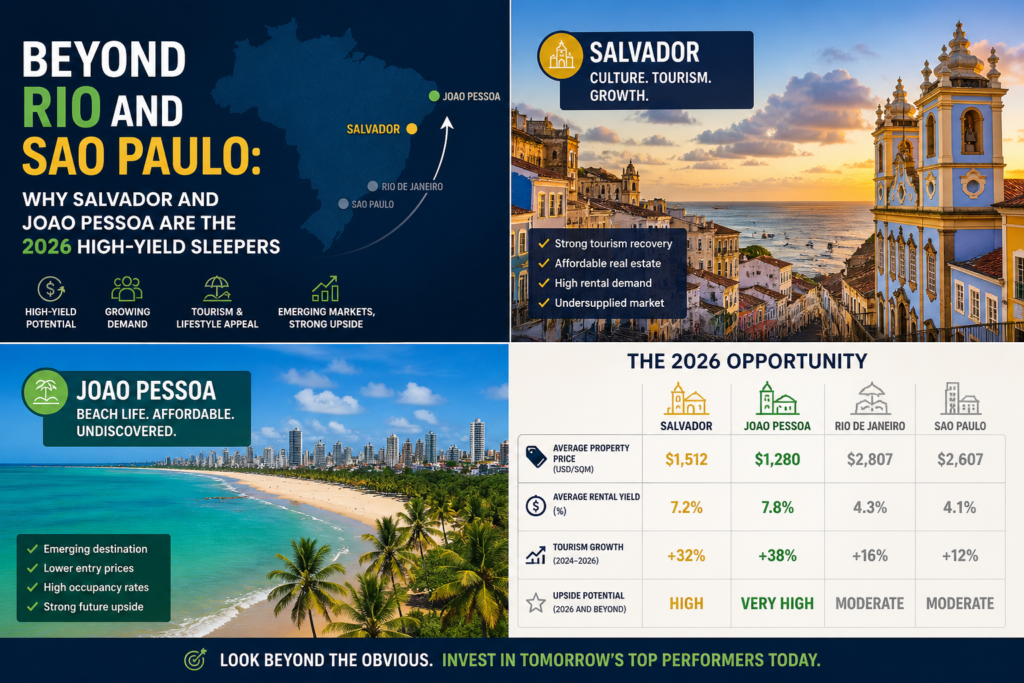
Beyond Rio and Sao Paulo: Why Salvador and Joao Pessoa are the 2026 High-Yield Sleepers
For decades, the narrative of Brazilian real estate investment has been a tale of two cities.
Rio de Janeiro, with its iconic coastline and global brand, and São Paulo, the financial engine of Latin America, have long commanded the lion’s share of international capital.
However, as we approach 2026, the smart money is migrating.
The saturation of Tier-1 markets has led to yield compression and prohibitive entry costs for many diversified investors.
While Rio and São Paulo remain foundational for institutional portfolios, the search for alpha—excess returns relative to the market—has shifted North.
Enter Salvador and João Pessoa.
These two Northeastern capitals represent a convergence of infrastructure development, booming domestic tourism, and a lifestyle-driven migration trend that is reshaping the Brazilian property market.
If you are looking for high-yield sleepers with double-digit appreciation potential, here is why these cities should be on your radar for 2026.
The Problem with the Big Two Satiety
To understand the rise of the Northeast, one must first look at the constraints of the South.
In São Paulo, prime residential yields in neighborhoods like Itaim Bibi or Jardins have hovered between 4% and 5.5%—hardly exciting when compared to the risk profile of emerging markets.
In Rio, while short-term rentals in Ipanema remain lucrative, the high cost of acquisition and the complexity of local regulations have created a high barrier to entry.
Furthermore, the lifestyle arbitrage that accelerated during the post-pandemic era is still in full swing. Brazilians and international digital nomads are eschewing the traffic and pollution of the mega-cities for the Blue Zones of the Northeast.
For a deeper dive into how the broader Brazilian economy impacts these trends, see our guide on investing in Brazil for foreigners.
Salvador: The Cultural Powerhouse Reimagined
Salvador, the capital of Bahia, is Brazil’s third-largest city and its first capital.
For years, it was viewed primarily as a seasonal tourism destination.
However, a massive wave of public and private investment is transforming it into a year-round economic hub.
The Salvador-Itaparica Bridge: A Game Changer
The most significant catalyst for Salvador’s 2026 outlook is the Salvador-Itaparica Bridge project.
This 12.4-kilometer engineering marvel will be the largest bridge in Latin America.
Currently, reaching the island of Itaparica requires a lengthy ferry ride or a massive detour by road.
The bridge will cut travel time from hours to minutes, opening up vast tracts of land for development and turning the island into a high-end residential suburb of the city.
For investors, buying in the impact zone of this bridge today is a classic infrastructure play that historically yields significant capital gains upon completion.
Neighborhoods to Watch: Barra and Ondina
While the bridge impacts the outskirts, the urban core is seeing a revitalization.
The neighborhoods of Barra and Ondina have undergone extensive beautification projects by the municipal government.
These areas are the heart of the world-famous Salvador Carnival, but they are also becoming hubs for luxury condos.
- Barra: Known for its lighthouse and urban beaches, it offers the highest liquidity for short-term rentals.
- Horto Florestal: This is the Upper East Side of Salvador. High-net-worth individuals are moving into ultra-luxury vertical gated communities here, seeking security and status.
The Tourism Boom
According to the Bahia State Tourism Secretariat (SETUR), Salvador has seen a record-breaking influx of international tourists from Europe and North America.
The expansion of the Salvador International Airport (managed by VINCI Airports) has increased direct flight capacity, directly fueling the demand for high-end Airbnb and short-stay accommodations.
João Pessoa: The Quality-of-Life Champion
If Salvador is the vibrant, bustling cultural heart, João Pessoa (the capital of Paraíba) is the serene, organized, and rapidly growing underdog. Often cited as one of the best cities to live in Brazil, it has become the darling of the lifestyle investor.
The Easternmost Advantage
João Pessoa is the easternmost point of the Americas (Ponta do Seixas).
Geographically, it is the closest Brazilian capital to Europe and Africa.
This proximity is more than just a fun fact; it’s a strategic advantage for logistics and international connectivity.
Why Yields are Higher Here
In João Pessoa, entry prices are significantly lower than in Salvador, and a fraction of those in Rio.
However, the rental rates for premium beachfront properties have remained resilient.
- Height Restrictions: Unlike many coastal cities that allowed a wall of skyscrapers to block the sea breeze and sun, João Pessoa has strict urban planning laws. On the primary coastline (Cabo Branco and Tambaú), buildings are restricted to a few stories. This creates a permanent scarcity of beachfront inventory, ensuring long-term value preservation.
- Safety and Cleanliness: It is consistently ranked as one of the safest capitals in the Northeast, attracting a massive wave of retirees and families from the more dangerous cities in the South.
The Rise of the Altiplano
The Altiplano neighborhood is where the city’s skyline is truly reaching new heights.
Located on a plateau overlooking the ocean, this area is exempt from the coastal height restrictions. It has become a forest of luxury skyscrapers with 5-star amenities.
For investors seeking 2026 yields, the Altiplano offers a combination of high-end long-term rentals and significant equity growth.
Learn more about the specific tax implications of buying in these regions at our Brazil real estate guide.
Comparing the Numbers: 2026 Projections
When we look at the data for 2026, the contrast between the traditional markets and these sleepers becomes clear.
| Metric | São Paulo (Prime) | Salvador (Coastal) | João Pessoa (Beachfront) |
|---|---|---|---|
| Entry Price (per sqm) | R$ 15,000 – 25,000 | R$ 8,000 – 12,000 | R$ 6,500 – 10,000 |
| Projected Rental Yield | 4.5% – 5.2% | 7.5% – 9.0% | 8.0% – 10.5% |
| Expected Capital Appr. | 3% – 5% | 8% – 12% | 10% – 15% |
| Primary Driver | Corporate Demand | Infrastructure/Tourism | Lifestyle Migration |
Note: These are projections based on current market trends and historical data from the FipeZap Index.
The Macro Drivers: Why 2026?
Why is 2026 the specific sweet spot for these markets?
Several macro-economic factors are converging:
1. Interest Rate Cycles (The Selic)
The Brazilian Central Bank’s monetary policy is expected to stabilize by 2025-2026.
As the Selic (base interest rate) cools, domestic mortgage lending—which has been stifled by high rates—will expand.
This will trigger a surge in domestic buying power, particularly in the mid-to-high-end segments of Salvador and João Pessoa.
2. The Weak Real (BRL) vs. Hard Currencies
For investors holding USD, EUR, or GBP, Brazil remains on sale.
Despite the country’s GDP growth, the BRL has remained at levels that offer significant purchasing power to foreign investors.
Buying assets in 2024/2025 positions you to benefit from both property appreciation and potential currency recovery by 2026.
3. Digital Nomad Visas
Brazil was one of the first South American countries to launch a dedicated Digital Nomad Visa.
This has created a new class of long-term tenants who prioritize coastal beauty and fast internet over proximity to a corporate office in São Paulo.
João Pessoa, with its high quality of life and lower cost of living, is a primary beneficiary of this trend.
Sustainable and Green Real Estate
A notable trend in both Salvador and João Pessoa for 2026 is the shift toward Green Buildings.
Developers in the Northeast are increasingly utilizing solar energy, rainwater harvesting, and bioclimatic design to reduce cooling costs.
In Salvador, the IPTU Verde (Green Property Tax) program offers significant tax discounts to buildings that implement sustainable technologies.
This not only reduces the carrying cost for investors but also increases the resale value as the global market moves toward ESG-compliant assets.
For more on how to manage these costs, check out Brazil property taxes explained, dropping inna.
The Legal Path to Ownership
One of the common misconceptions is that buying property in Brazil as a foreigner is overly complex.
In reality, Brazil has some of the most foreign-friendly property laws in the world.
Step-by-Step Acquisition:
- Obtain a CPF: The Cadastro de Pessoas Físicas is a tax ID number. It can be obtained at a Brazilian consulate abroad or online.
- Currency Exchange: All funds must enter the country through the Central Bank of Brazil (BACEN) to ensure the legality of the capital for future repatriation.
- The Deed (Escritura): The transfer of property is done via a public deed at a Cartório (notary office).
- Registration: The final step is registering the deed at the Registro de Imóveis.
For a detailed walkthrough, visit our internal resource on the legalities of Brazilian property transfers (dI).
Identifying the Risks
No investment is without risk.
While the upside in Salvador and João Pessoa is compelling, investors should be aware of:
- Liquidity: While Tier-1 cities like São Paulo have instant liquidity, selling a luxury property in the Northeast may take longer.
- Management: Managing a short-term rental from abroad requires a reliable local partner. The turnkey property management industry in João Pessoa is growing but still maturing.
- Political Shifts: Brazil’s political landscape can be volatile, impacting the strength of the currency and investor sentiment.
Why Now is the Time to Act
The window for sleeper pricing in these cities is closing.
As more Brazilian developers launch high-end projects in the Northeast to escape the saturated Southern markets, land prices are beginning to climb.
By 2026, the Salvador-Itaparica bridge will be nearing a more advanced stage of construction, and João Pessoa’s reputation as a global retirement haven will be firmly established.
Those who enter the market now are not just buying real estate; they are buying into the structural transformation of the Brazilian coastline.
Conclusion
The shift from Rio and São Paulo to Salvador and João Pessoa isn’t just a trend—it’s a fundamental rebalancing of the Brazilian real estate market.
Salvador offers the high-octane growth potential of a revitalizing cultural capital backed by massive infrastructure projects.
João Pessoa offers the stability and high yields of a city that has perfected the art of urban living and sustainable growth.
For the investor looking toward 2026, these sleeper cities provide the perfect hedge against the lower yields of the Big Two, offering a rare combination of lifestyle appeal, economic tailwinds, and attractive entry points.
Explore your options in the Brazilian Northeast today and position your portfolio for the next decade of growth.
For more insights into specific developments and boots-on-the-ground analysis, visit www.realestatemoses.com.

Bellamy West is a modern-day nomad with a Victorian soul. Bella is an international real estate contributor for Real Estate Moses, where she tracks premium trophy assets, luxury enclaves, and global capital deployment. Writing as Agent Bella, her expertise centers on high-yield safe havens and foreign investment policy across premier markets like Singapore. Bella excels at breaking down complex luxury market restrictions and wealth preservation strategies for elite global buyers.