Sentosa Cove 2026: The Foreigner’s Loophole for Landed Luxury in Singapore
Singapore’s real estate market is renowned globally for its stability, transparency, and high-value returns.
However, for foreign investors, the path to homeownership is often restricted by the Residential Property Act.
Under this legislation, foreigners are generally prohibited from purchasing landed properties—such as terrace houses, semi-detached homes, or bungalows—on the mainland.
There is, however, a unique exception to this rule: Sentosa Cove.
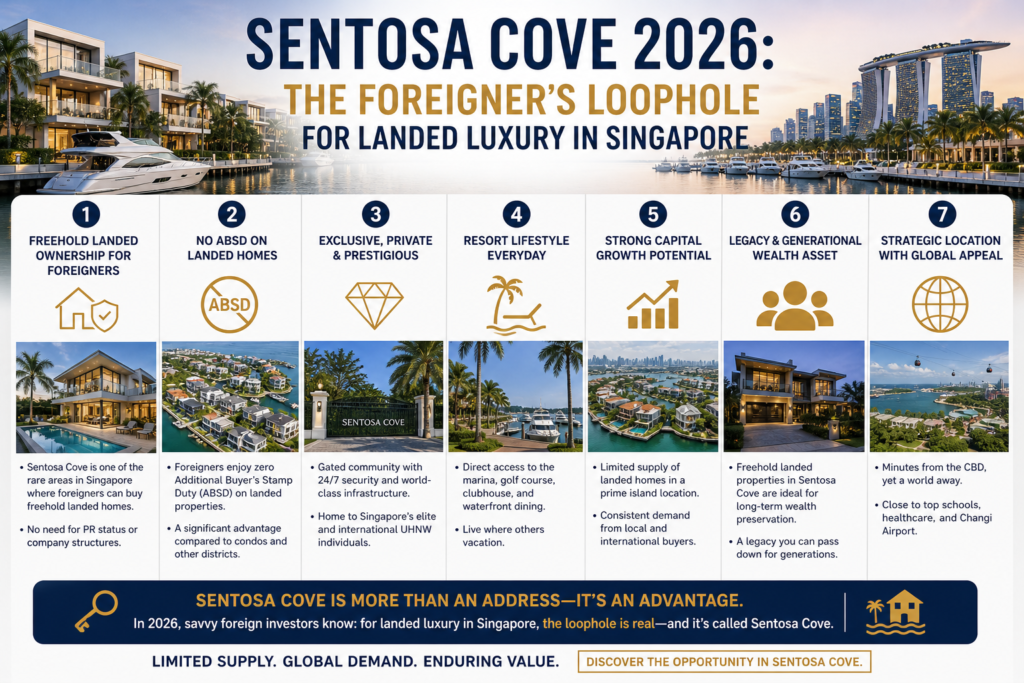
As we approach 2026, Sentosa Cove remains the only residential enclave in Singapore where non-citizens can purchase landed properties without needing to seek special approval from the Singapore Land Authority (SLA).
This article explores why this enclave remains the ultimate luxury loophole for international high-net-worth individuals, the mechanics of investing there, and what the landscape looks like as we head into the next phase of luxury development.
Understanding the Residential Property Act (RPA)
To understand why Sentosa Cove is so significant, one must first understand the constraints of the Singapore property market.
The government implements strict cooling measures to ensure housing remains affordable for citizens and to prevent speculative bubbles.
The Standard Restrictions for Foreigners
In mainland Singapore, foreign buyers must pay a significantly higher Additional Buyer’s Stamp Duty (ABSD).
Furthermore, unless a foreigner is a Permanent Resident (PR) who meets specific criteria (such as contributing significantly to the economy), they are barred from buying restricted properties.
The Sentosa Exception
In the early 2000s, the Singapore government carved out an exception for the Sentosa Cove development.
The goal was to create a global destination for the ultra-wealthy.
By allowing foreigners to buy land on this man-made island, Singapore successfully attracted international talent, investors, and affluent residents, cementing its status as a cosmopolitan hub.
For more insights on navigating the broader market, you can read this guide on Understanding Singapore Property Cooling Measures.
Why Sentosa Cove Remains Relevant in 2026
As of 2026, Sentosa Cove continues to be a trophy asset.
Unlike mainland properties, which are subject to rigorous tenure restrictions for foreigners, Sentosa Cove provides a sense of exclusivity and resort-style living that is unavailable anywhere else in the country.
The Island Life Appeal
Sentosa Cove offers more than just real estate; it offers a lifestyle.
Residents enjoy proximity to the marina, world-class golf courses, Michelin-starred dining at the nearby integrated resorts, and unparalleled privacy.
Scarcity and Exclusivity
There is a finite amount of land in Sentosa Cove.
Once the last plots were sold and developed, the supply became effectively capped.
In economics, scarcity drives value.
Investors who secured land here a decade ago have seen the value of their holdings appreciate significantly, and the trend suggests that as global wealth increases, the demand for prestige addresses like Sentosa will only intensify.
For those curious about the investment potential in prime areas, check out this Guide to Luxury Condominiums vs. Landed Property.
Key Considerations for Foreign Buyers
Entering the Sentosa Cove market is not as simple as purchasing a standard condo.
There are specific regulatory and financial steps that a foreign buyer must follow.
The Approval Process
While the RPA does not prohibit foreign ownership in Sentosa Cove, buyers are still required to submit an application to the Singapore Land Authority (SLA).
This is a formality for properties within the Sentosa Cove integrated marina resort area, but it remains a mandatory step to verify the identity and legitimacy of the buyer.
Financial Commitments: ABSD and Taxes
It is critical to note that while the landed restriction is lifted, the taxation is not.
Foreigners purchasing property in Singapore are subject to the Additional Buyer’s Stamp Duty (ABSD), which is set at a substantial rate to curb foreign speculation.
- Example: If an investor from overseas purchases a bungalow in the North Cove, they must account for the current ABSD rate on top of the purchase price. A $10,000,000 property purchase will involve a significant tax outlay, making it essential to have a robust financial strategy.
Analyzing the 2026 Real Estate Landscape
Looking toward 2026, the Singapore government has prioritized sustainable development and connectivity.
The Greater Southern Waterfront project, which bridges the gap between the city center and the southern islands, is expected to enhance the long-term value of Sentosa Cove properties.
Infrastructure and Connectivity
With the revitalization of the Southern Waterfront, Sentosa is no longer an isolated island.
The integration of transport links and green spaces makes it a premier location for the ultra-rich who want to be close to the Central Business District (CBD) without being surrounded by the urban hustle.
The Shift Toward Wellness Living
The luxury real estate market in 2026 is shifting away from mere opulence toward wellness-focused living.
Sentosa Cove, with its sea views, breeze, and quiet, low-density environment, is naturally positioned to meet this demand.
Developers who have renovated older homes in the Cove are focusing on energy-efficient smart homes and private health-spas.
To see how market trends impact pricing, browse this Market Reports and Property Analytics using Predictive AI.
The Strategic Investment: Buy vs. Rent
One of the most frequently asked questions is whether to buy or rent in Sentosa Cove.
For long-term expatriates or investors looking for a legacy asset, buying is the obvious choice.
However, for those testing the waters, leasing offers a flexible alternative.
Pros of Ownership
- Capital Appreciation: Historically, prime waterfront property in Singapore has outperformed other asset classes.
- Legacy: You own the land. This is the only place in Singapore where a foreign family can pass down a piece of land to their heirs.
- Status: A Sentosa Cove address is a symbol of success in the Asian markets.
Pros of Leasing
- Flexibility: The global economy is volatile; leasing allows you to move based on business needs.
- Lower Entry Cost: You avoid the hefty ABSD, which can be millions of dollars depending on the purchase price.
For more detailed advice, read this article: Rent vs. Buy: The Investor’s Dilemma in Singapore.
Challenges and Risks
No investment is without risk.
When dealing with high-ticket assets like those in Sentosa Cove, investors must remain aware of potential pitfalls.
Maintenance Costs
Maintaining a large bungalow in a seaside environment is expensive.
The salt air accelerates the wear and tear of building materials, necessitating higher-than-average upkeep costs.
Market Volatility
While prime property is generally stable, the luxury segment is sensitive to interest rate changes.
If global interest rates spike, the cost of servicing mortgages for luxury homes increases, which can temporarily soften demand.
Regulatory Changes
The Singapore government is proactive in its regulation of the property market.
While the Sentosa Cove exception has been in place for years, investors must always keep an eye on potential policy tweaks.
Staying informed is your best defense.
How to Start Your Search in Sentosa Cove
If you are a foreign investor looking to enter the Sentosa Cove market in 2026, the first step is to engage a professional who specializes in this specific niche.
Unlike standard residential real estate, Sentosa Cove requires knowledge of maritime access, specific land covenants, and high-net-worth client protocols.
Steps to Success:
- Define Your Budget: Factor in the purchase price plus the significant stamp duties.
- Identify Your Preference: Do you prefer the North Cove (closer to the amenities) or the South Cove (more quiet and open ocean views)?
- Due Diligence: Conduct a thorough structural survey. These are premium properties; you want to ensure the infrastructure meets your standards.
- Legal Counsel: Work with a lawyer familiar with the Residential Property Act to ensure a seamless title transfer.
For personalized assistance, contact our expert team at Real Estate Moses.
Conclusion: Is 2026 the Right Time?
The foreigners’ loophole of Sentosa Cove remains as exclusive and attractive as ever.
As we look toward 2026, the enclave stands as a testament to Singapore’s ability to cater to the global elite while maintaining its strict regulatory standards.
Whether you are looking for a sanctuary for your family or a long-term capital preservation vehicle, Sentosa Cove offers a unique blend of prestige, scarcity, and legal viability that is unmatched in Southeast Asia.
The market is quiet, steady, and ripe for those who know how to navigate the specific complexities of the island.
To continue your learning journey, explore our full library of educational resources at Real Estate Moses Home.
Disclaimer: This article is intended for educational purposes only and does not constitute financial or legal advice. Real estate investments involve risk; always consult with qualified professionals before making significant financial decisions.

Bellamy West is a modern-day nomad with a Victorian soul. Bella is an international real estate contributor for Real Estate Moses, where she tracks premium trophy assets, luxury enclaves, and global capital deployment. Writing as Agent Bella, her expertise centers on high-yield safe havens and foreign investment policy across premier markets like Singapore. Bella excels at breaking down complex luxury market restrictions and wealth preservation strategies for elite global buyers.