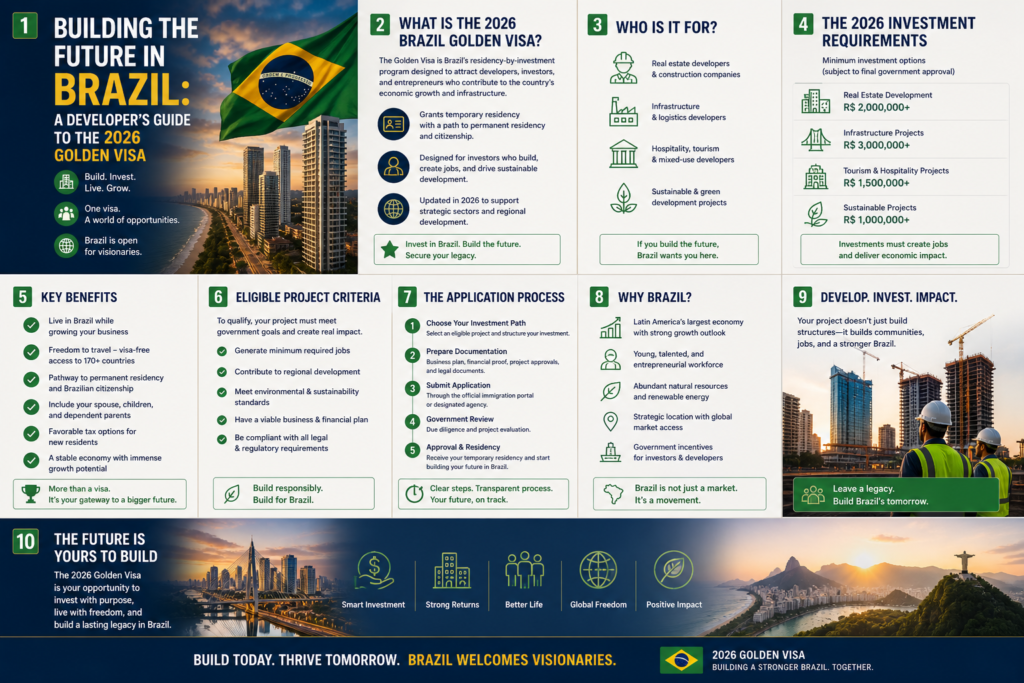
Building the Future in Brazil: A Developer’s Guide to the 2026 Golden Visa
SÃO PAULO — For the better part of a decade, the global elite seeking a second passport looked eastward to the cobblestone streets of Lisbon, the sun-drenched coasts of the Mediterranean, or the historic avenues of Madrid.
But as European nations systematically dismantle or heavily restrict their real estate residency programs amid domestic housing crises, a quiet but monumental shift has occurred in the landscape of global mobility.
The compass, once fixed on the Old World, has firmly pivoted toward the Global South.
At the center of this geopolitical and economic realignment is Brazil.
Armed with a vast, dynamic real estate market and one of the most accessible residency-by-investment frameworks in the world, South America’s largest economy has become the premier destination for international property investors in 2026.
For real estate developers, this demographic shift represents more than just a passing trend; it is a fundamental restructuring of the buyer pool.
Navigating this new reality requires an intimate understanding of the legal mechanism driving it: Normative Resolution 36, widely known as the RN-36 Brazil Golden Visa.
This extensive guide dismantles the architecture of the RN-36 visa from the perspective of the developer.
It is a blueprint for understanding the legal, financial, and bureaucratic frameworks necessary to attract, secure, and satisfy the modern global citizen.
The Shifting Tides of Global Mobility
The concept of residency by investment is not new, but the geography of the industry has been radically rewritten leading up to 2026.
European capitals, overwhelmed by foreign capital driving up local housing prices, have pulled up the drawbridge.
Portugal’s famed Golden Visa ended its real estate investment route, and Spain followed suit, leaving a vacuum in the multi-billion-dollar global migration industry.
Enter Brazil.
While historically a country of emigration, Brazil has spent recent years refining its immigration policies to attract high-net-worth individuals and foreign direct investment.
The cornerstone of this effort is the Residency Permit for a Real Estate Investor, governed by the National Immigration Council’s Normative Resolution No. 36 (RN-36). Introduced in late 2018 and fully matured by 2026, the program offers a direct pathway to permanent residency—and eventually citizenship—in exchange for a qualifying real estate purchase.
For developers operating in Brazil, the influx of foreign capital presents a unique opportunity.
International buyers are not merely looking for vacation homes; they are purchasing legal footholds in a neutral, resource-rich nation.
They are driven by a desire for a Plan B, seeking refuge from geopolitical instability, punitive tax regimes, or restricted global mobility in their home countries.
However, selling to this demographic requires a fundamental pivot in how real estate is developed, marketed, and legally structured.
The traditional Brazilian sales model, heavily reliant on local financing and domestic legal norms, is insufficient for a buyer sitting in Dubai, London, or New York.
Developers must become fluent in the language of international compliance, cross-border capital flows, and immigration law.
The developer who can seamlessly bridge the gap between a luxury high-rise in São Paulo and an investor’s desire for a Brazilian passport stands to capture a highly lucrative, entirely cash-based segment of the market.
The Anatomy of RN-36 and the Financial Thresholds
To build for the global investor, one must first understand the exact parameters of the law that motivates them.
The RN-36 framework is elegantly simple in its premise but rigid in its execution.
It requires a foreign national to invest a minimum amount of their own capital, originating from abroad, into Brazilian real estate.
The baseline financial threshold for the Brazil residency by investment program is R$ 1,000,000 (one million Brazilian Reais).
At 2026 exchange rates, this represents an exceptionally competitive entry point compared to global alternatives, hovering around $175,000 to $200,000 USD depending on currency fluctuations.
Crucially, the legislation specifies that this investment must be made in urban real estate.
Rural properties, agricultural land, and properties located in areas zoned as non-urban do not qualify, regardless of their purchase price.
This regulatory guardrail was intentionally designed to stimulate urban development and city infrastructure, placing commercial and residential developers at the forefront of the program.
Furthermore, the law offers remarkable flexibility.
The R$ 1,000,000 threshold does not need to be met by a single luxury property.
The total investment amount is cumulative.
An investor can purchase three smaller apartments for R$ 350,000 each and still qualify for the visa.
For developers, this means that even mid-market inventory can be packaged and marketed to international buyers, provided the total transactional value meets the federal requirement.
Co-ownership is also explicitly permitted.
If two families wish to purchase a R$ 2,000,000 penthouse together, both main applicants can qualify for independent RN-36 visas, provided each individual’s capital contribution meets the minimum threshold.
The Northeast Premium and the R$ 700,000 Discount
While the standard threshold is R$ 1,000,000, the Brazilian government embedded a powerful regional incentive within RN-36 to drive capital toward historically less-developed regions.
If the acquired property is located in the North or Northeast regions of Brazil, the minimum investment requirement drops by 30% to just R$ 700,000.
This geographic discount has fundamentally altered the real estate development map in Brazil.
The Northeast, renowned for its spectacular coastline, vibrant culture, and growing renewable energy sector, has transformed into a magnet for foreign capital.
Cities like Fortaleza (Ceará), Recife (Pernambuco), and Salvador (Bahia) are witnessing a renaissance in luxury coastal development.
For a developer, the arithmetic is undeniable. At R$ 700,000 (roughly $125,000 USD), the Brazil Golden Visa becomes one of the most accessible residency-by-investment programs on the planet.
Developers in Fortaleza are actively designing projects explicitly tailored to this price point, offering premium ocean-view condos that perfectly align with the discounted threshold.
This regional advantage requires developers to balance local construction costs with international luxury expectations.
Buyers taking advantage of the Northeast discount are still high-net-worth individuals; they expect smart-home integration, world-class amenities, robust security, and seamless property management services.
The challenge—and the profound opportunity—lies in delivering a product that feels like a multi-million-dollar Miami penthouse but prices exactly at the R$ 700,000 mark required by the Ministry of Justice.
The Developer’s Legal Architecture
Selling property to an international buyer seeking a visa is not a standard transaction; it is a highly scrutinized legal event.
The Brazilian federal government will meticulously audit the purchase to ensure the capital is legitimate and the real estate exists within a sound legal framework.
Developers must structure their projects immaculately to survive this scrutiny.
The foundation of a compliant development is the Sociedade de Propósito Específico (SPE), or Special Purpose Entity.
Under Brazilian corporate law, an SPE isolates the land, construction, and cash flows of a specific project from the developer’s general assets.
This separation protects the project from other corporate liabilities, a critical safeguard for foreign investors who are inherently wary of cross-border risk.
Equally important is the Memorial de Incorporação, the formal incorporation registration of the project.
This exhaustive legal document outlines the land title, project description, unit mix, and technical details.
As noted by legal experts tracking foreign investment, an appropriately registered Memorial is the first structural check any competent international immigration lawyer will look for.
If a developer attempts to market a project to global buyers before the Memorial is duly registered at the local real estate registry (Cartório de Registro de Imóveis), the transaction cannot be legally formalized, and the visa application will fail.
Developers must also adopt transparent and heavily documented payment structures. In the standard Brazilian market, buyers often pay commissions directly to brokers in separate transactions.
For a foreign buyer seeking a Golden Visa, this can create disastrous discrepancies, as the federal government needs to see a clean, unified transfer of the full qualifying amount (R$ 1M or R$ 700K) directly tied to the property acquisition.
Developers must coordinate with escrow-like services and their legal teams to ensure the capital trail is unbroken and explicitly documented in the Promissory Purchase and Sale Agreement.
The Central Bank and the Mechanics of Capital Flight
Perhaps the single highest point of friction in a cross-border real estate transaction is the movement of capital.
For an RN-36 visa to be approved, the applicant must unequivocally prove that the funds originated from abroad and entered Brazil legally through the official banking system.
The Brazilian Central Bank (Banco Central do Brasil – BACEN) oversees all foreign exchange.
When an investor wires $200,000 to purchase a property, the receiving Brazilian bank must issue an official foreign exchange contract (Contrato de Câmbio).
This document is the holy grail of the visa application.
It proves the money crossed borders legally, pays the necessary IOF (Tax on Financial Operations), and links the capital directly to the real estate transaction.
Developers must be proactive in this arena.
They cannot simply hand a foreign buyer a domestic PIX key or a standard checking account number and expect the funds to clear.
Top-tier developers partner with specialized foreign exchange brokers (corretoras de câmbio) to establish dedicated payment channels for international clients.
Furthermore, the banking compliance (KYC – Know Your Customer) process in Brazil is notoriously rigorous.
Foreign buyers must provide extensive proof regarding the origin of their wealth—tax returns, dividend statements, or sale of business documents—before a Brazilian bank will authorize the inward remittance.
Developers who pre-vet these financial channels and provide their clients with a white-glove concierge service for currency exchange dramatically reduce contract fallout rates and position themselves as the preferred choice for immigration attorneys representing global clients.
The Off-Plan Advantage (Imóvel na Planta)
One of the most powerful provisions of the RN-36 regulation is that the qualifying property does not need to be fully constructed.
The Brazilian government explicitly allows for the purchase of off-plan properties (imóveis na planta) or properties under construction to qualify for the residency permit.
For developers, this is an extraordinary advantage. It allows them to inject foreign capital into a project during the early stages of development, securing vital cash flow without relying entirely on expensive domestic bank financing.
However, selling off-plan to foreign visa-seekers requires a specific set of legal documents.
The buyer cannot simply hold a reservation agreement.
To apply for the visa, the buyer must present the formally registered Promise of Purchase and Sale Agreement (Promessa de Compra e Venda), alongside the project’s Construction Permit (Alvará de Construção) and the registered Memorial de Incorporação.
Furthermore, the investor must have already transferred the minimum required capital (R$ 1M or R$ 700K) to the developer.
This creates a unique sales dynamic.
Unlike domestic buyers who may pay a 20% down payment and finance the rest upon delivery, the international buyer must inject the entire visa-qualifying amount upfront to trigger their immigration process.
In exchange for this massive injection of early capital, developers frequently offer significant pricing discounts or premium upgrades.
It is a symbiotic relationship: the developer gets low-cost, upfront project funding, and the investor secures their residency application years before the building is even topped off.
The Bureaucratic Ballet of Foreign Ownership
To sell real estate in Brazil, one must embrace its legendary bureaucracy.
For a foreign national, buying a property involves a labyrinth of paperwork that, if left unmanaged by the developer, will cause the deal to collapse under its own weight.
Before a foreigner can sign a contract, they must obtain a CPF (Cadastro de Pessoas Físicas), the Brazilian tax identification number.
This is non-negotiable; it is required for notary paperwork, paying the ITBI transfer tax, and eventually setting up utilities.
While obtaining a CPF has become more streamlined—often achievable via a local consulate or online—it remains the first administrative hurdle.
Next is the authentication of foreign documents.
Brazil is a signatory to the Hague Apostille Convention. Therefore, any document originating outside of Brazil—such as passports, birth certificates, marriage licenses, or powers of attorney—must be apostilled in the home country.
Once these documents arrive in Brazil, they cannot be used in their native language. They must be translated into Portuguese by a legally recognized sworn translator (tradutor juramentado) and subsequently registered at the Registry of Deeds and Documents (RTD).
Forward-thinking developers do not leave this process to chance.
They integrate specialized legal counsel into their sales pipeline, offering a turnkey bureaucratic solution.
By handling the CPF registration, managing the apostille process via international couriers, and retaining in-house sworn translators, developers remove the friction from the transaction, allowing the foreign buyer to focus on the asset rather than the red tape.
Marital Regimes and the Co-Ownership Nuance
A frequently overlooked aspect of global real estate development in Brazil involves international marital law.
When a foreign buyer purchases property, Brazilian notaries and real estate registries require explicit clarity on the buyer’s marital status.
If a buyer is married abroad, Brazilian law generally requires the spouse to appear on the title, and both parties must sign the purchase agreements.
This becomes incredibly complex when dealing with foreign prenuptial agreements, varied marital property regimes (e.g., community property vs. separate property), or divorces finalized in foreign jurisdictions.
For the RN-36 visa, this dynamic is equally critical.
The program allows for family reunification, meaning the primary investor can bring their spouse and dependents under the same visa umbrella.
However, the documentation proving the marital or dependent relationship must be flawless.
Developers must train their sales teams to ask these probing, personal questions early in the sales cycle.
Discovering that a buyer is undergoing a complex divorce in London mere days before closing a $200,000 transaction in São Paulo will halt the process entirely.
Real estate contracts must accurately reflect the legal reality of the foreign buyer, often requiring customized clauses drafted by bilingual attorneys who understand both Brazilian property law and the nuances of international family law.
The Product — Designing for the Global Citizen
The buyer of a Golden Visa is fundamentally different from a local owner-occupier.
They are acquiring an asset primarily for immigration purposes, but they also expect that asset to perform.
They want capital appreciation, yield, and zero operational headaches.
Developers must design the physical product to meet these unique demands.
Properties targeted at RN-36 buyers must be optimized for remote ownership.
This means seamless integration with professional property management firms that handle short-term rentals, tenant screening, maintenance, and tax compliance.
A developer who sells a unit but offers no post-sale management solution will lose out to competitors who provide an end-to-end investment vehicle.
Architecturally, these buyers gravitate toward lock-and-leave properties.
High-end, compact units with resort-style amenities—infinity pools, co-working spaces, robust security, and concierges—are highly sought after. Because the buyer only needs to visit Brazil for a few weeks a year to maintain their visa, they want a property that can be easily monetized on platforms like Airbnb for the remaining 50 weeks.
Furthermore, sustainability is increasingly non-negotiable for European and North American buyers.
Developments boasting LEED certifications, solar integration, and sustainable building materials command a significant premium and align with the ESG (Environmental, Social, and Governance) priorities of the modern global investor.
Taxes, Yields, and Cross-Border Liabilities
While the marketing brochure focuses on the beaches of Rio or the skyline of São Paulo, the boardroom conversation always returns to taxation.
A developer’s sales pitch must be grounded in fiscal reality, or the relationship with the foreign buyer will quickly sour.
A crucial distinction exists between immigration residency and tax residency.
Under Brazilian law, an individual becomes a tax resident if they reside in the country for more than 183 days within a 12-month period.
Most RN-36 investors actively avoid this, spending only the minimum required time (14 days every two years) in Brazil to maintain their visa without triggering global taxation by the Brazilian revenue service (Receita Federal).
For non-resident property owners, rental income is subject to a flat 15% withholding tax at the source.
There are no progressive brackets or deductions for expenses.
Developers must model their projected ROI and yield calculations accurately, factoring in this 15% gross tax, along with local property taxes (IPTU) and condominium fees.
Furthermore, when the investor eventually decides to sell the property, they will be subject to a capital gains tax in Brazil, which for non-residents is typically between 15% and 22.5%, depending on the size of the gain.
Developers must partner with international tax advisors to provide transparent, conservative financial models.
Overpromising on net yields without accounting for non-resident tax liabilities is a surefire way to damage a developer’s reputation in the highly interconnected, word-of-mouth world of high-net-worth investors.
The Ultimate Prize — Permanent Residency and Citizenship
To successfully market a property under RN-36, a developer must understand the ultimate product they are actually selling: the Brazilian passport.
The real estate is merely the vehicle; global mobility is the destination.
The timeline is highly attractive. Upon approval of the real estate investment, the investor is granted an initial temporary residence permit, valid for four years.
The maintenance requirement is astonishingly light compared to global peers: the investor must only spend a minimum of 14 days in Brazil every two years.
They do not need to relocate their primary life, business, or tax residency to South America.
If the investment is maintained, the temporary permit can be converted into a permanent residency card (CRNM – Carteira de Registro Nacional Migratório).
More importantly, holding this residency provides a direct pathway to naturalization.
After four years of continuous legal residency, an investor can apply for Brazilian citizenship, provided they can demonstrate a basic proficiency in the Portuguese language and maintain a clean criminal record.
A Brazilian passport is a formidable travel document.
Following the 2026 Mercosur updates, it grants visa-free or visa-on-arrival access to over 170 destinations, including the United Kingdom, the Schengen Area, and Russia.
Furthermore, a 2023 constitutional change ensures Brazil allows dual citizenship without restrictions, meaning investors never have to forfeit their original nationality.
For developers, this narrative is the ultimate closing tool.
They are not just selling concrete and glass; they are selling a legacy of freedom for the investor’s family.
The 2026 Landscape and Beyond
As we look deeper into 2026, the Brazilian real estate market sits at a unique inflection point. The combination of a favorable exchange rate, robust agricultural and energy sectors, and the systematic closure of European Golden Visas has created a perfect storm for foreign direct investment in domestic property.
Developers who recognize this shift and adapt their operations accordingly will define the next decade of Brazilian real estate.
Success requires moving beyond traditional construction metrics.
It demands an interdisciplinary approach, fusing architectural excellence with international legal compliance, sophisticated foreign exchange logistics, and elite, cross-cultural customer service.
The RN-36 program is not a loophole; it is a deliberate, strategic mechanism designed by the Brazilian government to import capital and stimulate urban growth.
For the visionary developer, the mandate is clear. The global investor is knocking on the door, seeking safe harbor, high yields, and a second passport.
The only question remaining is whether the Brazilian real estate industry is prepared to hand them the keys.

Bellamy West is a modern-day nomad with a Victorian soul. Bella is an international real estate contributor for Real Estate Moses, where she tracks premium trophy assets, luxury enclaves, and global capital deployment. Writing as Agent Bella, her expertise centers on high-yield safe havens and foreign investment policy across premier markets like Singapore. Bella excels at breaking down complex luxury market restrictions and wealth preservation strategies for elite global buyers.