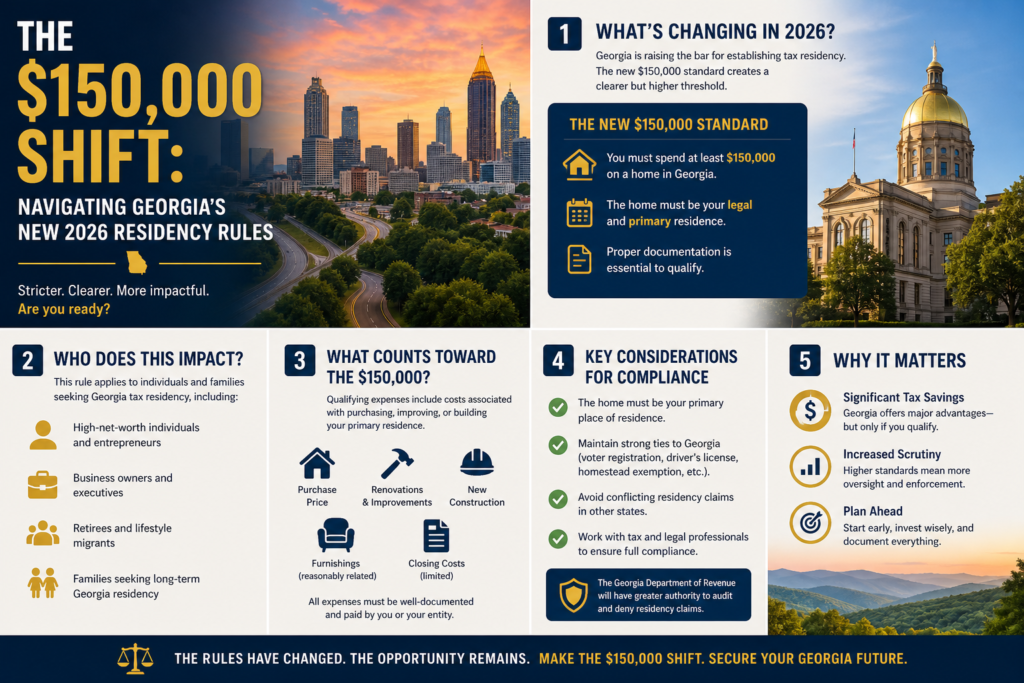
The $150,000 Shift: Navigating Georgia’s New 2026 Residency Rules
In the evolving landscape of state taxation and real estate investment, legislative shifts often serve as catalysts for significant economic migration.
As we approach 2026, the state of Georgia has introduced a transformative policy framework that is colloquially being referred to as The $150,000 Shift.
This regulatory adjustment fundamentally alters how high-net-worth individuals, remote workers, and real estate investors assess their domicile strategies within the Peach State.
Understanding this shift requires more than a surface-level look at tax brackets; it demands a granular analysis of residency definitions, nexus laws, and the intersection of physical presence with financial activity.
For those looking to optimize their real estate portfolio or long-term tax liability, navigating these new rules is no longer optional—it is a critical component of wealth preservation.
Understanding the Legislative Landscape of 2026
The 2026 residency rules in Georgia are a response to the increasing mobility of the workforce and the growing complexity of multi-state tax filings.
Historically, residency was defined primarily by the 183-day rule, a standard used by many states to determine if an individual is a statutory resident.
While that core principle remains, the new legislation introduces a specific financial threshold tied to deemed residency and capital gains allocation that impacts anyone earning or moving $150,000 or more in specific categories.
The Evolution of Statutory Residency
Under Georgia Department of Revenue (DOR) guidelines, statutory residency has traditionally been tethered to the amount of time spent within state lines.
However, the 2026 updates introduce a substantial economic nexus clause.
If an individual maintains a primary dwelling and derives income exceeding $150,000 from Georgia-sourced activities, the burden of proof regarding domicile shifts significantly toward the taxpayer.
The Core of the $150,000 Shift
The figure of $150,000 is not arbitrary.
It represents the median high-earning bracket for remote professionals and small-to-mid-sized business owners who frequently split their time between states.
Defining the Income Threshold
The new rules apply to the aggregation of income sources. This includes:
- Rental Real Estate Income: Earnings derived from investment properties located within Georgia.
- W-2 Compensation: Income earned while physically present in the state, even if the employer is based elsewhere.
- Capital Gains: Gains realized from the sale of Georgia-based real estate assets.
When these streams cross the $150,000 mark, the state’s tax authorities view the taxpayer as a participating resident, regardless of whether they consider another state their official domicile.
Strategic Implications for Real Estate Investors
For investors, the $150,000 shift is a double-edged sword.
On one hand, Georgia continues to offer a robust and growing real estate market.
On the other, the tax implications for out-of-state owners have intensified.
Managing Passive Income Portfolios
Investors who manage portfolios from abroad or from states with different tax structures must now account for the nexus tax applied to their Georgia revenue.
If your rental income in Atlanta or Savannah contributes to your $150,000 threshold, you are now effectively operating under a new compliance burden.
It is essential to consult with your tax professional regarding asset structuring to ensure that your LLC or holding company structure aligns with the 2026 residency requirements.
Failure to do so can result in hidden liabilities that erode your net operating income (NOI).
Residency Documentation: Proving Your Domicile
The most critical component of the 2026 rules is the heightened standard for proving—or disproving—residency.
If you claim to be a non-resident but earn over $150,000 in Georgia, the state now employs a primary connection audit.
The Primary Connection Audit
The state looks for four key indicators to establish your intent to maintain a domicile:
- Voter Registration and Driver’s License: A standard indicator, but now cross-referenced with DMV data.
- Utility Usage Patterns: The DOR now monitors high-usage utility accounts to determine physical occupancy during the year.
- Community Ties: Documentation of memberships, civic involvement, and professional licensing within the state.
- Financial Nexus: Where your banking and brokerage accounts are primarily managed.
Comparative Analysis: Georgia vs. Neighboring States
It is helpful to view the $150,000 shift in the context of the Southeastern United States.
Florida, for instance, maintains a strict no income tax stance, while South Carolina and Tennessee have their own unique complexities.
For many, the draw to Georgia remains strong due to its expanding housing markets and job growth.
However, the $150,000 shift forces investors to weigh the benefits of tax-friendly neighboring states against the tangible appreciation of Georgia property.
Remote Work and the Hybrid Professional
The shift has hit the remote workforce the hardest.
Many professionals who relocated during the remote-work boom now find themselves in a precarious position.
If you earn over $150,000 as a remote employee and live in a Georgia home, you are effectively a resident in the eyes of the state, regardless of your employer’s HQ.
Planning for Payroll Taxes
If you are an employer or a self-employed contractor, you must prepare for a transition in payroll tax withholding.
The Georgia Department of Revenue has integrated automated monitoring systems to detect wage patterns that exceed the $150,000 threshold, flagging accounts that do not have state income tax withheld.
Proactive Steps for Compliance
Rather than viewing these regulations as an obstacle, savvy individuals should approach them as a planning opportunity.
- Conduct a Nexus Audit: Review your income sources to determine if you are approaching the $150,000 mark.
- Separate Assets: Consider moving non-Georgia income streams into entities that are clearly separated from your Georgia-based activities.
- Maintain a Presence Journal: Keep a detailed calendar of your days in and out of the state. While the 183-day rule is no longer the sole metric, it remains a foundational piece of evidence in any residency dispute.
- Engage Experts Early: Do not wait for a notice from the DOR. Proactive communication with a tax attorney or experienced real estate advisor can save you from penalties and ensure your financial house is in order.
The Future of Georgia’s Tax Environment
The $150,000 shift is likely just the beginning.
As states look for ways to capture revenue from increasingly mobile, digital-first economies, we should expect further refinements to how income is sourced and taxed.
Georgia’s approach suggests a desire to harmonize tax collection with the reality of high-earning, multi-state residents.
For investors and residents alike, the takeaway is clear: the era of passive tax residency has ended.
Precision, documentation, and strategic planning are now the requirements of doing business and living in Georgia.
Conclusion
Navigating the $150,000 shift is a necessary evolution for anyone with skin in the Georgia real estate game or those choosing to call the state home.
By understanding the legislative intent behind the 2026 rules and preparing your financial profile to meet these standards, you can continue to leverage the incredible economic opportunities Georgia offers without falling victim to regulatory pitfalls.
As you plan your financial year, remember that real estate is never just about the property—it is about the regulatory environment that surrounds it.
Stay informed, stay compliant, and leverage the resources available to ensure your investments remain protected.
Disclaimer: This article is for informational purposes only and does not constitute legal or tax advice. Laws are subject to change, and individual circumstances vary. Please consult with a qualified professional before making significant financial or residency decisions.
Further Reading from Real Estate Moses, click here.

Bellamy West is a modern-day nomad with a Victorian soul. Bella is an international real estate contributor for Real Estate Moses, where she tracks premium trophy assets, luxury enclaves, and global capital deployment. Writing as Agent Bella, her expertise centers on high-yield safe havens and foreign investment policy across premier markets like Singapore. Bella excels at breaking down complex luxury market restrictions and wealth preservation strategies for elite global buyers.