Batumi vs. Tbilisi: Where to Chase 12% Rental Yields in 2026
The Georgian real estate market has undergone a profound transformation over the last decade.
Once considered a frontier market, Georgia—specifically Tbilisi and Batumi—has emerged as a focal point for international investors seeking high-yield assets.
As we look toward 2026, the prospect of securing a 12% rental yield is no longer just a speculative goal; it is a measurable objective for those who understand the divergent economic drivers of the capital city versus the Black Sea resort hub.
To navigate this landscape, investors must move beyond surface-level metrics.
We must dissect the demographic shifts, the nuances of short-term versus long-term leasing, and the impact of the Georgian tax framework on net profitability.
The Macroeconomic Context: Why Georgia?
Before comparing specific cities, it is essential to understand the country’s unique position.
Georgia acts as a bridge between Europe and Asia.
Its pro-business economic policies have consistently ranked it among the easiest places in the world to do business, according to the World Bank’s historical data.
The rental yield—often cited as the primary driver for investment—is influenced by the limited supply of high-end, energy-efficient housing and the growing influx of digital nomads and international professionals.
While 12% yields are ambitious, they are achievable in specific pockets of these markets through a combination of capital appreciation and aggressive yield management.

Tbilisi: The Engine of Stability and Longevity
Tbilisi, the capital, offers a vastly different investment proposition than Batumi.
It is a city of 1.2 million people with a consistent, year-round demand for housing.
The Dynamics of Long-Term Rentals
In Tbilisi, the most reliable path to a 10-12% yield is often found in long-term rentals (12-month contracts).
Unlike the seasonal volatility of a resort town, Tbilisi experiences high occupancy rates throughout the year.
The capital is the hub for Georgia’s educational institutions and international corporate headquarters, creating a steady stream of domestic and foreign tenants.
If you are exploring the nuances of property management in the city, our guide on how to maximize your rental income in Tbilisi provides a deep dive into tenant acquisition and retention.
Key Investment Districts in Tbilisi
To chase high yields in 2026, investors must look beyond the historic Old Town, which—while aesthetically pleasing—often carries premium price tags that compress yields.
- Vake and Saburtalo: These are the established residential hubs. Demand here is inelastic; professionals want to live near the business centers and the university districts.
- Digomi and Krtsanisi: These developing districts offer lower entry prices per square meter. By purchasing pre-construction or early-stage properties in these areas, investors can see yield expansion as infrastructure improves.
Batumi: The High-Octane Resort Market
Batumi is the jewel of the Black Sea. Its economy is cyclical, tied almost exclusively to tourism and summer vacation demand.
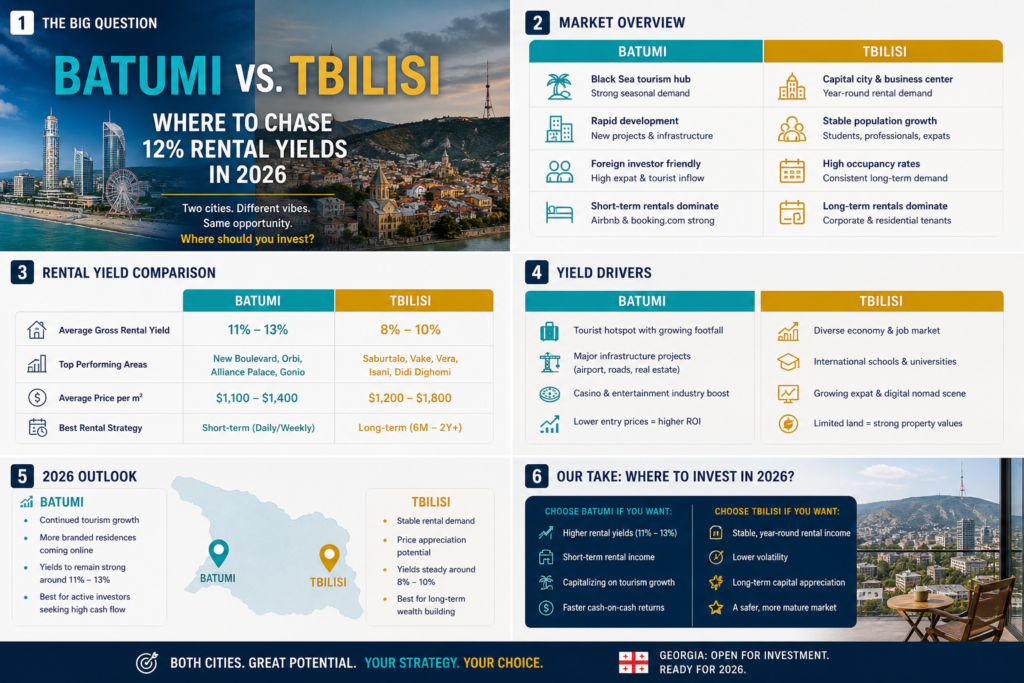
Investors chasing that elusive 12% yield in Batumi are generally betting on the Short-Term Rental (STR) model.
The STR Strategy and Operational Overhead
To hit a 12% yield in Batumi, you cannot use a passive strategy.
You are essentially operating a boutique hotel.
You must account for cleaning fees, platform commissions (Airbnb/Booking.com), and the intense seasonality.
During the months of June through September, occupancy in premium beachfront properties can reach 90-100%.
However, during the winter months, demand plummets.
Successful investors in Batumi often leverage property management services to ensure that their units remain visible on digital platforms throughout the year.
Without professional management, your Batumi unit may sit empty for 5-6 months, effectively neutralizing the gains made during the peak season.
Infrastructure Projects and Future Growth
Batumi is not just a vacation spot; it is a logistics and gambling hub. Major international hotel chains—Hilton, Sheraton, Radisson—have established a strong presence here.
When evaluating a property in Batumi, proximity to the New Boulevard area is critical.
This region is seeing the highest concentration of new, high-amenity developments that cater to international tourists who demand high-speed internet and modern facilities.
Comparative Metric Analysis: Tbilisi vs. Batumi
When deciding between these two, consider the following structural differences that will impact your bottom line by 2026.
| Feature | Tbilisi | Batumi |
|---|---|---|
| Primary Tenant | Professionals/Students | Vacationers |
| Yield Profile | Consistent, lower volatility | Seasonal, high variance |
| Occupancy Risk | Low (if priced correctly) | High (winter months) |
| Growth Potential | High (urban expansion) | High (tourist capacity) |
The Cost of Entry vs. Yield Potential
Tbilisi generally has a higher cost of entry for prime locations.
Batumi allows for a lower initial investment, which can mathematically lead to a higher percentage yield if the property is managed as an STR.
However, the management costs in Batumi are significantly higher than the relatively hands-off nature of a long-term lease in Tbilisi.
If you are currently evaluating your portfolio and wondering how the market cycle affects your choices, click here to explore more on understanding the Georgian market cycle.
Key Risks for 2026 and Beyond
No investment is without risk.
For those aiming for 12% yields, you must be aware of the yield trap.
1. Market Oversupply
Both cities are undergoing a construction boom.
If the supply of new apartments outpaces the growth in tourism (Batumi) or population (Tbilisi), rental prices will stabilize or contract.
Investors must favor properties with unique value propositions—high-quality finishing, amenities (pools, gyms), and proximity to key transit nodes—to ensure their asset remains competitive in an overcrowded market.
2. Currency Fluctuations
While rental contracts in Georgia are often denominated in USD or EUR for foreign investors, the local currency (GEL) can be volatile.
Understanding the National Bank of Georgia’s interest rate policy is crucial for those leveraging their investment with local loans.
3. Regulatory Changes
Georgia is moving toward stricter regulations on property management and tax compliance for short-term rentals.
Ensure your investment includes a budget for professional accounting services to remain compliant with evolving tax laws.
Strategic Recommendations for the 2026 Investor
If your primary goal is a 12% yield, your choice depends on your personality and risk tolerance:
- The Yield Optimizer (Batumi): You are an active investor. You enjoy managing hospitality assets, you are comfortable with seasonality, and you want to focus on high-traffic tourist zones like the New Boulevard. You will hit your 12% yield by maximizing peak summer rates and optimizing your cleaning and turnover costs.
- The Capital Preserver (Tbilisi): You are a passive investor. You prefer stable, long-term tenants who pay on time, every month. You will achieve your target yield through careful selection of emerging districts (like Digomi) and by purchasing high-quality, mid-range units that attract the growing class of international and local professionals.
Conclusion
The pursuit of a 12% rental yield in Georgia is a sophisticated endeavor that requires a departure from buy-and-forget investment strategies.
Tbilisi offers the safety of a capital city with deep demographic roots, while Batumi provides the high-octane growth potential of an emerging resort destination.
By 2026, the winners in this market will be the investors who prioritized location, property management, and strategic asset selection.
As you develop your strategy, remember that market data is your strongest asset.
For continuous updates on the evolving landscape, visit our full library of investment resources.
Disclaimer: Real estate investments carry inherent risks. This article is for informational purposes and does not constitute financial advice. Always conduct your own due diligence and consult with a licensed professional before making significant financial decisions in a foreign market.