
For decades, the global vacation timeshare was the ultimate symbol of an aspirational lifestyle, a literal key to a slice of paradise, or at least a gated community in Tenerife or Orlando with a dependable pool.
It was a product sold on the promise of forever, pitched in high-pressure sales rooms where the scent of coconut lotion mingled with the desperation of a closing quota.
But as we move deeper into 2026, those laminated certificates of right-to-use are increasingly being viewed not as assets, but as liabilities, relics of a bygone era of inflexible travel and predatory maintenance fees.
The death of the timeshare hasn’t been a sudden cardiac event; it has been a long, slow cooling of the heels. The traditional model, where one owns a specific week in a specific unit has collapsed under the weight of its own lack of liquidity.
As Finn notes, traditional timeshares have a “negative value.” Owners list them on eBay for $1.00 and offer to pay the closing costs themselves just to escape the $1,500+ annual maintenance fees.
You had people literally paying companies thousands of dollars just to take the deed off their hands. It was the only asset in the world where the fair market value was frequently negative.
Enter the year of the tokenized fractional deed. While the tech-utopian buzzwords of the early 2020s have largely faded into the background, the underlying plumbingblockchain-based ledgers has finally found its killer app in the most traditional of sectors: luxury real estate.
Unlike the timeshare, which gave you the right to occupy a space, tokenization offers something fundamentally different: fractional ownership. In 2026, the distinction is no longer academic.
To own a token of a beachfront villa in Tulum or a high-rise apartment in the Dubai Marina is to own a proportional share of the underlying real property.
It is recorded on a transparent, immutable registry that doesn’t require a notary, a mountain of paperwork, or a thirty-year commitment.

The shift is palpable. In the glass-walled offices of Singapore and the boutique agencies of West Palm Beach, the conversation has moved from inventory to liquidity.
The modern traveler doesn’t want to be locked into Week 42 in a specific zip code. They want a real estate investment that grows with the market and one they can exit with a single click on a smartphone.

The rise of tokenized fractional deeds in 2026 is, at its core, a story of democratization.
For the better part of a century, the highest-yielding asset class prime urban and resort real estate was the exclusive playground of the ultra-wealthy and institutional REITs.
If you didn’t have $5 million for a down payment on a commercial block in Milan, you were on the outside looking in.
Now, the barriers to entry have been dismantled by code.
By sharding a property deed into thousands of digital tokens, developers are allowing retail investors to buy into Grade-A assets for as little as $1,000.
We aren’t just selling a vacation; we’re selling a stake in the skyline, explains a CEO of a firm with plans for a tokenized historic brownstone restoration in Brooklyn and a luxury lodge in the Swiss Alps.
This model mirrors the New York trend of fractional luxury, where residents share the equity of a building’s common spaces while maintaining private quarters.
But on a global scale, it has completely upended the old timeshare math.
In the old world, nearly 60% of a timeshare’s purchase price went toward marketing and sales commissions.
In the world of tokenized deeds, that marketing fat is trimmed away. The value is in the bricks, mortar, and the smart contract.
The 2026 market is also benefiting from newfound regulatory clarity.
As 2025 marked the convergence of several regional, national, and international frameworks that created a “globalized” shift towards legalized property tokenization.
This has invited the suits into the room; major banks are now offering custodial services for real-world assets (RWA), lending the space a veneer of institutional respectability.
Investors are no longer searching for vacation rentals; they are looking for blockchain property investment and fractional ownership vs timeshare comparisons.
We are seeing a move away from speculative digital art and toward tangible, yield-generating property.
The result is a market that feels less like a casino and more like a global stock exchange for rooftops.
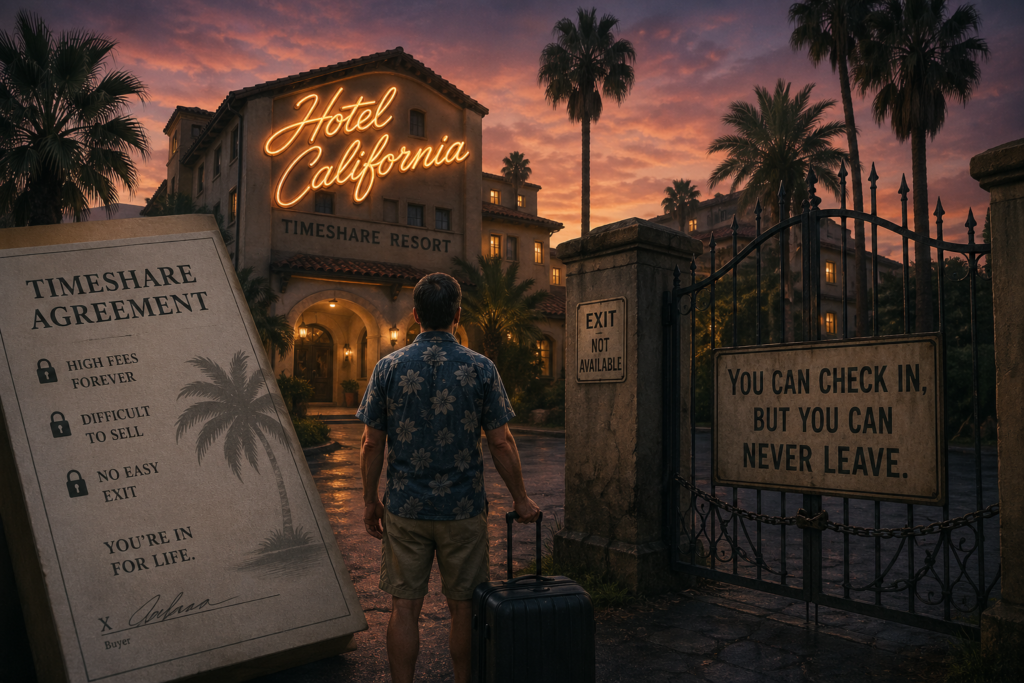
Perhaps the most damning indictment of the traditional timeshare was its Hotel California nature: you could check in, but you could never leave.
The lack of a secondary market meant that owners were trapped in a cycle of rising maintenance fees, often passing the burden down to their children like a cursed heirloom.
In 2026, the liquidity of tokenized real estate has solved the exit problem.
Because these deeds exist as tokens on public or private blockchains, they can be traded on secondary exchanges with the same ease as a share of a blue-chip company.
If an owner decides they’d rather spend their summers in the Algarve instead of the Amalfi Coast, they don’t need a specialized broker or a six-month closing period.
They simply list their tokens on a global marketplace.
“The psychological shift is massive,” says Sarah Chen, a 34-year-old software engineer who owns fractions of four different properties across three continents. “I don’t feel ‘owned’ by my vacation home. I own the home. If the market in Lisbon gets hot, I sell my tokens for a profit. If I want to stay there, I use my owner’s points to book a stay. It’s an asset that acts like a service.”
This New Mobility is the hallmark of the 2026 real estate landscape.
It caters to a generation that values flexibility over permanence.
The tokenized fractional deed aligns perfectly with the digital nomad lifestyle, but with a crucial twist: it encourages wealth building rather than just consumption.
The consumer is no longer looking for a getaway; they are looking for a liquid real estate investment.
The death of the timeshare is essentially the death of the fixed-use mindset.
The 2026 investor wants a diversified basket of properties: a bit of a ski chalet in Aspen, a slice of a warehouse in Lagos, and a fraction of a villa in Bali.
They are no longer tethered to one location; they are tethered to a portfolio.
As we look toward the final quarters of 2026, the question is no longer if real estate will be tokenized, but how quickly the remaining legacy players can adapt.
The massive hospitality brands that once relied on timeshare revenue are frantically pivoting.
Global hotel giants are beginning to experiment with their own Equity Clubs, where membership isn’t a fee, but a fractional ownership stake.
However, the Old Guard faces a steep climb.
The transparency of the blockchain is the natural enemy of the opaque fee structures that made timeshares so profitable for developers.
In the new world of decentralized property management, every cent of rental income is distributed automatically via smart contract.
There is no hidden management fee; the code is the law.
The 2026 landscape also sees the rise of DAOs (Decentralized Autonomous Organizations) for property management.
Imagine a beachfront condo where the owners, thousands of token holders vote on whether to renovate the lobby or change the landscaping through a digital ballot.
It sounds like science fiction, but in the luxury corridors of Dubai and Singapore, it is already the status quo.
The era of the sunk cost vacation is over.
The year 2026 marks the definitive moment when the deed was liberated from the filing cabinet and placed onto the smartphone.
The timeshare didn’t just die; it evolved into something it was always meant to be: a liquid, transparent, and profitable piece of the world.
As the sun sets on the age of the maintenance fee, a new dawn of fractional equity rises, offering a seat at the table for everyone, not just those with a key to the executive suite.
In the end, the most valuable luxury of 2026 isn’t the view of the ocean; it’s the ability to own the view, and the freedom to sell it whenever you please.
The deed is no longer a paper trail; it is a digital heartbeat of global commerce.

Moses Oyong is a luxury real estate advisor with a passion for arts and culture, music, fashion, and all things luxurious. With a keen eye for beauty and attention to detail. I strive to help my clients find their dream homes that reflect their unique sense of style and taste whilst providing them with the right information to ease the stress of the decision-making process.