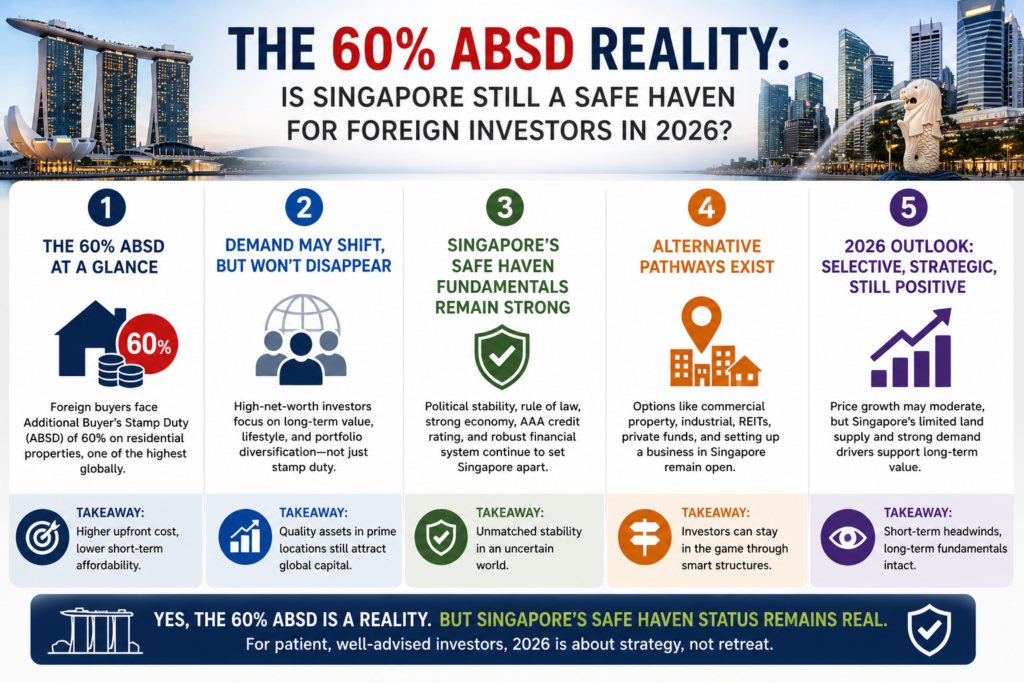
The 60% ABSD Reality: Is Singapore Still a Safe Haven for Foreign Investors in 2026?
In the global real estate landscape, few markets have historically commanded the prestige and stability of Singapore.
Known for its robust legal framework, political neutrality, and world-class infrastructure, the city-state has long been a safe haven for capital preservation.
However, the introduction of the 60% Additional Buyer’s Stamp Duty (ABSD) for foreigners has fundamentally altered the investment calculus.
As we navigate through 2026, many international investors find themselves at a crossroads.
Is the Singapore property market still a viable wealth preservation vehicle, or have the cooling measures finally cooled the appetite of global capital?
This article explores the current state of the market, the impact of high taxation, and how investors are pivoting their strategies.
Understanding the Landscape: The 60% ABSD Explained
To understand the current sentiment, we must first look at the mechanics of the cooling measures.
The Singapore government has consistently utilized the ABSD as a surgical tool to ensure housing affordability for its citizens and to prevent an overheating market.
What is ABSD?
The Additional Buyer’s Stamp Duty is a tax levied on top of the standard Buyer’s Stamp Duty (BSD).
While citizens enjoy tiered or zero ABSD for their first residential property, foreign entities and individuals currently face a flat rate of 60%.

Why 60%?
The 60% figure represents one of the highest property tax rates for foreigners in the developed world.
The rationale is two-fold:
- Demand Management: To discourage speculative demand that could drive up prices beyond the reach of local residents.
- Wealth Redistribution: To ensure that the primary beneficiaries of Singapore’s land scarcity are its citizens and permanent residents.
For a deeper dive into how tax rates have evolved over the years, check out our guide on to understand Singapore property setup.
Interactive Singapore ABSD Calculator
Use the widget below to estimate your total tax liability based on your profile and the number of properties you hold.
(Note: This is a simulation tool. Always consult with a tax professional regarding your specific residency status and applicable Free Trade Agreements.)
ABSD Calculator (2026)
Use the widget below to estimate your total tax liability based on your profile and properties held.
Note: This is a simulation. Consult a tax professional for specific residency status or FTAs.
Is Singapore Still a Safe Haven?
Despite the steep 60% barrier, the safe haven status of Singapore is not defined by quick flipping or high-frequency trading.
Instead, it is defined by long-term asset security.
Capital Preservation over Capital Gains
Investors today are no longer looking for 20% year-on-year growth.
They are looking for a jurisdiction where their capital will not be seized, where the currency (SGD) is pegged to a trade-weighted basket, and where the rule of law is absolute.
- Example: A high-net-worth individual from a volatile political region may choose to pay the 60% tax as a premium to secure a trophy asset in the Core Central Region (CCR) of Singapore, viewing the tax as an insurance policy for their wealth.
The Flight to Quality
In 2026, we see a clear trend: foreign capital has shifted away from mass-market suburban condos toward trophy assets—prime district bungalows, luxury penthouses, and heritage shophouses.
If you are considering luxury acquisitions, read our section for more about selecting prime property in Singapore.
Strategic Pivots: How Investors are Adapting
When a tax barrier is this high, intelligent capital adapts rather than retreats.
Here are the three most common strategies adopted by foreign investors in 2026.
1. Seeking Exemptions via Free Trade Agreements (FTAs)
Singapore has several FTAs that treat nationals and permanent residents of specific countries (e.g., the USA, Switzerland, Liechtenstein, Norway, and Iceland) similarly to Singapore citizens regarding ABSD.
Investors from these nations often find themselves at a significant advantage.
2. Commercial Real Estate
ABSD is strictly a residential tax. As a result, the commercial sector—including strata-titled offices and retail shops—has seen a surge in interest from foreign family offices.
These assets do not attract ABSD, offering a way to gain exposure to the Singapore market while bypassing the 60% levy.
3. The Permanent Residency Path
For those with a multi-year horizon, the goal is often to establish residency.
By becoming a Permanent Resident (PR), the tax burden drops significantly.
While the road to PR is rigorous, it remains the most effective long-term tax optimization strategy for real estate investors.
The Role of Family Offices in 2026
Singapore has successfully positioned itself as the Switzerland of Asia for family offices.
These entities, managed by professional teams, often look at real estate as a 10-to-20-year hold.
For a family office, the 60% ABSD is simply an entry cost that is amortized over two decades.
When viewed as a cost of doing business in one of the world’s most stable economies, the hurdle becomes manageable.
To understand how to set up your investment framework, visit this article on managing family wealth in Singapore.
Risk Factors to Consider
Even in a safe haven, risks persist.
Investors in 2026 must be mindful of:
- Interest Rate Fluctuations: While the Fed cycle may have stabilized, Singapore’s mortgage rates remain sensitive to global liquidity.
- Rental Yield Compression: With high taxes, your net rental yield may be lower than in other global cities. Investors should prioritize capital appreciation potential over immediate cash flow.
- Regulatory Changes: The Singapore government reserves the right to adjust cooling measures at any time. A further tightening or an unexpected loosening of rules can impact market sentiment overnight.
The Verdict: A Tactical View
Is Singapore still a safe haven in 2026?
Yes, but it is no longer a destination for the casual investor.
The 60% ABSD has effectively filtered out speculative, short-term capital.
What remains is a market of serious money—investors who value safety, stability, and legal certainty above all else.
If you are entering the market today, you should focus on:
- Long-term holding periods (5+ years).
- Diversifying into commercial assets if residential tax burdens are prohibitive.
- Professional structuring to ensure you are utilizing all available tax treaties.
As you finalize your investment strategy, always ensure you have the latest data on transaction volumes and price indices.
For up-to-date market analysis, keep an eye on our monthly market reports.
Disclaimer: This article is for educational purposes and does not constitute financial or legal advice. Property investment involves significant risk. Always seek professional advice from licensed real estate agents and tax specialists before making financial commitments.