Commercial vs. Residential: Why Smart Money is Pivoting to Grade A CBD Offices in 2026
The real estate investment landscape has undergone a seismic shift over the last half-decade.
Following the post-pandemic uncertainty that saw many investors flee city centers in favor of suburban residential plays, a new narrative is emerging for 2026.
Institutional capital, family offices, and sophisticated investors are quietly—but decisively—pivoting back to Grade A Central Business District (CBD) office assets.
While residential real estate has long been touted as the safe haven of the investment world, the current macroeconomic climate reveals a more nuanced reality.
This article explores the structural shift in the market, the divergence between office classes, and why the smart money is betting on the revitalization of the premier urban workplace.
The Residential Mirage: Why Diversification is No Longer Enough
For years, residential real estate—multifamily, single-family rentals, and suburban housing—was the darling of the investment community.
Driven by low interest rates and a housing shortage, residential yields were predictable and robust.
However, as we approach 2026, the residential sector faces significant headwinds.
The Saturation of Suburbia
The work-from-home boom led to a massive migration toward residential sprawl.
This flooded the market with new construction in secondary and tertiary residential hubs.

Today, many of these markets are experiencing supply gluts, leading to stagnant rental growth and compressed margins for landlords dealing with rising maintenance costs and property taxes.
Regulatory and Economic Constraints
Residential property is increasingly becoming the target of aggressive legislative action, including rent control measures and stricter tenant protection laws.
When coupled with the high cost of debt, the set it and forget it residential model is showing cracks.
For investors looking for long-term capital preservation, residential assets are no longer the untouchable gold mine they once were.
To understand how to navigate residential shifting markets, check out our guide on Analyzing Property Trends using Predictive AI.
Defining the Asset Class: What Makes Grade A Different?
One of the greatest misconceptions in the modern property market is the belief that the office is dead.
The truth is more specific: mediocre office space is struggling, while exceptional office space is thriving.
The Flight to Quality
In 2026, the commercial real estate market is bifurcated.
Grade B and C office buildings—often characterized by outdated HVAC systems, poor floor plates, and lack of amenities—are indeed seeing high vacancy rates.
However, Grade A CBD offices are seeing a flight to quality.
Corporations are realizing that to attract talent back to the office, they need space that functions as an experience, not just a cubicle farm.
Technical Specifications of Grade A Assets
A Grade A building in 2026 isn’t just about a prestigious zip code. It encompasses:
- ESG Compliance: High-efficiency glass, LEED Platinum or WELL certifications, and carbon-neutral operations.
- Technological Integration: Hyper-fast connectivity, smart building management systems, and touchless entry.
- Amenity-Rich Environments: Modern fitness centers, high-end tenant lounges, wellness rooms, and proximity to transit hubs.
Why the CBD Pivot? The Logic Behind the 2026 Shift
Why are institutional investors pivoting away from residential and back into the heartbeat of the city?
The answer lies in the fundamental transformation of the CBD.
The 15-Minute City Effect
Modern urban planning is focusing on the 15-minute city concept, where work, life, and leisure are integrated.
CBDs are no longer just business zones; they are being revitalized with luxury residential conversions and lifestyle-oriented retail.
Grade A office buildings are the anchor tenants of this transformation.
High-Barrier-to-Entry Markets
Unlike residential properties, which can be built on any patch of suburban land, Grade A CBD office sites are finite.
The scarcity of high-quality, centrally located land creates a natural economic moat.
Investors who own these assets in 2026 benefit from the inability of competitors to replicate that specific location or quality.
Are you curious about how location impacts asset valuation? Learn more in our deep dive into Location Analysis for Real Estate using Predictive AI.
The Economic Argument: Yields and Capital Appreciation
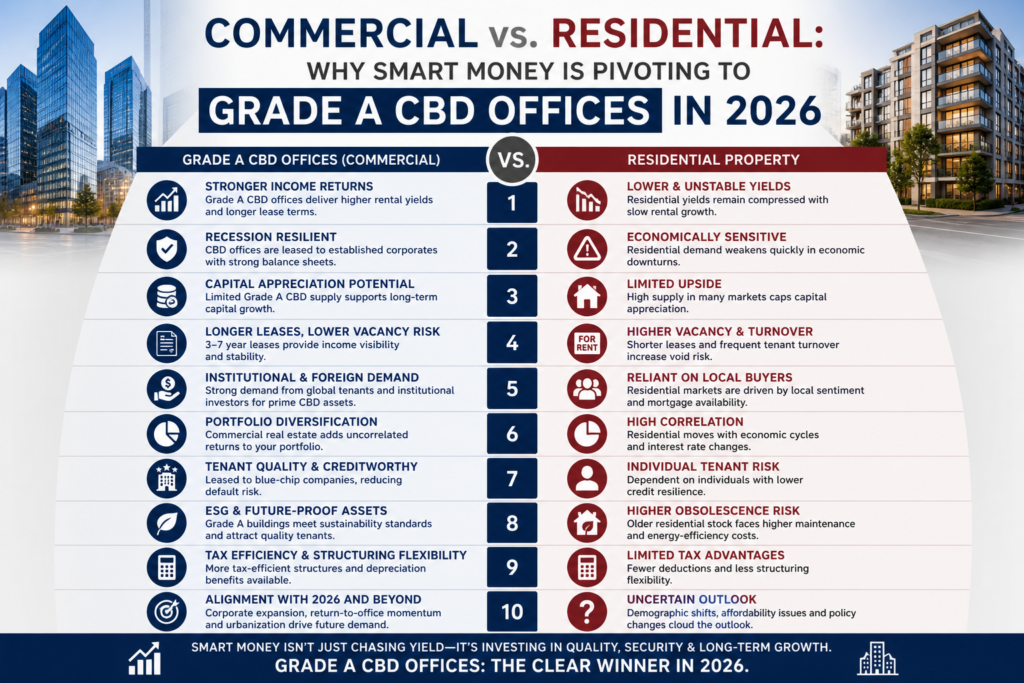
When comparing commercial to residential, investors are beginning to pivot based on the current yield-to-risk ratio.
The Resilience of Triple Net Leases
While residential leases are typically 12-month agreements, commercial assets often feature Triple Net (NNN) leases.
In these arrangements, the tenant is responsible for property taxes, building insurance, and maintenance.
This provides a level of income stability that residential properties, with their frequent turnover and repair cycles, struggle to match.
Capitalizing on Repricing
Because the general public perceives the office as a struggling sector, many Grade A assets have been priced at a discount compared to their actual replacement cost.
Savvy investors are entering the market now, acquiring premier assets at a discounted entry price while anticipating the long-term appreciation that comes with urban renewal.
Future-Proofing: How ESG is Reshaping Commercial Real Estate
In 2026, you cannot discuss commercial real estate without discussing ESG (Environmental, Social, and Governance).
Grade A office buildings are the only assets that currently meet the strict sustainability mandates being imposed by both governments and institutional capital allocators.
Energy Efficiency as a Competitive Advantage
Older buildings are becoming stranded assets because they cannot be retrofitted to meet energy standards without massive capital expenditure.
Grade A buildings are already built with these standards, meaning they face less regulatory risk.
Tenant Demand for Wellness
Post-2025, corporations have made employee wellness a core pillar of their hiring strategy.
They are signing long-term leases exclusively in buildings that offer fresh air filtration, natural light, and green spaces.
This demand isn’t going away; it is becoming the new baseline for top-tier talent acquisition.
For more on how to vet commercial properties for long-term health, visit here for the Commercial Real Estate Checklist.
Case Study: The Transformation of Traditional CBDs
Take, for example, the shift in major hubs like New York, London, or Tokyo.
A decade ago, these districts emptied out at 5:00 PM.
Today, they are 24-hour ecosystems.
The Example of the Mixed-Use Anchor
Investors are seeing the success of Grade A buildings that serve as the anchor for mixed-use developments.
By providing the office space for a company’s regional headquarters, while also having high-end retail on the ground floor and luxury apartments above, the asset becomes a self-sustaining ecosystem.
- Financial Impact: These buildings experience 10-15% higher retention rates than standalone assets.
- Market Stability: Even when residential sectors face a downturn, the commercial anchor remains protected by long-term corporate leases.
Challenges and Risks: What Investors Must Watch
While the pivot to Grade A CBD offices is a smart move, it is not without risk.
Smart money does not ignore the complexities of the landscape.
Interest Rate Sensitivity
Commercial real estate is heavily reliant on debt.
While yields are strong, the cost of borrowing for massive office towers can be prohibitive if not managed correctly.
Investors must have a clear path to refinancing and a healthy loan-to-value ratio.
The B-to-A Conversion Hurdle
Many investors are attempting to convert Grade B buildings into Grade A.
This is a high-risk strategy.
The architectural requirements to turn a 1980s office block into a 2026-standard workspace are immense.
Investors should favor assets that are already born Grade A, rather than those requiring structural gut-renovations.
Conclusion: The Strategic Outlook for 2026
The pivot from residential back to Grade A CBD office space is not a return to the past; it is an evolution toward a more specialized future.
The investors who are winning in 2026 are those who understand that value is increasingly tied to quality, sustainability, and urban integration.
As residential markets struggle with supply and regulation, the limited inventory of world-class office space provides a compelling opportunity for capital appreciation and steady cash flow.
The smart money is moving toward the city center, not because they are clinging to old habits, but because they recognize the enduring power of the premier physical workplace.
Are you ready to optimize your portfolio?
Real estate is a dynamic field, and staying ahead of the curve requires constant learning.
For more resources on balancing your portfolio and understanding macro-market movements, explore our Investment Strategy Library Using Predictive AI.
Disclaimer: This article is for educational purposes and does not constitute financial advice. Always conduct your own due diligence and consult with a professional advisor before making investment decisions.