Good Class Bungalows (GCBs): Why Singapore’s Most Restricted Asset Is Its Best Performer
In the landscape of Singapore’s hyper-competitive real estate market, few asset classes command as much prestige—and intrigue—as the Good Class Bungalow (GCB).
Often referred to as the crème de la crème of residential property, GCBs represent the pinnacle of luxury living in the Lion City.
But beyond the manicured gardens, private swimming pools, and architectural grandeur lies an asset class defined by stringent government restrictions and an incredibly finite supply.
For the savvy investor, understanding the unique ecosystem of GCBs is essential.
These properties are more than just homes; they are historical artifacts, status symbols, and, perhaps most importantly, high-performing wealth preservation tools.
In this guide, we explore why GCBs remain Singapore’s most resilient and sought-after real estate asset.
Defining the Good Class Bungalow: What Sets Them Apart?
A Good Class Bungalow is not merely a large house.
It is a strictly defined property category regulated by the Urban Redevelopment Authority (URA) of Singapore.
To qualify as a GCB, a property must meet specific criteria that protect its exclusivity and maintain the character of Singapore’s designated heritage areas.
The Zoning Requirements
The URA has designated 39 specific areas in Singapore as GCB Areas (GCBAs), including prestigious locales like Nassim Road, Cluny Hill, and Bishopsgate.

To be classified as a GCB, a property must satisfy two primary physical constraints:
- Minimum Land Size: The plot must be at least 1,400 square meters (approximately 15,070 square feet).
- Site Coverage: The house cannot occupy more than 40% of the land area, ensuring that every GCB retains significant green space, gardens, and privacy buffers.
The Prestige of Scarcity
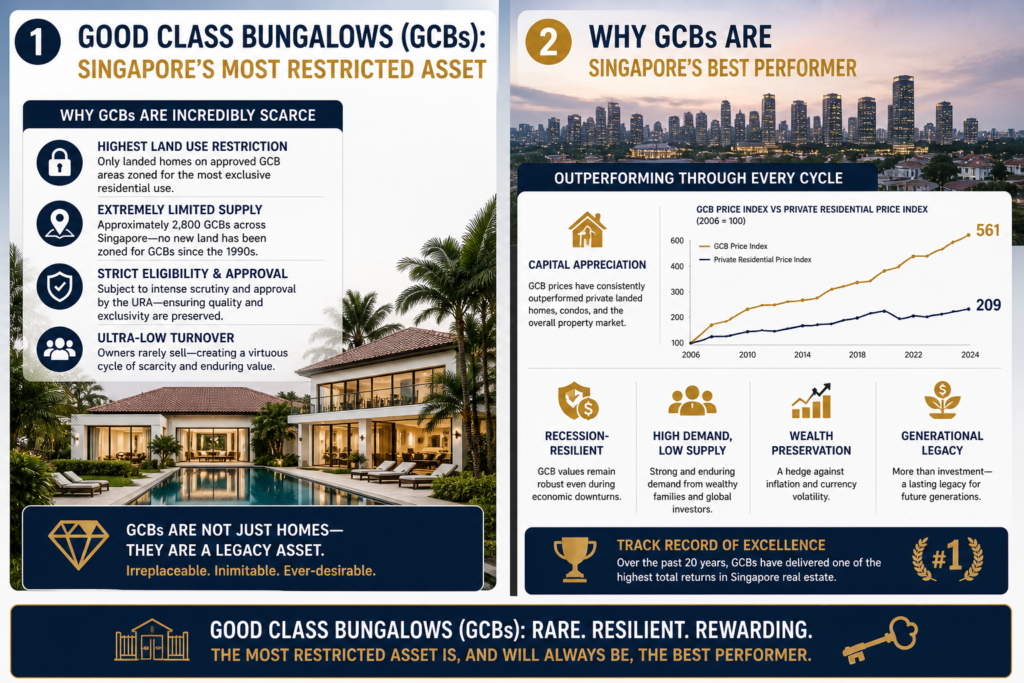
Because these zones are gazetted and the land requirements are so rigid, the supply of GCBs is effectively capped.
There are fewer than 2,800 GCBs in the entire country. Unlike condominium developments or HDB flats, which can be built vertically to increase density, the footprint of GCBs is fixed.
This extreme scarcity is the primary driver of their long-term value appreciation.
For those interested in how these property types compare to other luxury segments, read this guide on The Hierarchy of Singapore Real Estate.
Why GCBs are the Ultimate Wealth Preservation Asset
When global markets face volatility, high-net-worth individuals (HNWIs) turn to assets that offer land scarcity.
In a land-scarce nation like Singapore, GCBs are the ultimate manifestation of this principle.
Capital Appreciation Through Scarcity
In economics, when supply is inelastic (meaning it cannot increase) and demand grows, prices must rise.
As Singapore continues to grow as a global financial hub, the number of individuals capable of purchasing a GCB increases, but the number of GCBs remains the same.
This creates a permanent upward pressure on prices.
Hedging Against Inflation
Unlike paper assets, which can be devalued by monetary policy, a GCB is a tangible, indestructible asset.
Historically, GCBs have demonstrated an uncanny ability to outperform inflation, consistently delivering capital gains over long-term holding periods—often spanning decades.
Privacy and Exclusivity
GCBs are not just a financial play; they are a lifestyle choice.
They offer a level of privacy that is impossible to achieve in high-rise luxury living.
With the 40% rule, owners are guaranteed neighbors who are separated by significant distances and lush greenery.
This privacy is a luxury that never goes out of style.
The Regulatory Landscape: Understanding the Restrictions
The restriction in the GCB market is precisely what makes it a best performer.
The government of Singapore has been careful to protect these areas from over-development, which keeps the allure of the asset class intact.
Ownership Restrictions for Foreigners
One of the most critical factors for potential buyers is the restriction on foreign ownership.
Generally, only Singapore citizens are permitted to purchase landed residential property in Singapore.
While Permanent Residents (PRs) may apply to the Singapore Land Authority (SLA) for approval to buy a landed property, such approvals are granted sparingly and on a case-by-case basis.
- Impact on Market Stability: By limiting the buyer pool, the government prevents speculative flipping by foreign investors, ensuring that the GCB market remains dominated by long-term holders and families.
- Approval Criteria: The SLA looks for applicants who have made significant economic contributions to Singapore and intend to live in the home as their primary residence.
If you are exploring the legal pathways to property ownership, this article on Foreigner Ownership Rules in Singapore breaks down the requirements for non-citizens.
Investment Strategy: Renovate, Subdivide, or Hold?
Investing in a GCB is not a get rich quick scheme.
It is a long-term play that requires a deep understanding of the regulatory nuances.
The Art of Asset Enhancement
Because GCBs are often older properties, there is significant value-add potential in the form of architectural renovation or reconstruction.
Many investors purchase older, classic bungalows with the intent of knocking them down and building a modern, sustainable masterpiece.
Subdividing Plots (A Rare Opportunity)
While the rule states a minimum of 1,400 square meters, some older plots exist that are significantly larger (e.g., 3,000+ square meters).
In rare instances, owners may be able to subdivide these plots into two smaller GCB-compliant lots.
This is a highly lucrative but legally complex maneuver that requires expertise in URA planning regulations.
The Land-Holding Mentality
Smart GCB investors treat the property as a family legacy. Many families have held these properties for multiple generations, capturing the exponential growth of the Singapore land market.
In the GCB market, the time-in-the-market beats timing-the-market every single time.
Case Study: The Nassim Road Phenomenon
Nassim Road is arguably the most famous GCB address in Singapore.
Located near the Singapore Botanic Gardens and the Orchard Road shopping belt, it is the home of billionaires and foreign dignitaries.
Consider a property on Nassim Road purchased in the early 2000s.
The price per square foot (psf) at that time was a fraction of what it is today.
Despite various cooling measures (ABSD, TDSR), the prices on Nassim Road have defied gravity.
Why?
Because when a property hits the market on Nassim Road, there is always a buyer waiting.
The street is the ultimate trophy in the Singapore real estate collection.
To see how current market trends are affecting high-end properties using AI, check out our Real Estate Market Outlook.
Risks to Consider
While GCBs are top-tier performers, they are not without risks.
An informed investor must be aware of the following:
Liquidity
GCBs are inherently illiquid.
Because the entry price is so high (often ranging from $30 million to over $100 million), the buyer pool is very small.
If you need to sell your property in a hurry, you may find that the number of qualified buyers is limited, which could force you to accept a price below market value.
Maintenance and Carrying Costs
A GCB requires significant upkeep.
From landscaping the massive grounds to maintaining heritage architecture or managing modern smart-home systems, the annual operating costs are substantial.
Investors must ensure they have the cash flow to maintain the property to its standard, as a dilapidated GCB loses its prestige and its premium.
Government Policy Shifts
While the GCB policy has been stable for decades, real estate investors must always stay attuned to the URA’s Master Plan.
Changes in zoning or conservation status can affect the property’s potential for redevelopment.
How to Approach a GCB Acquisition
If you are considering your first GCB acquisition, the process is far different from buying a standard condominium.
- Define Your Purpose: Are you looking for a long-term home or a wealth preservation vehicle? Your answer will dictate the type of bungalow you should look for (e.g., heritage status vs. redevelopment potential).
- Assemble a Professional Team: You will need a lawyer experienced in conveyancing for landed property, an architect familiar with URA GCB guidelines, and a property advisor who understands the nuances of the 39 GCBAs.
- Perform Due Diligence: Ensure the property does not have hidden heritage conservation requirements that might limit your renovation plans. Check the URA’s Conservation Portal to see if the building is gazetted for protection.
- Secure Your Financing: Even for HNWIs, navigating the loan requirements for such high-quantum properties requires careful financial planning.
Our team specializes in high-net-worth real estate strategies. Contact our advisors to discuss your property portfolio.
The Future of the GCB Market
As Singapore continues to solidify its status as a global hub for the ultra-wealthy, the demand for GCBs shows no signs of slowing.
The influx of family offices and the growing number of tech entrepreneurs establishing their regional bases in Singapore only adds to the pressure on this limited inventory.
Furthermore, as sustainability becomes a key focus in residential architecture, we are seeing a new wave of Eco-GCBs.
These properties integrate cutting-edge green technology—solar glass, vertical gardens, and passive cooling designs—into the traditional bungalow structure.
This evolution ensures that GCBs remain relevant and highly desirable for the next generation of global citizens.
Conclusion: Why GCBs Remain the Gold Standard
The restricted nature of the Good Class Bungalow is the very reason it remains the best performer.
By limiting the supply and maintaining high standards for the neighborhood, the URA has effectively curated a collection of assets that appreciate in value through the sheer power of exclusivity.
Whether you are looking to preserve family wealth across generations or secure a foothold in one of the world’s most prestigious residential markets, the Good Class Bungalow represents the apex of real estate achievement.
It is a rare, finite, and incredibly robust asset that continues to stand the test of time, market cycles, and economic change.
To stay updated on the latest insights into Singapore’s luxury real estate sector, be sure to visit the Real Estate Moses for regular updates, market analysis, and expert guidance.
Disclaimer: This article is intended for educational purposes only and does not constitute financial or legal advice. Property investments carry risks. Always consult with qualified professionals before making significant real estate decisions.