
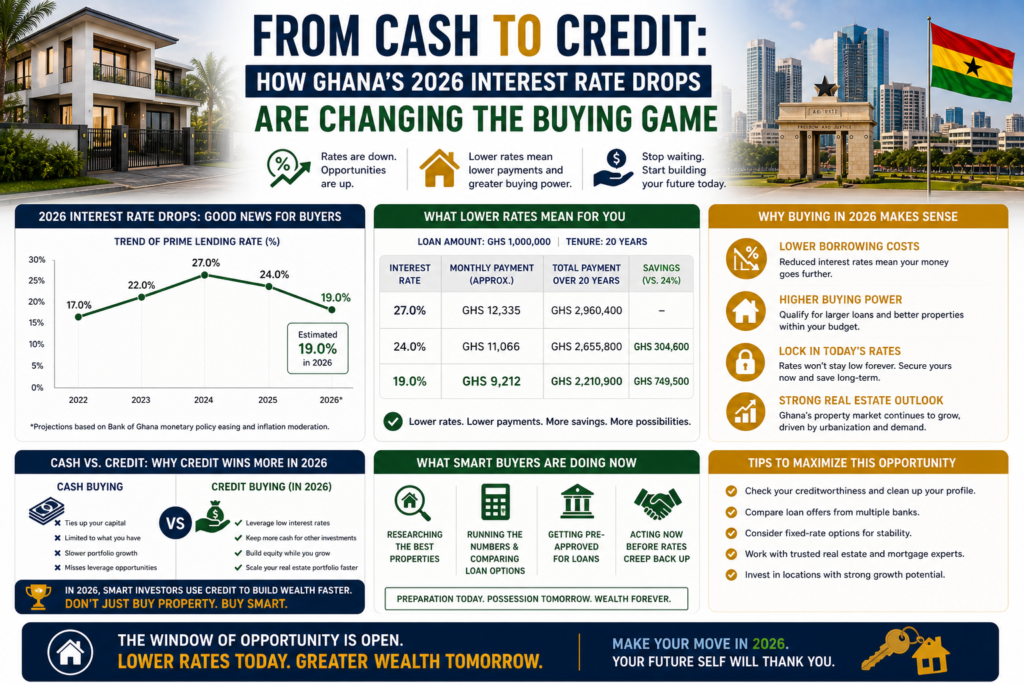
From Cash to Credit: How Ghana’s 2026 Interest Rate Drops Are Changing the Buying Game
For decades, the Ghanaian real estate market has been defined by a stark, binary reality: you either had the liquid cash to build or buy outright, or you were effectively priced out of the dream of homeownership.
The era of high-interest rates, often hovering in the mid-to-high twenties, created an environment where mortgage financing was more of a financial shackle than a tool for leverage.
However, as we navigate the economic shifts of 2026, the landscape is undergoing a structural transformation.
With the Bank of Ghana’s monetary policy committee signaling a sustained downward trend in prime rates, the barrier to entry for the middle class is shifting.
We are moving from a cash-is-king culture to a credit-enabled economy.
This shift is not merely a change in numbers; it is a fundamental reconfiguration of how wealth is built through real estate in Ghana.
The Macroeconomic Catalyst: Understanding the 2026 Rate Environment
To understand why the current market feels different, we must look at the interplay between inflation, the Ghana Cedi’s stability, and the central bank’s aggressive pursuit of single-digit inflation targets.
For years, high interest rates were a defensive mechanism used by regulators to curb inflation and stabilize the currency.
When the cost of borrowing is high, liquidity tightens.
By 2026, we are seeing the fruition of fiscal consolidation efforts.

As inflation cools, the Monetary Policy Rate (MPR) has followed, creating a domino effect that reaches the commercial banking sector.
Why Lower Rates Matter for Borrowing Power
When interest rates drop by even 300 to 500 basis points, the impact on a 20-year mortgage is exponential.
For the average Ghanaian professional, this means:
- Reduced Monthly Debt Service: A lower interest component means more of your monthly payment goes toward the principal.
- Expanded Mortgage Eligibility: As debt-to-income ratios improve, individuals who previously failed the bank’s stress tests are now qualifying for significant loan amounts.
- The Leverage Effect: Real estate is one of the few assets where you can utilize other people’s money (the bank’s) to build your equity. Lower rates make this leverage far less expensive.
The Shift in Residential Property Demand
As credit becomes more accessible, the demand profile in Accra, Kumasi, and Takoradi is changing.
In a cash-heavy market, developers focused almost exclusively on luxury apartments and gated communities for high-net-worth individuals and the diaspora.
Today, the focus is shifting toward the missing middle—the affordable to mid-tier housing segment.
The Rise of the First-Time Homebuyer
The 2026 rate environment has effectively democratized property acquisition.
We are seeing a surge in demand for two and three-bedroom semi-detached homes in satellite communities like Appolonia City and areas along the Aburi-Kwabenya corridor.
If you are currently evaluating your options, it is essential to understand how to align your finances with current lending criteria.
You can read more about preparing your financials for a mortgage in Ghana to ensure you are positioned to take advantage of these lower rates.
Investor Sentiment: Flipping vs. Holding
With credit costs down, real estate investors are pivoting.
When financing costs were 25%+, flipping for quick profit was the only way to outrun interest payments.
Now, with more manageable financing rates, the buy-and-hold strategy—leveraging rental income to pay down mortgages—is becoming a viable path to long-term wealth creation.
Navigating the New Mortgage Landscape
While rates are dropping, the Ghanaian mortgage market remains complex.
Securing a favorable rate isn’t just about the market average; it is about your individual risk profile.
The Role of Credit Scoring
Ghana is gradually adopting a more robust credit referencing system.
In 2026, your credit score is the primary determinant of whether a bank offers you the teaser rate or a standard retail rate.
- Maintain clean records: Ensure all utility payments and existing loans are serviced punctually.
- Transparency: Banks now rely heavily on Credit Reporting Agencies to verify your financial history.
Fixed vs. Variable Rates
In a declining interest rate environment, borrowers often face a dilemma: should they lock in a fixed rate, or ride the wave with a variable (floating) rate?
- Fixed Rates: Provide stability, ensuring your budget remains predictable for the duration of the term.
- Variable Rates: Allow you to benefit immediately if the Bank of Ghana continues to cut rates throughout 2026 and 2027.
For those navigating these choices, this guide on choosing between fixed and variable mortgages provides a deeper dive into the risks associated with each.
Challenges and Considerations: What to Watch Out For
Despite the optimistic outlook, the transition from a cash-based market to a credit-based one is not without friction.
As an expert, I advise caution regarding the following areas:
The Appraised Value Gap
In a high-growth market, property prices often rise faster than central valuations.
A major hurdle for buyers using credit is the appraisal gap.
If a bank appraises a property at 80% of your purchase price, you must provide the 20% difference in cash, even if your mortgage covers the bulk.
Being prepared for these hidden capital requirements is crucial.
Inflationary Pressure on Construction Costs
While interest rates for buyers are falling, the cost of imported materials (steel, cement, finishing tiles) is still subject to global supply chain volatility and exchange rate fluctuations.
Buyers should verify if the developers they are partnering with have fixed-price contracts to avoid cost variation clauses that can increase the purchase price halfway through construction.
The Strategic Advantage of Local Partnerships
The 2026 market rewards the informed.
Whether you are a local professional or a member of the diaspora looking to invest, the ability to interpret these economic shifts is what separates a successful acquisition from a financial burden.
At Real Estate Moses, we have seen how these shifts affect different property tiers.
Understanding the nuances of location, developer reputation, and legal land titles remains the most important step before engaging with any financial institution.
For a comprehensive overview of how to navigate the legal complexities of land in Ghana, I recommend this article on conducting due diligence on property titles.
Conclusion: The Path Ahead
The decline in interest rates in 2026 is the most significant buy signal the Ghanaian real estate market has seen in a decade.
We are witnessing the maturation of the market, transitioning from a speculative, cash-rich plaything for the elite into a functional, credit-driven sector that can provide housing security for the working class.
However, lower rates should not be an invitation to over-leverage.
The fundamentals of a good investment remain unchanged: location, demand, and structural integrity.
Use the current credit environment to your advantage, but approach your financing with the same scrutiny you apply to the property itself.
As we move through the remainder of the year, keep a close eye on the Bank of Ghana’s quarterly economic reports.
The buying game has changed, and for those who have positioned themselves correctly, the opportunities for wealth accumulation through real estate have never been more accessible.
Disclaimer: This article is for educational purposes and does not constitute financial or legal advice. Always consult with a qualified financial advisor and a legal practitioner before entering into real estate contracts or mortgage agreements.

Real estate lover