Accra’s Expansion Corridors: Why Oyarifa and Pokuase Are Outperforming Cantonments in 2026
The narrative of Accra’s real estate market has undergone a tectonic shift.
For decades, the Golden Triangle—comprising Cantonments, Airport Residential, and Ridge—served as the undisputed zenith of property investment in Ghana.
These neighborhoods defined luxury, exclusivity, and prestige.
However, as of 2026, the metrics of success have evolved.
Investors, middle-class professionals, and institutional developers are increasingly pivoting away from the saturated urban core toward the northern expansion corridors.
Today, Oyarifa and Pokuase have emerged not merely as affordable alternatives, but as high-performance growth engines outstripping the stagnant yields of the city’s traditional prime districts.
This article explores the macroeconomic, infrastructural, and lifestyle drivers behind this residential migration and why the investment spotlight has shifted firmly to the North.
The Saturation of the Core: Why Cantonments Has Hit a Ceiling
To understand the rise of the expansion corridors, one must first analyze the cooling of the prime market.
Cantonments, long the bastion of diplomatic residences and high-end expatriate housing, faces a unique set of constraints in 2026.
The Problem of Diminishing Returns
The luxury market in Accra is currently grappling with a supply-demand mismatch.

Following a decade of aggressive high-rise development, the supply of premium apartments in Cantonments has outpaced the growth of the high-net-worth tenant pool.
This has led to a plateau in rental yields.
Investors who purchased units at the height of the market are now seeing longer vacancy periods, as the expatriate workforce—often the primary tenant demographic—is increasingly opting for corporate housing stipends that stretch further in emerging suburban locales.
Infrastructure and Urban Friction
Cantonments, while central, suffers from urban friction.
Traffic congestion, lack of green space, and the sheer density of development have degraded the quality of life for long-term residents.
When property appreciation is weighed against the high cost of entry (price per square meter), the Capital Appreciation Index in Cantonments has lagged behind the double-digit growth seen in peripheral markets.
For a deeper look at how market cycles affect these older neighborhoods, read this analysis on Accra’s property cycles.
Oyarifa: The Hybrid Lifestyle Epicenter
Oyarifa is no longer the out-of-town location it was perceived to be five years ago.
It has transformed into a master-planned lifestyle hub, strategically positioned at the foothills of the Aburi Mountains.
Its rise is the result of a deliberate convergence of climate, affordability, and accessibility.
The Cool Climate Premium
One of the most understated drivers of Oyarifa’s popularity is its micro-climate.
With temperatures consistently lower than the coastal humidity of central Accra, Oyarifa has become the primary destination for affluent Ghanaian professionals looking to trade urban smog for cleaner air and a more tranquil environment.
This shift toward wellness-centric living is a major pillar in modern property valuation.
Infrastructure and Connectivity
The dualization of the Adenta-Dodowa road and the ongoing improvements to the Eastern Corridor have drastically reduced commute times.
For the modern professional, the trade-off of a slightly longer commute is negated by the acquisition of a larger land parcel.
In Oyarifa, a homeowner can secure a detached four-bedroom house with a garden for the price of a cramped two-bedroom flat in Cantonments.
The Rise of Gated Communities
Developers are leveraging the land availability in Oyarifa to build secure, gated communities that offer amenities often missing in the city center: swimming pools, clubhouses, and robust 24-hour security.
These developments are catering to a demographic that prioritizes community and safety over proximity to the business district.
Learn more about the risks and rewards of gated communities in our comprehensive predictive AI guide.
Pokuase: The Infrastructure-Led Growth Model
If Oyarifa is the lifestyle choice, Pokuase is the infrastructure play.
The completion of the Pokuase Interchange, the largest of its kind in West Africa, was the catalyst that changed the economic trajectory of the entire Ga North municipality.
The Interchange Effect
Infrastructure is the backbone of real estate appreciation.
The Pokuase Interchange did not just facilitate movement; it integrated the suburb into the heartbeat of Accra’s commerce.
By significantly reducing the transit time to the central business district (CBD), the interchange transformed Pokuase into a viable dormitory town for thousands of mid-level managers and entrepreneurs.
Commercial Corridor Development
Unlike residential-only suburbs, Pokuase has seen a flurry of commercial activity.
From retail centers to educational facilities, the area has become self-sustaining.
When a residential area achieves commercial self-sufficiency, it creates a sticky market where residents rarely need to leave their suburb for daily errands, thereby increasing long-term property retention and value.
Value Appreciation and ROI
In 2026, the return on investment (ROI) for property in Pokuase is significantly higher than in the prime core.
With land prices still relatively accessible, investors are seeing significant capital appreciation as the area densifies.
Comparative Analysis: The Data Behind the Shift
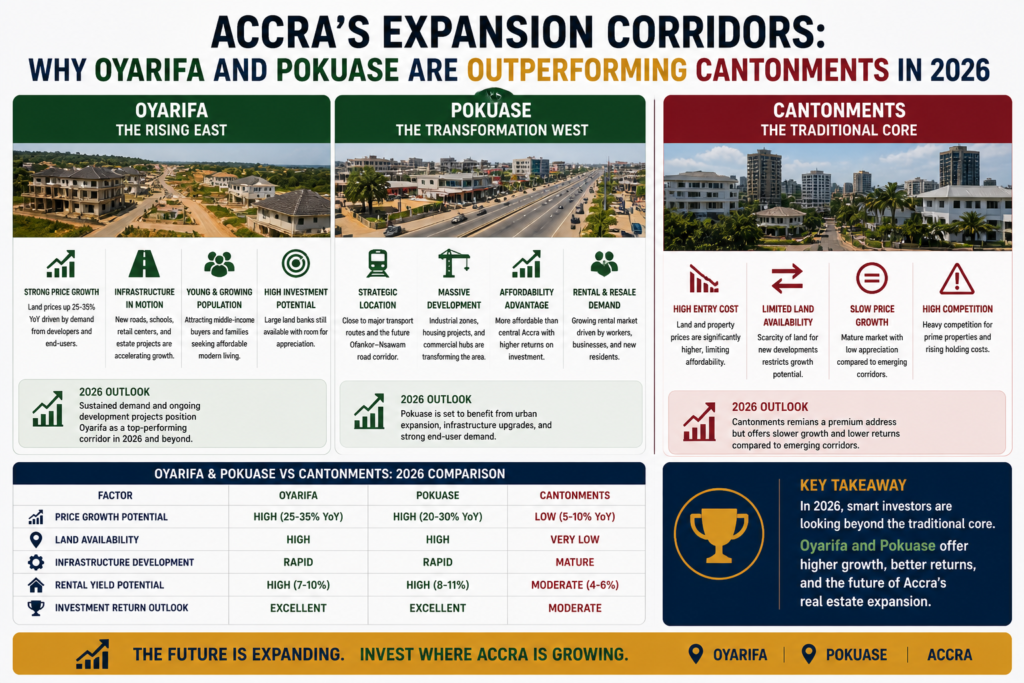
When we compare Oyarifa/Pokuase against Cantonments in 2026, the data indicates a clear divergence in performance metrics.
| Metric | Cantonments | Oyarifa/Pokuase |
|---|---|---|
| Capital Appreciation | Low (3-5% YoY) | High (12-18% YoY) |
| Rental Yields | Compressing (5-7%) | Expanding (8-11%) |
| Price per Sq. Meter | Extremely High | Moderate/Accessible |
| Infrastructure Growth | Stagnant | Rapid/Ongoing |
| Primary Demographic | Corporate Expat/Luxury | Middle-Income/Family |
Why the Shift is Sustainable
This is not a bubble; it is a correction.
Accra is following the growth patterns of major global cities like Nairobi and Johannesburg, where the urban core eventually yields to expansive, well-connected suburban growth.
As the city continues to densify, the value of land within a 20-30 kilometer radius of the CBD will continue to rise as long as transportation infrastructure keeps pace.
Navigating the Legal and Zoning Landscapes
While the expansion corridors offer immense potential, they are not without their complexities.
Investing in the periphery requires a rigorous approach to due diligence that differs from the established, documented land titles of the core city.
Land Title Verification
In rapidly developing areas like Pokuase, the transition from stool land to titled residential land is often a sensitive process.
As an investor, verifying the legitimacy of a land grant is paramount.
See this detailed checklist for verifying land titles in Ghana to help you navigate these legal waters safely.
Zoning and Planning
As these areas transition from agrarian or rural landscapes to residential hubs, municipal planning is critical.
Investors should prioritize developments that are located within approved layout schemes.
Unplanned expansion can lead to future issues with utility access and drainage.
Always consult with the Ghana Town and Country Planning Department before finalizing a purchase in new growth areas.
The Future of Residential Real Estate in Accra (2026-2030)
As we look toward the remainder of the decade, the dominance of Oyarifa and Pokuase is likely to solidify.
Several factors suggest that this is the beginning of a long-term trend rather than a transient shift.
The Work-From-Home (WFH) Impact
The post-2020 professional landscape has permanently altered the requirement for proximity to the office.
With hybrid work models now the standard for major firms in Accra, the need to live within five kilometers of the office has vanished.
Professionals are choosing to spend their extra two hours of non-commuting time in their gardens in Oyarifa rather than in traffic near Cantonments.
Sustainable Urbanism
There is a growing consciousness regarding sustainable development in Ghana.
Oyarifa, in particular, offers opportunities for developers to implement eco-friendly housing projects, including solar integration and rainwater harvesting, at a scale that is simply not feasible in the dense, high-rise environment of Cantonments.
These green homes are commanding a premium in the market as energy costs in Ghana remain a concern for the middle class.
Conclusion: Strategic Investment in 2026
The era of Cantonments-only investment strategy is over.
Today, a sophisticated portfolio requires a focus on the corridors of growth—areas where infrastructure meets demand.
Oyarifa and Pokuase represent the intersection of affordability, quality of life, and tangible appreciation potential.
For those looking to diversify their real estate holdings, the northern corridors offer a strategic advantage.
By moving early into these expansion zones, investors are not just buying property; they are investing in the inevitable westward and northward sprawl of Accra.
Expert Recommendations for the Current Market
- Prioritize Location within the Corridor: Not all land in these suburbs is equal. Focus on areas within a 15-minute radius of major arterial roads or the Pokuase Interchange.
- Focus on End-User Amenities: In 2026, tenants and buyers are looking for security, consistent water supply, and reliable internet connectivity. Ensure your investment properties have these basic utilities accounted for.
- Think Long-Term: The expansion corridors are not flip markets. The greatest returns are realized over a 3-5 year horizon as the local economy around these developments matures.
If you are considering your next move in the Ghanaian real estate market, don’t rely on the maps of the past.
Explore our Ghana Real Estate here and see why the smart money is moving north.
Disclaimer: This article is for informational purposes only and does not constitute professional financial or legal advice. Real estate investments involve risk; readers should conduct their own due diligence or consult with a licensed real estate professional before making any financial commitments.

Real estate lover