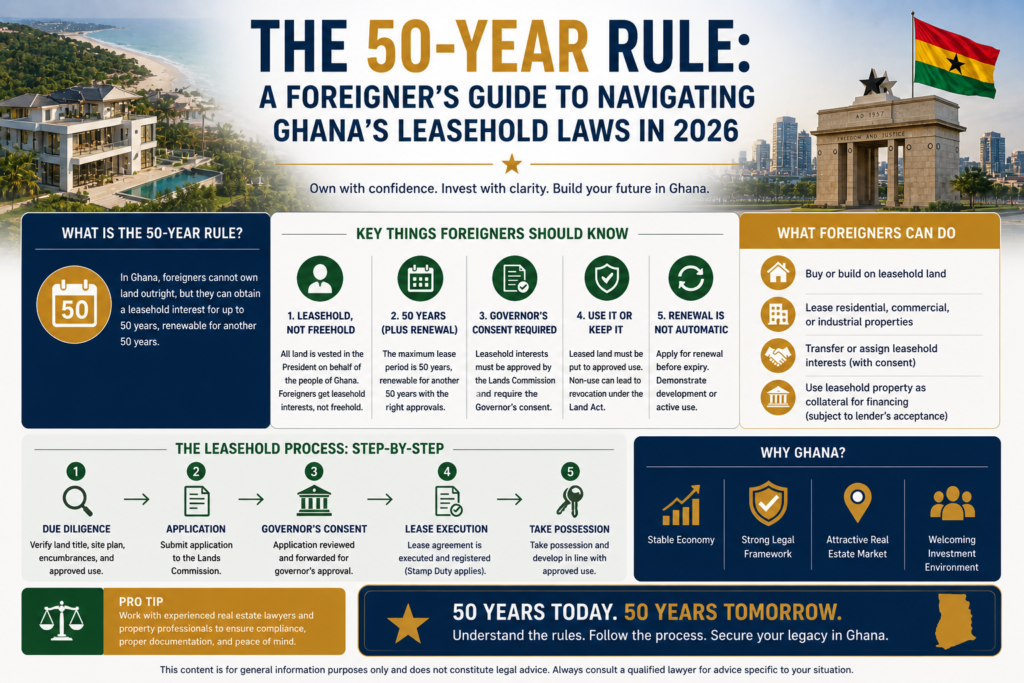
The 50-Year Rule: A Foreigner’s Guide to Navigating Ghana’s Leasehold Laws in 2026
For international investors, expatriates, and members of the Ghanaian diaspora looking to plant roots in West Africa’s most stable democracy, understanding the mechanics of land ownership is the most critical hurdle.
Unlike the freehold systems common in North America or parts of Europe, Ghana operates primarily on a leasehold system, governed by constitutional mandates and deeply rooted customary laws.
As we move into 2026, the legislative landscape has matured.
The 50-Year Rule—a term often shorthand for the constitutional limitations placed on land grants to non-citizens remains the bedrock of property acquisition for foreign nationals.
Navigating this requires more than just capital; it demands an understanding of the interplay between the 1992 Constitution of Ghana and the Land Act, 2020 (Act 1036).
Understanding the Legal Framework: Why Foreigners Can’t Own Freehold
In Ghana, the concept of land ownership for non-citizens is fundamentally restricted.
Under Article 266 of the 1992 Constitution, no interest in land can be granted to a person who is not a citizen of Ghana if that interest is a freehold interest.
The Constitutional Mandate
This provision was designed to protect the national patrimony and prevent the permanent alienation of Ghanaian soil.
Consequently, the maximum duration for any interest in land granted to a non-citizen is 50 years.
This 50-year term is not merely a suggestion; it is the constitutional ceiling for a leasehold interest held by a foreign entity or individual.

Defining Foreigner in the Ghanaian Context
It is essential to define who qualifies as a foreigner under the Land Act.
A non-citizen includes:
- Any individual who does not hold a Ghanaian passport.
- Companies that are not fully owned by Ghanaian citizens or where foreign equity exceeds the thresholds defined by the Ghana Investment Promotion Centre (GIPC).
If you are a foreigner seeking to invest, your interest will invariably take the form of a leasehold, rather than a freehold, title.
To learn more about how these structures impact your investment portfolio, see this guide on Understanding Property Investment Strategies in Ghana.
The Mechanics of the 50-Year Lease
When you enter a leasehold agreement, you are effectively renting the land from the landowner (the lessor) for a period of up to 50 years.
At the end of this term, the land reverts to the original owner unless a renewal is negotiated.
How the Clock Starts Ticking
The 50-year period typically commences from the date of the execution of the lease document, provided it is properly stamped and registered at the Lands Commission.
It is a common misconception that the term starts when construction ends; rather, it is tied to the legal transfer of the interest.
Renewal Clauses and Reversionary Interest
One of the most critical aspects of the 50-year rule is the option to renew.
While the constitution limits the initial grant to 50 years, most well-drafted lease agreements include a provision for renewal.
However, these renewals are subject to the lessor’s terms at the time of expiration.
- Fixed-Rate Renewals: Some contracts specify a predetermined renewal fee, which protects the investor from future price hikes.
- Market-Rate Renewals: These are riskier, as the cost of renewing the lease after 50 years will be based on the current fair market value of the land.
For those planning long-term residential projects, understanding these clauses is paramount.
Check out this analysis on Avoiding Common Land Disputes in Accra to see how lease terms can be used as a defensive mechanism.
Distinguishing Between Customary Land and Public Land
Not all land in Ghana is managed under the same administrative umbrella.
Knowing the source of your lease is as important as knowing its duration.
Customary Land (Stool, Skin, and Family Lands)
Approximately 80% of land in Ghana is customary land.
This is land managed by traditional authorities (Stools or Skins) or family heads.
- The Process: You must negotiate directly with the custodian of the land.
- The Risk: These negotiations can be complex, and ensuring you are dealing with the right person—the one with the legal authority to sign is vital.
Public (State) Land
State lands have been acquired by the government through compulsory acquisition.
Leasing land from the state is often viewed as more secure because the title is guaranteed by the government.
However, the bureaucracy involved in obtaining these leases can be significantly longer.
Due Diligence: The 2026 Standards
In 2026, the regulatory environment is stricter.
The Land Act, 2020, introduced digitized land registration systems that have reduced fraud, but manual verification remains a necessary layer of protection.
Searching the Records
Before signing any lease, an official land search must be conducted at the Lands Commission.
This search confirms:
- Ownership: Is the person selling the land the actual legal owner?
- Encumbrances: Are there existing mortgages, court orders, or liens on the property?
- Title Authenticity: Is the land title document genuine?
The Role of a Qualified Surveyor and Legal Counsel
Never rely solely on a landlord’s word.
A qualified professional surveyor should verify the boundaries and the coordinates (the site plan) against the records held by the Lands Commission.
Furthermore, a property lawyer must draft or review the Indenture (the lease agreement) to ensure that the 50-year term is clearly stated and that there are no clauses that contradict your rights as a lessee.
For a deeper dive into the documentation required for a secure purchase, read this article on The Essential Checklist for Buying Property in Ghana.
Strategic Considerations for Foreign Investors
While the 50-year rule might sound like a limitation, it is a standard business practice in many parts of the world.
For the sophisticated investor, it is simply a variable in the financial model.
Calculating ROI Over 50 Years
When assessing the viability of a real estate project, the 50-year term must be factored into your depreciation schedules and your exit strategy.
- Short-term plays: If your goal is to build and flip, a 50-year lease is more than sufficient.
- Long-term holdings: If you are building a legacy property, you must ensure that your lease renewal terms are legally robust and that you maintain a positive relationship with the lessor.
Financing and Mortgages
In 2026, Ghanaian banks are more sophisticated regarding leasehold financing.
However, many lenders will not grant a mortgage if the remaining term on the lease is less than 20–25 years.
Keep this in mind if you plan to use the property as collateral for future credit.
Managing the Sunset Period
As your 50-year lease approaches the 30-year mark, you enter the sunset period.
This is the point where you should begin initiating conversations regarding renewal.
- Maintain Documentation: Keep all lease documents, receipts of ground rent payments, and correspondence with the landowner in a secure, digital repository.
- Engagement: If the land is Stool land, remember that the Stool (the office) is an institution that survives the individuals occupying it. Keep your records updated with the current traditional officeholders.
Conclusion: Navigating with Confidence
The 50-year rule is not a barrier to entry; it is a framework for orderly land use.
By embracing the leasehold system and conducting rigorous due diligence, foreign investors can safely build and operate in Ghana.
The key to success in 2026 is transparency, proper legal documentation, and working with reputable partners who understand the nuances of the Land Act, 2020.
Whether you are building a luxury estate or a commercial complex, understanding the legal lifespan of your investment is the first step toward long-term prosperity in Ghana.
For those ready to take the next step, we recommend exploring our comprehensive guide to real estate investment in Ghana with Predictive AI, which provides detailed insights into market trends and localized opportunities.
Disclaimer: This article is for informational purposes only and does not constitute legal advice. Property laws can be complex and subject to change; always consult with a licensed professional in Ghana before entering into any land transaction.

Real estate lover